

Tsoniang Stupa and Samdrub Monastery
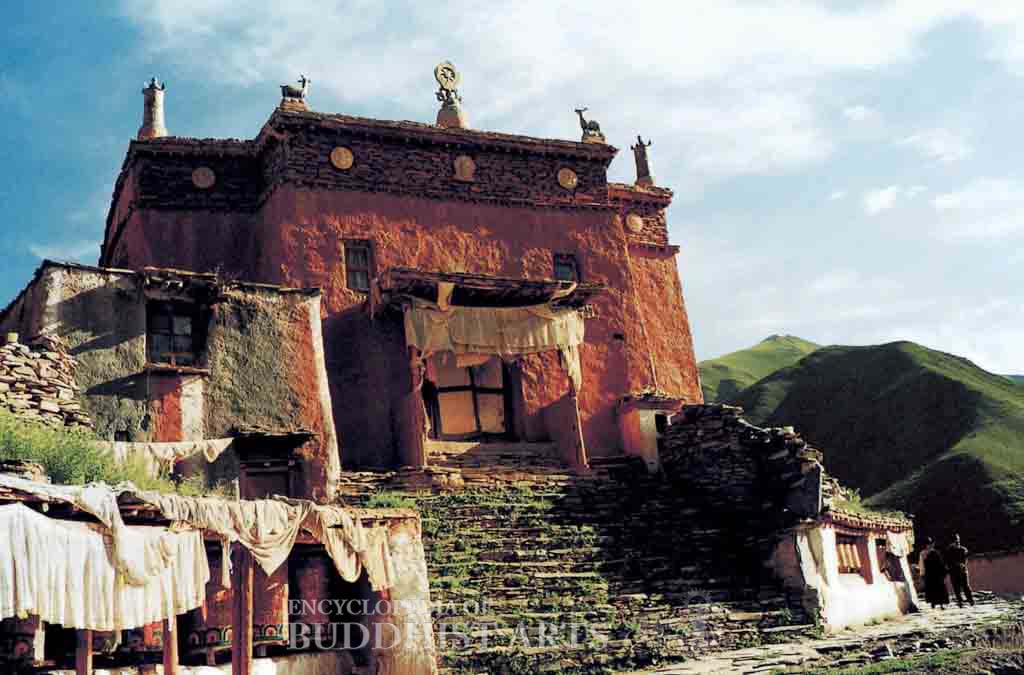
Samdrub Monastery: Small Assembly Hall
Tsoniang Stupa and Samdrub Monastery
CHINA, Qinghai, Yushu
Samdrub Monastery was built on the site of a Tibetan Bon monastery, whose date of establishment is unknown. The oldest remaining structure is the Tsoniang Stupa, which was built in 1029 during the Northern Song dynasty. The Samdrub Monastery was built not far from the stupa in 1429 during the Ming dynasty. The stupa was repaired between 1859 and 1860 during the Qing dynasty. The site was listed as a National Cultural Heritage Site in 2001.
The Tsoniang Stupa and Samdrub Monastery are more than 300 m apart, with the monastery standing to the southeast of the stupa. The Tsoniang Stupa was designed and constructed by Mengdejiana, one of the propagators of Buddhism in Tibet and a renowned Indian Buddhist Elder. He helped set the standards and regulations for Tibetan Buddhist paintings and stupas. As a result, the Tsoniang Stupa has been regarded as the standard example of a Tibetan-style stupa.
The stupa is 28.3 m high and the square base consists of four tiers. The first tier has a side length of 81 m. There is an entrance on the eastern side of the stupa body. The finial is made of wood. There are hidden corridors and rooms inside the stupa. The hidden corridors decorated with wall paintings as well as the stupa’s composition of clay, wood, and stone are also distinguishing features.
The main buildings of Samdrub Monastery include a large assembly hall, a small assembly hall, and the Protector Shrine. All three structures were built in Tibetan stone style. The top section of the wall is surrounded by a red ocher band and there are mirrors set on the walls. Within the halls there are many columns, all of which are different.
For more details, go to the Encyclopedia of Buddhist Arts: Architecture T-Z, page 1152.
Cite this article:
author = Hsingyun and Youheng and Johnson, Peter and Mankuang and Lancaster, Lewis,
booktitle = {Encyclopedia of Buddhist Arts: Architecture T-Z},
pages = 1152,
title = {{Tsoniang Stupa and Samdrub Monastery}},
volume = 4,
year = {2016}}