
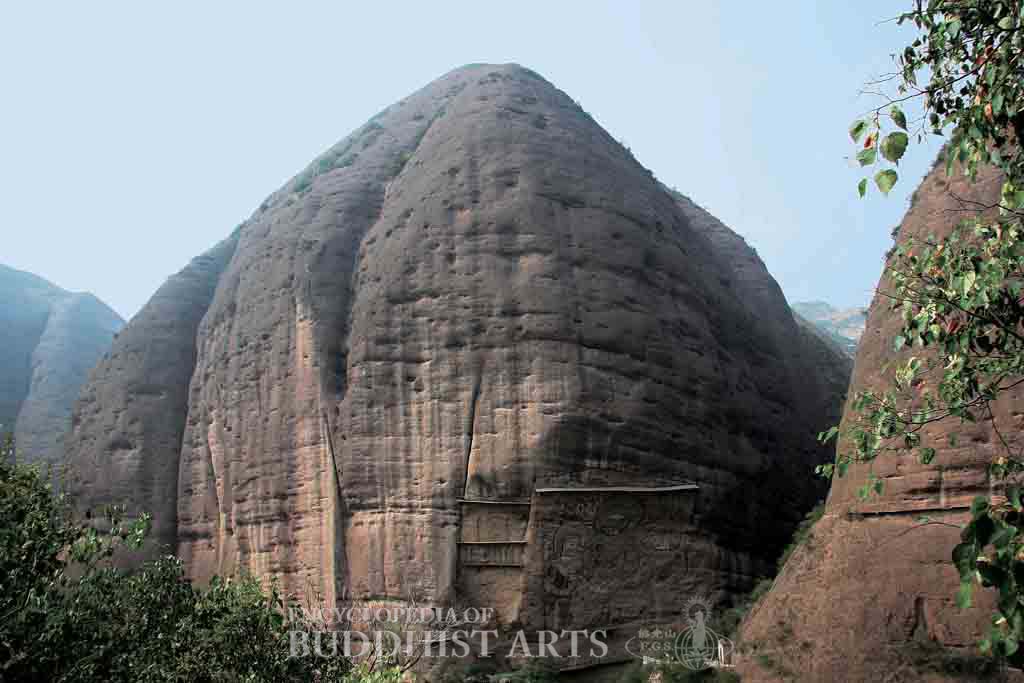
Lashao Temple Caves
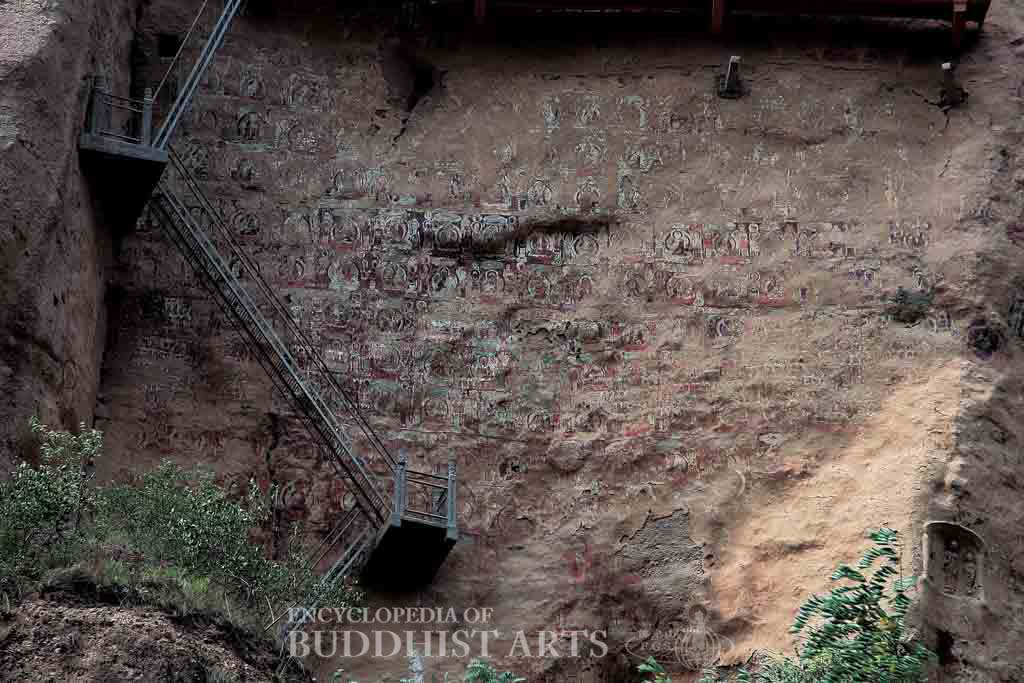
Lashao Temple Caves: Murals
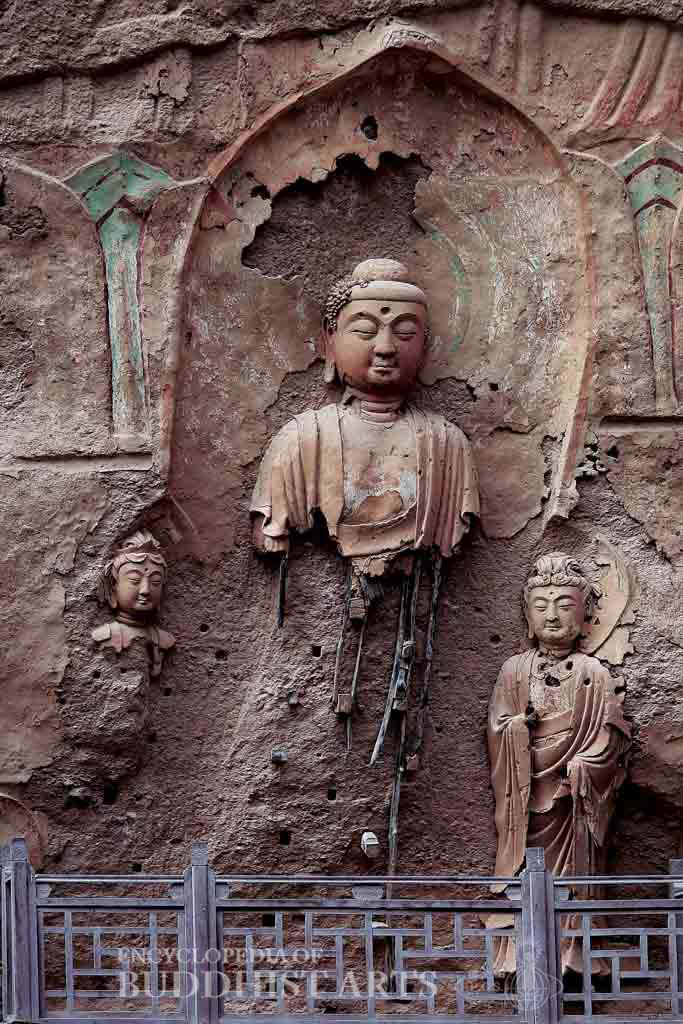
Lashao Temple Caves: Niche 1 - Buddha Triad
Lashao Temple Caves
CHINA, Gansu, Tianshui
Also known as the Great Buddha Cliff, the Lashao Temple Caves are located 25 km northeast of Wushan county, on the north cliff face of the Xiangshui Valley. As one of the larger cave systems near Maijishan, the site was excavated during the Northern Zhou dynasty (557–581), and renovations were made between the Sui (581–618) and the Yuan (1271–1368) dynasties; consequently, the caves house a variety of art from five different dynasties. The extant 25 caves, along with the Shuiliandong Cave, were listed as a National Cultural Heritage Site in 2001.
Niche 1 features relief carvings of a Buddha with two Bodhisattvas. The carvings were carved directly onto the steep cliff about 60 m above ground. The Sumeru throne of the main Buddha image has six layers, between each of which are carvings of lotus petals. The layers are adorned with images of seated lions, seated deer, and standing elephants, creating a combination of figures that is extremely rare in relief carvings. An inscription dated to 559 during the Northern Zhou dynasty is found next to the northernmost Bodhisattva. It states that the carvings were commissioned by General Yuchi Jiong and monk Daozang. Above the carvings are wooden eaves, 31 m in length and 3 m in depth. Each of the rectangular panels that form the eaves is painted with an image of a Buddha or Bodhisattva. These wooden configurations are considered valuable in the study of ancient Chinese architectural structures. Remnants of Song dynasty (960–1279) sculptures and Buddha niches are found beneath the cave.
The murals of the Lashao Temple Caves comprise approximately two-thirds of the total cliff face. Themes include the Buddha teaching the Dharma, heavenly beings listening to the Dharma, Thousand Buddhas, and illustrations of the Western Pure Land. Due to natural erosion, the majority of them have peeled away over time, thus any remaining images are considered extremely rare.
Four Tibetan stupas from the Yuan dynasty are carved onto the cliff face. Tibetan influence is found in murals from later periods, which are valuable material for the study of the spread and development of Tibetan Buddhism in the Longyou (present day Gansu) region.
For more details, go to the Encyclopedia of Buddhist Arts: Caves R-L, page 643.
Cite this article:
author = Hsingyun and Youheng and Johnson, Peter and Mankuang and Huntington, Susan and Edson, Gary and Neather, Robert,
booktitle = {Encyclopedia of Buddhist Arts: Caves R-L},
pages = 643,
title = {{Lashao Temple Caves}},
volume = 6,
year = {2016}}