
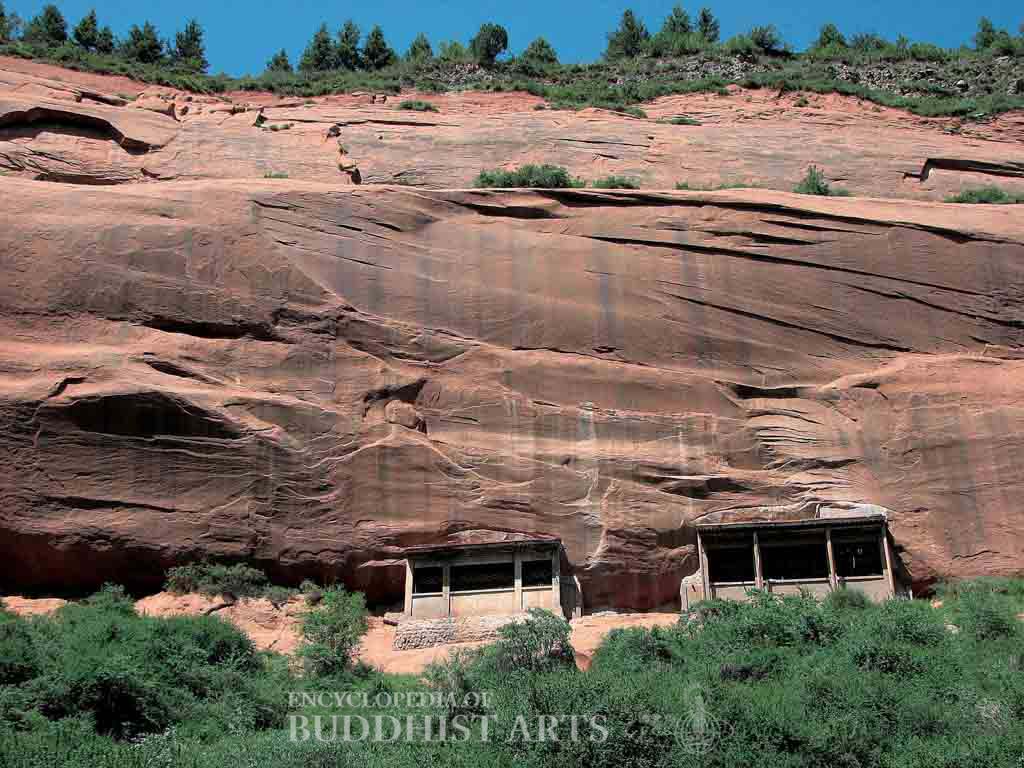
Jinta Temple Caves
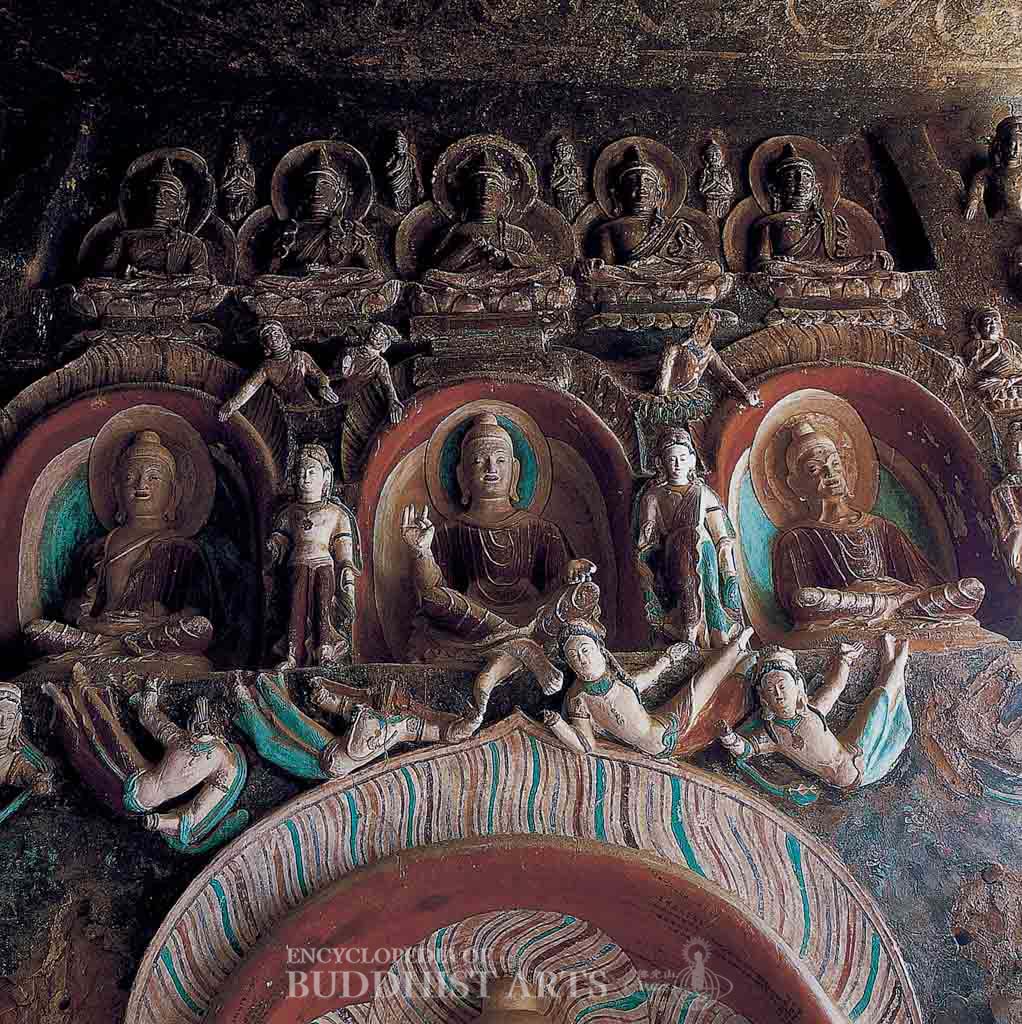
Jinta Temple Caves: East Cave - Central Pillar (left side, upper level)
Jinta Temple Caves
CHINA, Gansu, Zhangye
The Jinta Temple Caves are located in Sunan county of Zhangye, about 26 km from Mati Temple. The two largest caves, known as the East Cave and West Cave, face south and are located approximately 60 m above the ground. Construction of these caves began during the Northern Liang dynasty (397–439).
The East Cave is 9.7 m wide, 6.05 m high, and 7.65 m deep. At the center, a square pillar connects to the domed ceiling. However, due to a collapse, the central pillar is nearly exposed to the edge of the cliff. There are three levels of niches located on all four sides of the central pillar. The center of the lower levels on each side features an arched niche within which sits a Buddha in the full lotus position with an attendant Bodhisattva on either side. The north side is an exception with disciples standing in attendance as opposed to Bodhisattvas. Above all the niches’ apsaras are depicted in the midst of flight. These sculptures appear to be made of clay with wooden cores, and many figures have been repainted over time. The niches in the middle and upper levels are smaller than the lower level ones. The middle level niches are arched and rather shallow, with a Buddha sitting inside. The faces of the Buddhas are slightly long, and they sit either cross-ankled or in full lotus position upon a throne. There are attendant Bodhisattvas present on either side of the Buddhas.
On the upper level of the north, east, and south sides, there are ten Buddhas and ten Bodhisattvas, sculpted during the Northern Dynasties (386–581). The west side has five Buddhas which were made during the Yuan dynasty (1271–1368). In between the niches on all levels, there are various small Buddhas, Bodhisattvas, and apsaras. These carvings are either in the standing or sitting position; some are deep in thought, while others gaze solemnly or have slight smiles on their faces.
Only two levels of murals still survive on the side walls of the East Cave. Each of the lower levels once held an illustration of the Buddha teaching the Dharma, and the surrounding space was filled with neat rows of Thousand Buddhas. The surviving Thousand Buddhas on the upper level were repainted during the Yuan dynasty. Among the numerous inscriptions within the cave is one that dates to 1813 of the Qing dynasty with the name Zhang Mansai. The largest inscription is found on the west wall and indicates that between the years 1522 and 1566 during the Ming dynasty, money for restoration was raised by a monk who was appalled by the state of disrepair of the temple and the sculptures.
Although it is significantly smaller in size, the interior design of the West Cave is similar to that of the East Cave. The West Cave measures 7.9 m wide, 4.3 m high, and 3.9 m deep. Each side of the central pillar features three levels of niches. There is an arched niche on each of the lowest levels, and inside is a seated Buddha flanked by a Bodhisattva and Guhyapadavajra. The middle level niches also house a seated Buddha with attendant Bodhisattvas. On the north side of the pillar, Maitreya Buddha sits with ankles crossed and is flanked by a Bodhisattva and a disciple on each side. The Buddha on the east side sits with legs pendent inside a niche with four Bodhisattvas on either side who are seated in full lotus position. The west side of the pillar shows a Bodhisattva in contemplation, who sits in relaxation posture, accompanied on each side by four more Bodhisattvas in full lotus position. The upper level is decorated with a variety of Thousand Buddhas or with Bodhisattvas. Three levels of murals still survive along the side walls within the West Cave. At the center of the lower level of each wall, almost identical to what was found in the East Cave, there is a simple illustration of the Buddha teaching the Dharma, flanked by two attendant Bodhisattvas, and surrounded by the Thousand Buddhas. At the middle and upper levels, there are additional Thousand Buddhas. It is estimated that these depictions were painted during the Western Xia period (1032–1227). Apsaras and Bodhisattvas making offerings fill the ceiling and surround the central pillar in tidy rows.
The layout and subject matter found in the Jinta Temple Caves are reminiscent of the early caves at Mogao and Tiantishan (Heavenly Stairway Mountain). This suggests that the style of art in this area was influential and thus utilized among several different groups in varying locations and eras.
Although the sculptures were redecorated by subsequent dynasties, the original features still remain. The subject matter of the cave art is diverse and the grandeur with which the sculptures were decorated is a characteristic rarely seen in the Hexi area. The Jinta Temple Caves demonstrate a close connection with the Kuchean caves, as well as the exchange of cave art styles and construction techniques that existed between the Xinjiang and Hexi regions. This evinces the great influence that these caves had on the evolution and history of cave art in the area.
For more details, go to the Encyclopedia of Buddhist Arts: Caves R-L, page 438.
Cite this article:
author = Hsingyun and Youheng and Johnson, Peter and Mankuang and Huntington, Susan and Edson, Gary and Neather, Robert,
booktitle = {Encyclopedia of Buddhist Arts: Caves R-L},
pages = 438,
title = {{Jinta Temple Caves}},
volume = 6,
year = {2016}}