
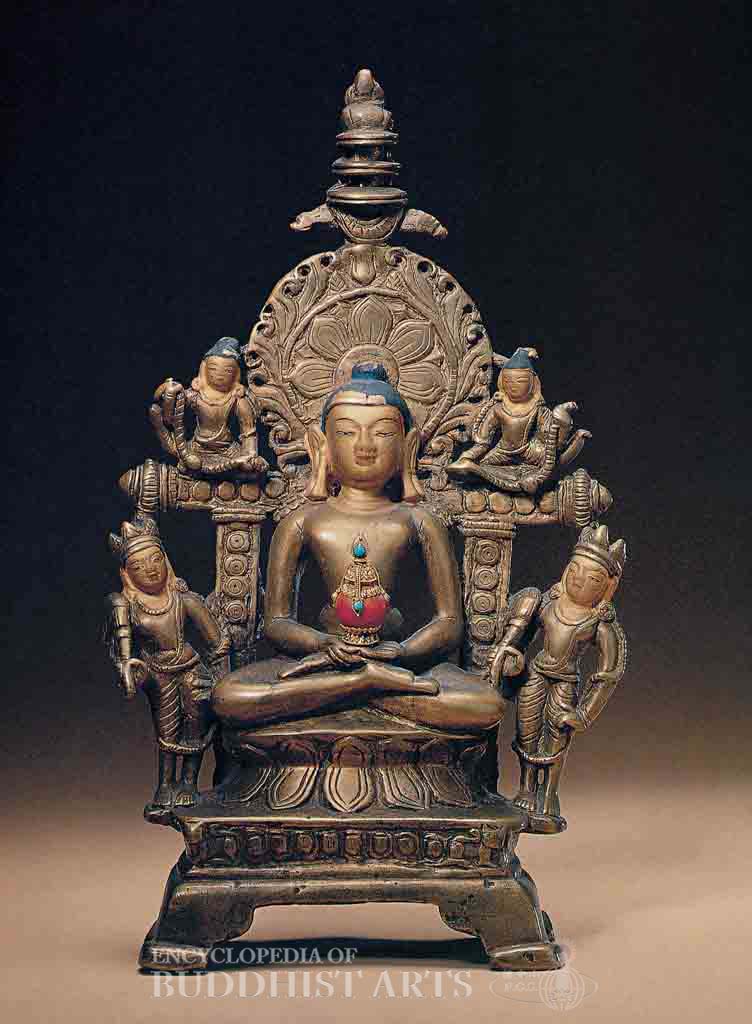
Amitabha Buddha and Attendants
Brass
Amitabha Buddha and Attendants
CHINA
This Tibetan Buddhist sculpture was created in the Kashmiri style. The image was recorded by an official under order of Emperor Qianlong (reigned 1736–1795) in 1752 according to the inscription that is carved in Chinese, Manchu, Mongolian, and Tibetan.
Amitabha, the Buddha of long life, is located in the center. The figure’s hair is painted blue. It has a prominent usnisa and ears that are exaggeratedly elongated. The unadorned Buddha sits in a full lotus position upon a lotus pedestal. A vase, set with turquoise, is a later addition. Bodhisattvas stand on either side wearing trefoil crowns and hold whisks, an accessory held often by personal attendants. The Bodhisattvas also wear short robes, which were popular attire in western Tibet at the time. Two Naga Kings sit on the throne’s crossbar. The design of the throne back is similar to door beams from the Pala period (circa 8th–12th century) found in northeastern India.
For more details, go to the Encyclopedia of Buddhist Arts: Sculpture A-F, page 34.
Cite this article:
author = Hsingyun and Youheng and Lovelock, Yann and Chou, Yuan and Huntington, Susan and Edson, Gary and Neather, Robert,
booktitle = {Encyclopedia of Buddhist Arts: Sculpture A-F},
pages = 34,
title = {{Amitabha Buddha and Attendants}},
volume = 10,
year = {2016}}