
Stele
Stone
Stele
CHINA; Western Wei dynasty
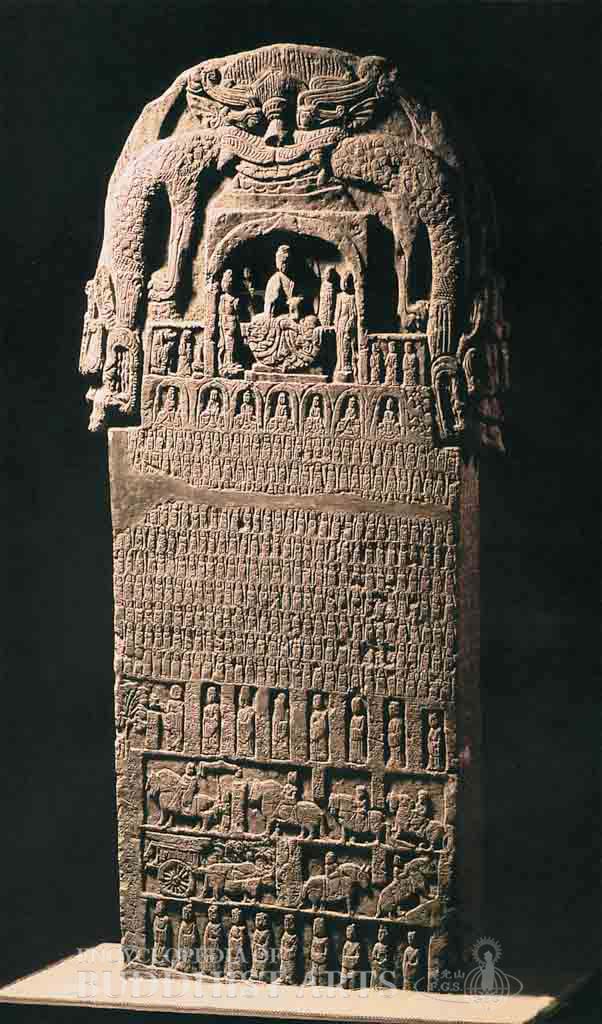
On this stele, the head of kirtimukha with its jaws around a pair of bending dragons form the it’s upper curve. A Buddha attended by Bodhisattvas and disciples sirs within an arched niche beneath an upper composition. The lower part of the Buddha’s monastic robe fans out in wave-like layers characteristic of Western Wei dynasty (535–556) statues. A row of devotees is inset beneath the forefeet of the dragons and below them are the seven Buddhas.
The middle section includes ten rows of Buddhas, with a lower section containing eight donors. Their names are carved beside them, but have been weathered too severely to decipher. More donors riding on horseback appear below, with a cart drawn by oxen at the end of their winding procession. A further ten donors in line are at the very bottom of the stele. An inscription on one side states the stele was dedicated in 546 by a devotee with the family name Quan. The delicate carving and dense layout shows apparent influence by the Chinese culture from the central plains.
For more details, go to the Encyclopedia of Buddhist Arts: Sculpture St-Z, page 1163.
Cite this article:
author = Hsingyun and Youheng and Lovelock, Yann and Chou, Yuan and Huntington, Susan and Edson, Gary and Neather, Robert,
booktitle = {Encyclopedia of Buddhist Arts: Sculpture St-Z},
pages = 1163,
title = {{Stele}},
volume = 13,
year = {2016}}