
Mogao Cave 275: King Candraprabha Jataka
Mogao Cave 275: King Candraprabha Jataka
CHINA, Gansu, Dunhuang; Northern Liang Kingdom
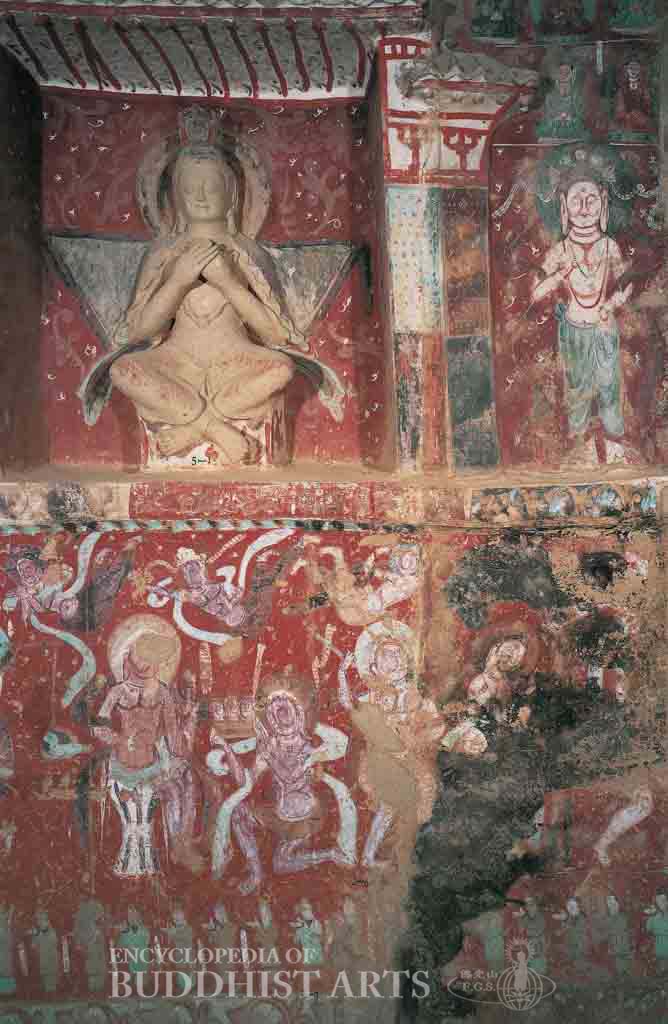
This illustration is painted on the middle section of the north wall. The story it portrays is found in the Sutra of the Wise and the Foolish. Candraprabha was a supremely generous king who distributed all his wealth to those in need. Mara, disguised as a neighboring king, offered a large reward to whoever would bring him King Candraprabha’s head. A brahmin accepted the task and, knowing the king’s generosity, simply went to Candraprabha’s court to request his head. When he arrived, the chief minister offered the brahmin precious golden heads adorned with jewels in place of the king’s, but the brahmin would not be deterred. Upon hearing the brahmin’s request, King Candraprabha readily agreed, and gave the ultimate demonstration of his generosity by allowing the brahmin to behead him.
On the left, Candraprabha’s chief minister kneels on one leg, offering the precious golden heads on a tray. He has a nimbus and wears a short dhoti with a long stole draped around the arms. On the right side of the mural is the beheading scene. King Candraprabha stands beneath a tree with palms joined. Above, a man ties the king’s hair to a branch of the tree and the brahmin lifts a sword. Apsaras fly above the main figures in the two scenes. However, much of the right scene has been damaged and obscured over time.
For more details, go to the Encyclopedia of Buddhist Arts: Caves Mo-S, page 1094.
Cite this article:
author = Hsingyun and Youheng and Johnson, Peter and Mankuang and Huntington, Susan and Edson, Gary and Neather, Robert,
booktitle = {Encyclopedia of Buddhist Arts: Caves Mo-S},
pages = 1094,
title = {{Mogao Cave 275: King Candraprabha Jataka}},
volume = 8,
year = {2016}}