
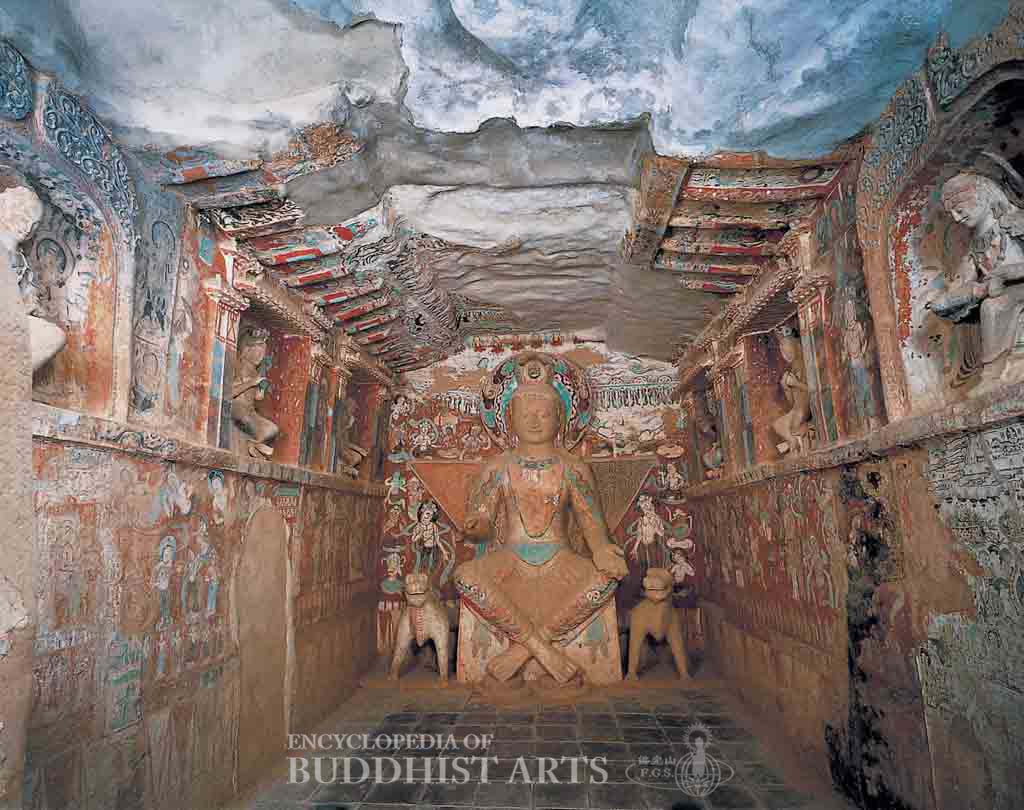
Mogao Cave 275
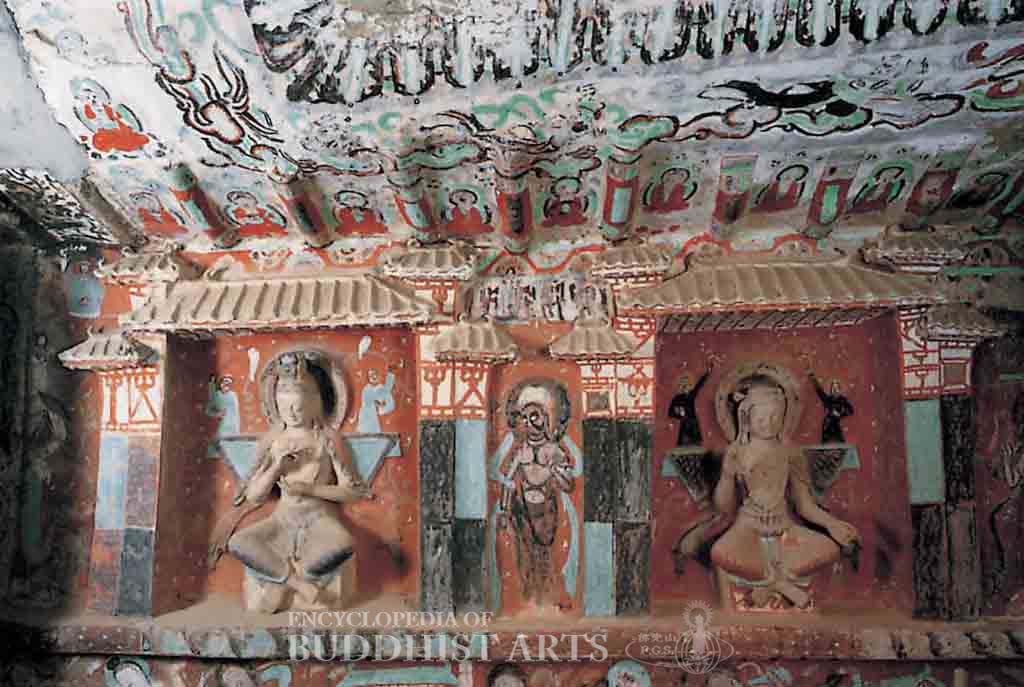
Mogao Cave 275: House-Like Niches (south wall)
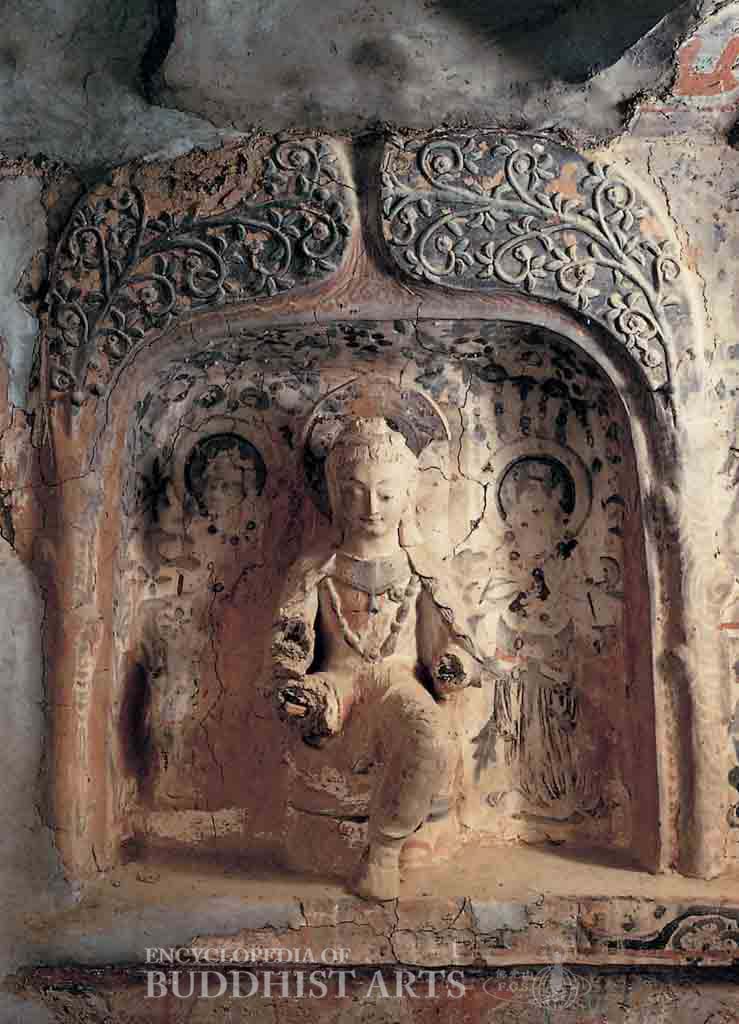
Mogao Cave 275: Niche Framed by Twin Trees (south wall)
Mogao Cave 275
CHINA, Gansu, Dunhuang
Situated on the third level in the central section of the south area, this cave dates to the Northern Liang Kingdom (397–439) and is among the three oldest caves at the site. The cave is 3.34 m in width and 5.5 m in depth, with a gabled ceiling. An earthquake during the Late Tang period (846–907) led to the collapse of the front wall. During the Five Dynasties (907–960) and the Song dynasty (960–1279), a wall was built in the center, separating the cave into a front chamber and a rear chamber. A number of other renovations were also conducted at that time.
A 3.4 m Maitreya sits with legs crossed at the ankles on a throne flanked by two lions in front of the back (west) wall. Maitreya has a circular nimbus and wears a triple-disc crown, two necklaces, and a stole. The left hand rests palm-up on the knee. The right arm is raised but the right hand is missing. Two attendant Bodhisattvas and numerous smaller Bodhisattvas are painted on the back wall. These figures are portrayed in varied poses, both standing and sitting.
There are three niches on each of the north and south walls; the two closest to the rear of the chamber on each wall are framed by reliefs of square columns and sloping eaves. All four of these house-like niches contain statues of cross-ankled Bodhisattvas. The two remaining niches are framed by reliefs of twin trees and house Bodhisattvas in contemplation. On the lower south wall are illustrations from the Life of the Buddha, including the Four Encounters, and below these are a row of Bodhisattvas, with decorative patterns lining the base of the wall. On the lower north wall are narrative illustrations from the Sutra of the Wise and the Foolish, which mostly consist of Jataka tales. Below are portraits of donors and decorative patterns.
On the front (east) wall, there are three images of the Buddha teaching the Dharma, five seated Buddhas above the doorway, and illustrations of Cintamanicakra Avalokitesvara and Amoghapasa Avalokitesvara to the left and right of the doorway, respectively.
For more details, go to the Encyclopedia of Buddhist Arts: Caves Mo-S, page 1091.
Cite this article:
author = Hsingyun and Youheng and Johnson, Peter and Mankuang and Huntington, Susan and Edson, Gary and Neather, Robert,
booktitle = {Encyclopedia of Buddhist Arts: Caves Mo-S},
pages = 1091,
title = {{Mogao Cave 275}},
volume = 8,
year = {2016}}