
Mogao Cave 272
Mogao Cave 272
CHINA, Gansu, Dunhuang
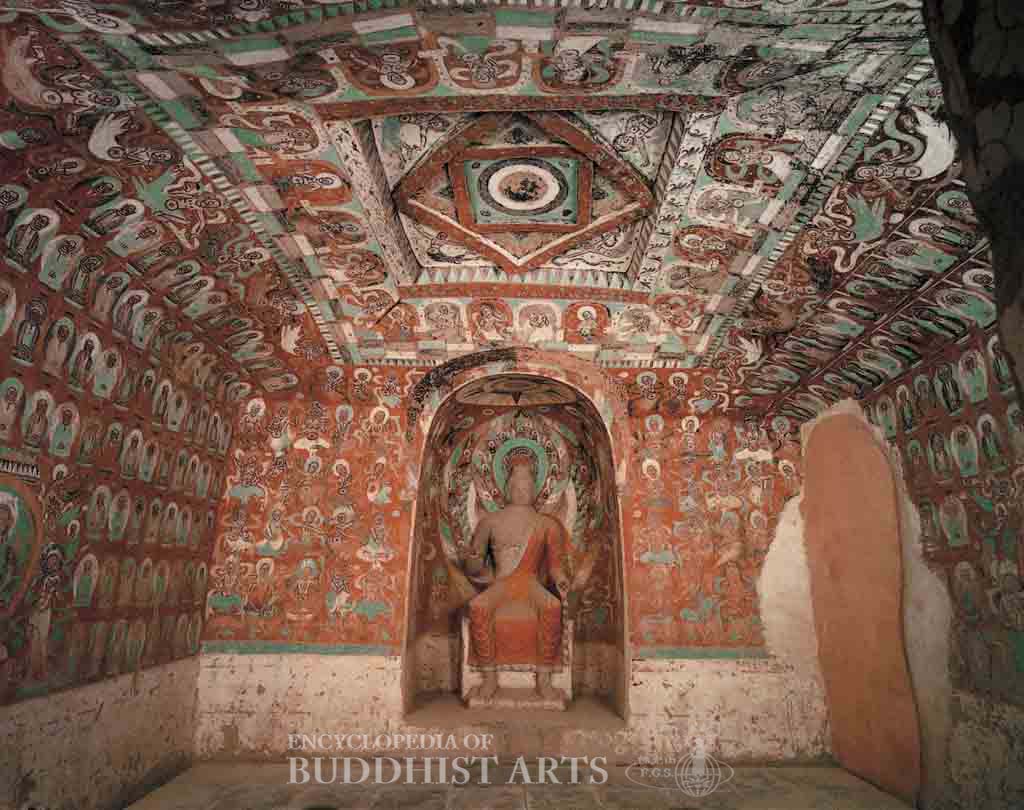
Located on the third level in the central section of the south area, this shrine cave was built during the Northern Liang Kingdom (397–439) and renovated during the Five Dynasties (907–960). It is one of the three oldest Mogao Caves. The cave consists of a single square chamber measuring 3.1 m in width and 2.7 m in depth. The vaulted ceiling has a square caisson in the center decorated with lotuses and flame patterns. Surrounding it are images of heavenly musicians, apsaras, Bodhisattvas, and the Thousand Buddhas.
An arched niche in the center of the back (west) wall houses a Buddha seated with legs pendent on a throne. This 1.38 m high statue has been repaired several times. The figure has curled hair, a usnisa, a square face with sharp features, and broad shoulders. Dressed in a close-fitting monastic robe, the Buddha raises one arm and rests the other beside the right leg. Both hands are missing. A painted oval nimbus encircles the Buddha’s head, and a mandorla surrounds the body; they are both decorated with images of Buddhas and apsaras.
The niche lintel is embellished with flames, lotuses, and triangular patterns. Painted on the walls of the niche behind the Buddha are two attendant Bodhisattvas and thirteen smaller Bodhisattvas making offerings. Rows of Bodhisattvas are painted on the back wall outside the niche as well. They are depicted both standing and sitting in a variety of poses, and are dressed in long garments.
The north and south walls are covered with images of the Thousand Buddhas, all dressed uniformly and sitting in lotus position. Their colors alternate in a regular pattern. In the center of both walls are Dharma teaching scenes that include images of a Buddha, two Bodhisattvas, and four disciples. The Buddhas sit in full lotus position; the Buddha on the north wall is on a diamond throne and the Buddha on the south wall is on a lion throne. The entrance on the front (east) wall is surrounded by more Thousand Buddha images. A passageway outside the entrance, built during the Five Dynasties, has a Buddha Welcoming the Deceased painted on the ceiling, Amoghapasa Avalokitesvara on the south wall, and Cintamanicakra Avalokitesvara on the north wall. All these images are damaged.
For more details, go to the Encyclopedia of Buddhist Arts: Caves Mo-S, page 1086.
Cite this article:
author = Hsingyun and Youheng and Johnson, Peter and Mankuang and Huntington, Susan and Edson, Gary and Neather, Robert,
booktitle = {Encyclopedia of Buddhist Arts: Caves Mo-S},
pages = 1086,
title = {{Mogao Cave 272}},
volume = 8,
year = {2016}}