
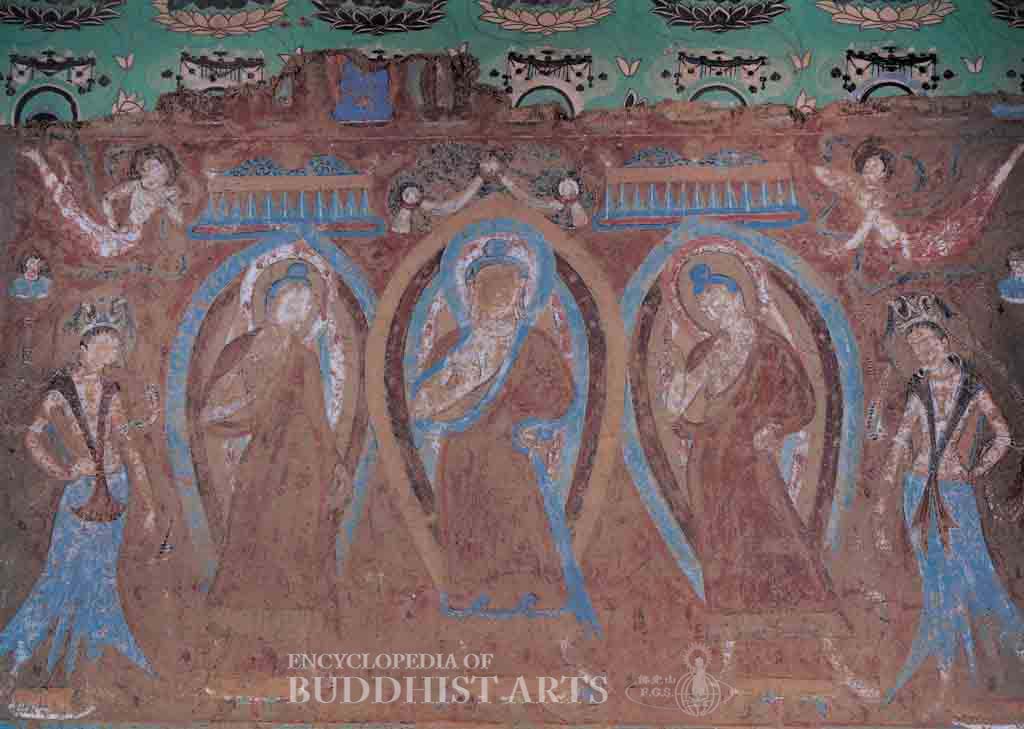
Mogao Cave 263: Three Buddhas
Mogao Cave 263: Three Buddhas
CHINA, Gansu, Dunhuang; Northern Wei dynasty
This mural is painted on the south wall. The three Buddhas possibly represent the Buddhas of the Past, Present, and Future. The Buddha in the center is the tallest, and the adjacent Buddhas both face slightly inward. Each Buddha has a nimbus and a mandorla, a round usnisa, and blue hair. They are all clothed in brown monastic robes. Their faces are now faded and indistinct. The right hand of each probably forms the vitarka (teaching) mudra. Canopies hang above the three Buddhas; the central canopy is composed of leaves and ribbons.
Two flying apsaras are painted in the upper corners of the mural. They have nimbuses and wear long garments with flowing stoles. Two attendant Bodhisattvas wearing triple-disc crowns with trailing ribbons stand below, flanking the three Buddhas. Their upper torsos are bare but for a shawl draped over the shoulders and crossed at the abdomen, and they wear long lower garments. Their heads are slightly tilted to one side, and they stand in tribhanga posture on lotus pedestals.
For more details, go to the Encyclopedia of Buddhist Arts: Caves Mo-S, page 1083.
Cite this article:
author = Hsingyun and Youheng and Johnson, Peter and Mankuang and Huntington, Susan and Edson, Gary and Neather, Robert,
booktitle = {Encyclopedia of Buddhist Arts: Caves Mo-S},
pages = 1083,
title = {{Mogao Cave 263: Three Buddhas}},
volume = 8,
year = {2016}}