
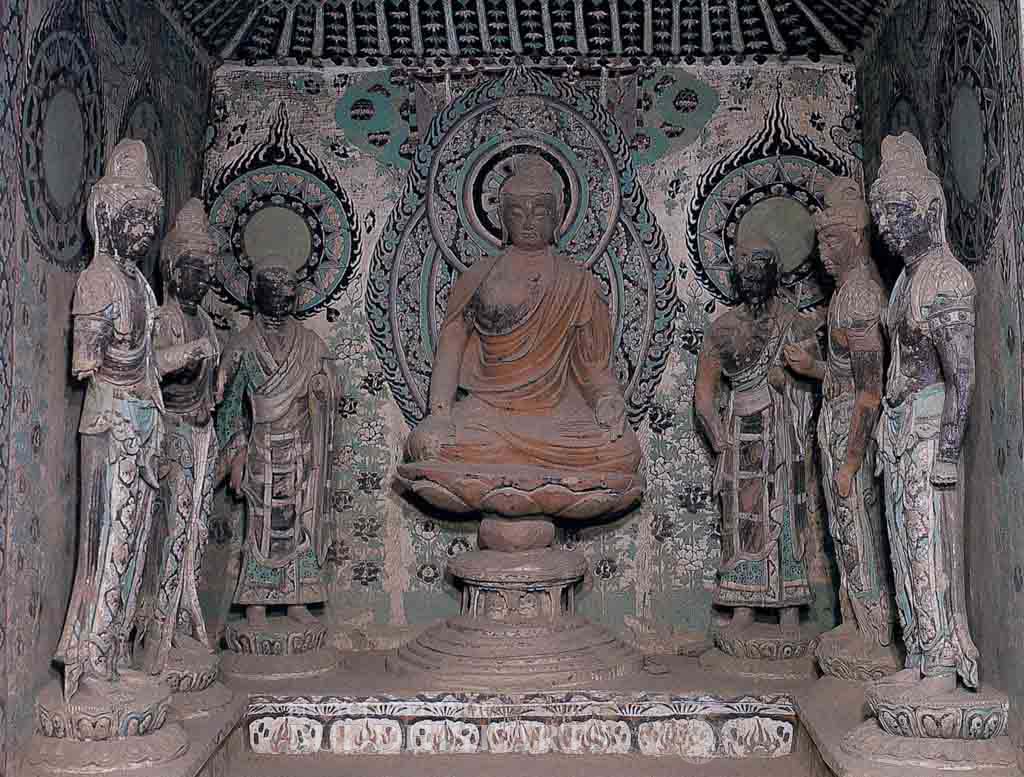
Mogao Cave 263: Niche Sculptures (central pillar, east side)
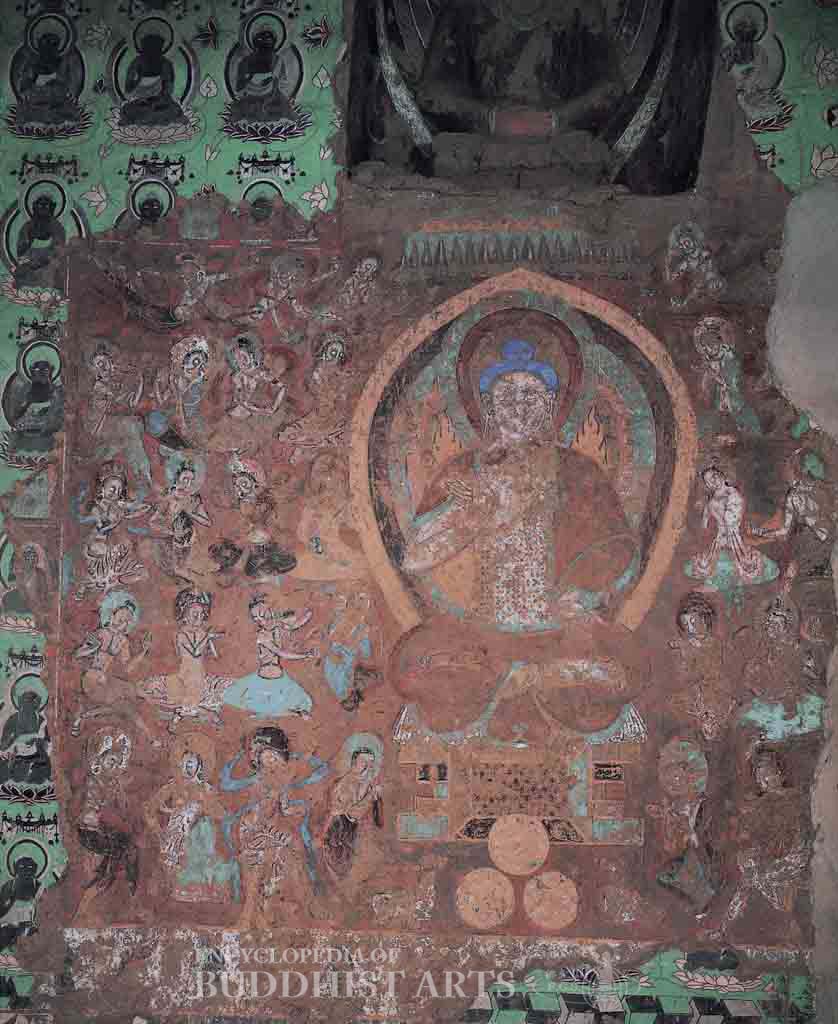
Mogao Cave 263: Buddha Teaching the Dharma (north wall)
Mogao Cave 263
CHINA, Gansu, Dunhuang
This modified central pillar cave is situated in the south area of the site. It was constructed during the Northern Wei dynasty (386–534), and was renovated during the Five Dynasties (907–960) and the Song dynasty (960–1279). The cave originally had a gabled ceiling at the front and a central pillar surrounded by a flat ceiling at the rear. The cave entrance was narrowed during later renovations, sealing off the east slope of the ceiling and the original front (east) wall. Part of the front wall collapsed in the late 19th century to reveal murals from the Northern Wei dynasty. In the early 20th century, Sergey F. Oldenburg, a Russian explorer, removed a number of Northern Wei murals, including images of the Thousand Buddhas, heavenly musicians, and the Defeat of Mara. Most of the remaining murals and sculptures in the cave date from the later renovation periods. In 1942, some of these murals were removed to reveal more of the original Northern Wei images.
The east side of the central pillar was expanded into a niche with a trapezoidal roof. The niche houses statues of a seated Buddha, two disciples, and four Bodhisattvas. Apsaras, flowers, and lotus-born children are painted on the walls. At the top of the niche, there are images of four apsaras and a shelter made of plantain leaves. The north, south, and west sides of the pillar have images of decorative valances, apsaras, and Bodhisattvas making offerings.
On the back (west) and side walls, the upper sections are embellished with valances and flying apsaras, the middle sections with Thousand Buddha images, and the bottom with donors and jewels below ogival arches. In addition, on the lower north wall are portraits of two monks. On all three walls, the central sections of the murals have been removed to reveal the original Northern Wei works beneath. On the back wall is an arched niche that houses a Buddha in meditation, and below is a mural of the Buddha teaching the Dharma. A niche in the north wall contains a statue of the Buddha in meditation and painted images of apsaras and Bodhisattvas on each side. Below the niche is a mural of Sakyamuni Buddha’s First Turning of the Dharma Wheel at Deer Park. On the south wall is another arched niche containing a seated Buddha in meditation and an illustration of the Buddha’s Defeat of Mara.
The original east slope of the gabled ceiling has images of nine heavenly beings making offerings, and floral patterns added during later periods. On the renovated front wall, the outer layer included heavenly musicians at the top, the Thousand Buddhas in the middle, and four monks making offerings at the bottom, as well as two male donors from the Five Dynasties period. The original front wall features Northern Wei paintings of ten monks and the Buddha teaching the Dharma. In the lower register are portraits of nine male donors from the Five Dynasties; four of these are damaged. Both sides of the wall built during the Five Dynasties and Song dynasty are painted with murals of Jakata tales and the Pure Land.
For more details, go to the Encyclopedia of Buddhist Arts: Caves Mo-S, page 1079.
Cite this article:
author = Hsingyun and Youheng and Johnson, Peter and Mankuang and Huntington, Susan and Edson, Gary and Neather, Robert,
booktitle = {Encyclopedia of Buddhist Arts: Caves Mo-S},
pages = 1079,
title = {{Mogao Cave 263}},
volume = 8,
year = {2016}}