
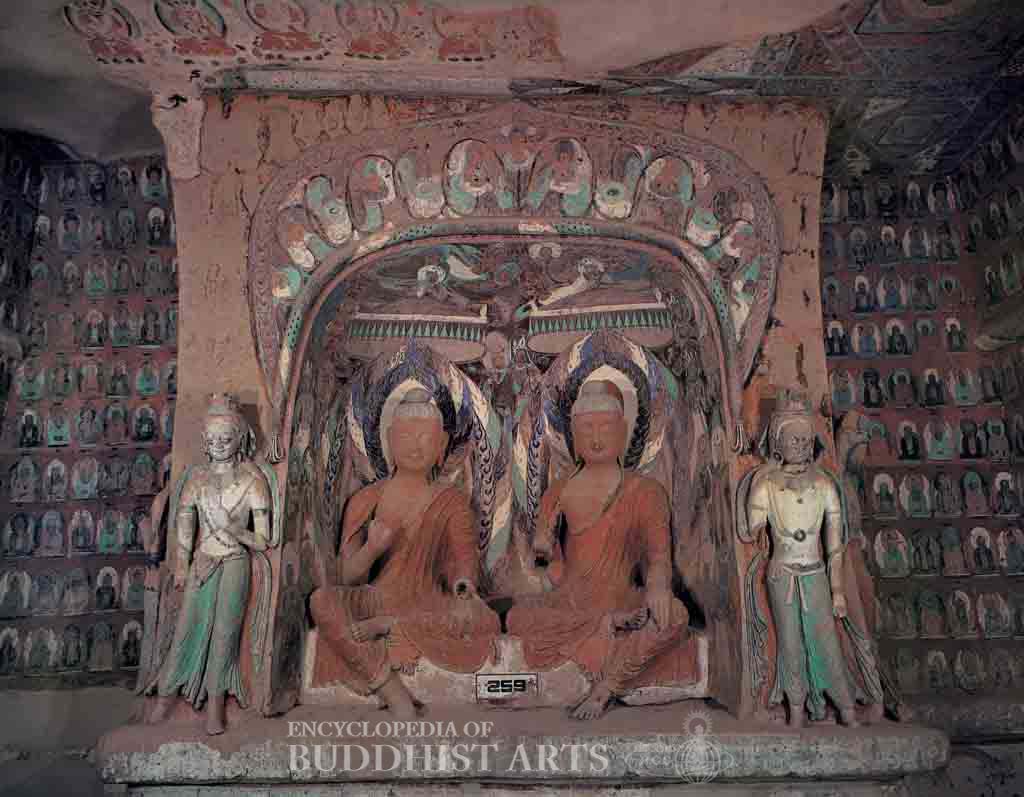
Mogao Cave 259: Sakyamuni and Prabhutaratna Buddhas
Clay
Mogao Cave 259: Sakyamuni and Prabhutaratna Buddhas
CHINA, Gansu, Dunhuang; Northern Wei dynasty
These figures are found within the niche in the half-pillar in front of the back (west) wall of the main chamber. The two Buddhas are seated next to each other. The iconography originates from the “Chapter on the Emergence of the Prabhutaratna Pagoda” in the Lotus Sutra. The Buddhas are seated on a rectangular throne, each with a petal-shaped nimbus and a mandorla decorated with flame patterns. The style and clothing of the Buddhas are similar, and both have usnisas and curled hair. Their faces are round, the eyes half-closed, and the lips slightly pursed. They are clothed in ocher red robes that cross the left shoulders. The contours of the garments are shaped with deep ridges formed from stucco, creating a rich texture. The left hand of the Buddha on the left is missing, and the right hand, which is damaged, is raised in front of the chest in what was likely the vitarka (teaching) mudra. The Buddha on the right is missing the right hand, and the left hand is placed on the knee. The Buddhas’ leg positions mirror each other; the inner legs are folded under and the outer legs extend down. Sakyamuni and Prabhutaratna Buddhas seated together are a common theme in caves dating from the Northern Wei dynasty (386–581).
For more details, go to the Encyclopedia of Buddhist Arts: Caves M-Mo, page 1077.
Cite this article:
author = Hsingyun and Youheng and Johnson, Peter and Mankuang and Huntington, Susan and Edson, Gary and Neather, Robert,
booktitle = {Encyclopedia of Buddhist Arts: Caves M-Mo},
pages = 1077,
title = {{Mogao Cave 259: Sakyamuni and Prabhutaratna Buddhas}},
volume = 7,
year = {2016}}