
Mogao Cave 259
Mogao Cave 259
CHINA, Gansu, Dunhuang
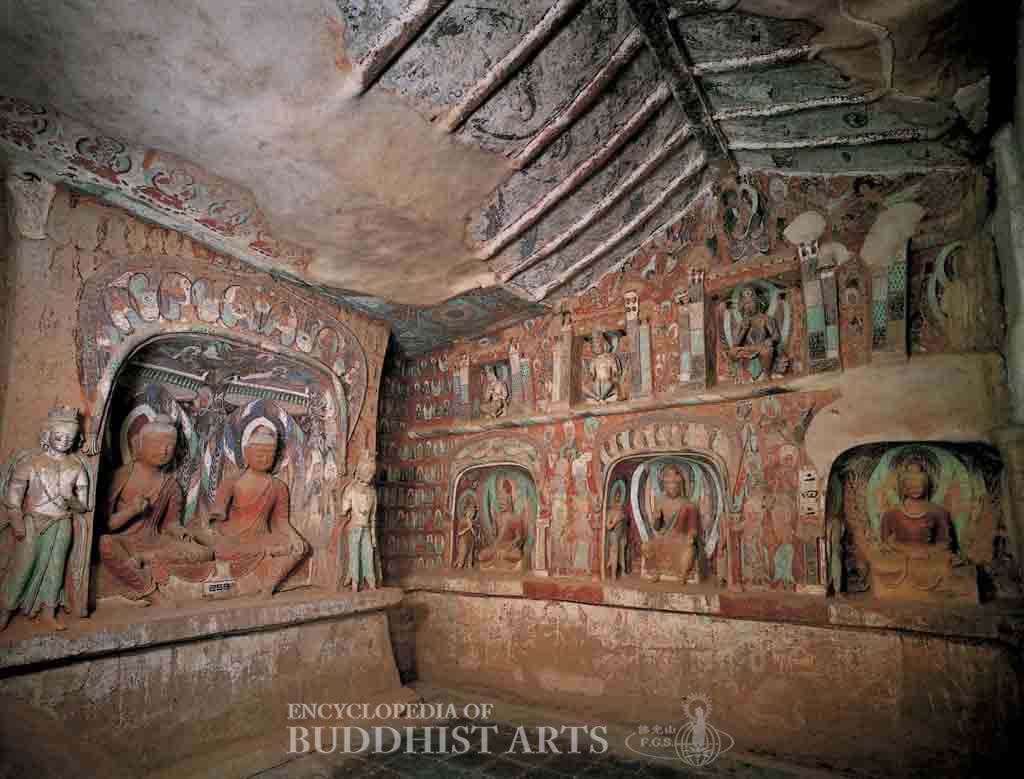
Situated in the south area of the Mogao Caves site, this cave was built during the Northern Wei dynasty (386–534). Some statues in the cave were damaged and repaired or replaced in later periods. The reconstructed statues are sturdy and simple in style. The ceiling of the cave is gabled at the front with paintings of apsaras, lotus flowers, and Bodhisattvas making offerings, while the rear ceiling is flat with paintings of floral medallions and apsaras.
A large half-pillar on the back (west) wall has a niche that contains statues of Sakyamuni and Prabhutaratna Buddhas seated side by side. The arched lintel is decorated with a tasseled ribbon relief and paintings of lotuses and apsaras. Painted on the walls within the niche are 14 Bodhisattvas and 10 apsaras, and flanking the niche are two standing Bodhisattva statues. There are faded portraits of Northern Wei donors on the pillar base, and on either side of the pillar on the back wall are paintings of the Thousand Buddhas, as well as the remnants of a yaksa image at the bottom left.
The north and south walls both have two rows of niches: four upper niches and three lower niches in the north wall, and three upper niches with one lower niche in the south wall. The upper niches are rectangular and bordered by columns, while the lower niches are arched. The contents of the niches along the north wall are well preserved while those on the south wall are less so. At the top of both walls are images of the Buddha teaching the Dharma, and between the niches are images of Bodhisattvas. The far west side of both walls is covered with Thousand Buddha images. On the north wall, one upper niche houses a Bodhisattva in contemplation along with painted images of a Bodhisattva and an apsara, and another two upper niches house cross-ankled Bodhisattvas with painted attendant Bodhisattvas. The three lower niches on the north wall house statues of a Buddha seated in full lotus position, a Buddha seated with legs pendent accompanied by two attendant Bodhisattvas, and a Buddha seated in full lotus position, also with two attendant Bodhisattvas. On the south wall, three cross-ankled Bodhisattva statues remain in two of the upper niches, and in the right lower niche is a Buddha seated in full lotus position with one attendant Bodhisattva. The lower niche has a honeysuckle pattern and two dragon heads painted on the lintel, and on the back wall of the niche is the Buddha’s large mandorla along with two lotus-born figures. On the lower north and south walls are illustrations of donors together with decorative patterns and yaksas below. The walls of the cave are painted in red ocher, though much of the color has faded over time.
For more details, go to the Encyclopedia of Buddhist Arts: Caves M-Mo, page 1076.
Cite this article:
author = Hsingyun and Youheng and Johnson, Peter and Mankuang and Huntington, Susan and Edson, Gary and Neather, Robert,
booktitle = {Encyclopedia of Buddhist Arts: Caves M-Mo},
pages = 1076,
title = {{Mogao Cave 259}},
volume = 7,
year = {2016}}