
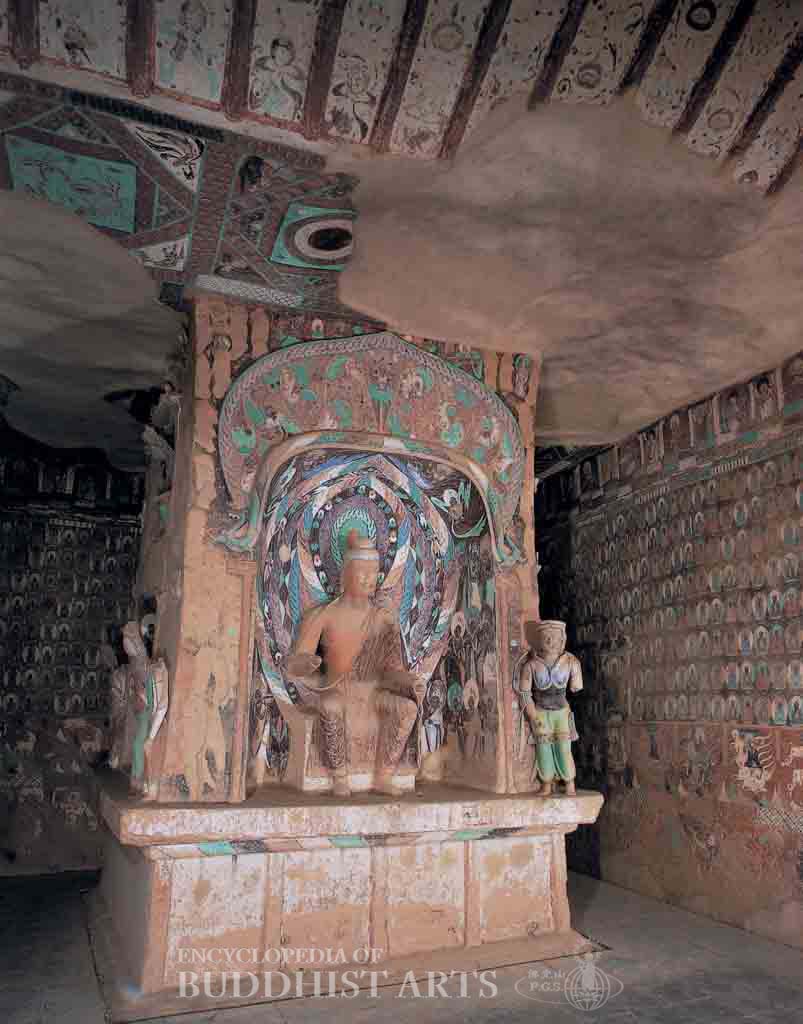
Mogao Cave 257: Central Pillar
Mogao Cave 257
CHINA, Gansu, Dunhuang
Situated in the south area of the site, this central pillar cave was constructed during the Northern Wei dynasty (386–534). In the center of the chamber is a square pillar with niches on all four sides. The front of the chamber has a gabled ceiling painted with lotus flowers and figures holding lotuses. The ceiling is flat at the rear of the cave, and is decorated with apsaras, lotus-born children, and lotus patterns.
The main Buddha statue is seated within a niche on the east side of the central pillar. The large ogee arch lintel is embellished with flame patterns, and dragon heads are carved in relief on either side. The Buddha has a large usnisa and a petal-shaped nimbus and mandorla. The head of the Buddha was replaced in a later period. The Buddha wears a monastic robe draped over the left shoulder. One arm rests on the knee and the other is raised slightly; both hands are missing. The figure is seated with legs pendent on a rectangular throne. On each side within the niche are paintings of ten Bodhisattvas making offerings and two flying apsaras. Outside the niche there were originally two sculptures of Heavenly Kings and several Bodhisattvas in relief, but only one of each remains. At the base of the pillar are the faint remnants of donor images from the Northern Wei and Song (960–1279) dynasties.
On each of the north, south, and west sides of the pillar are two niches. The upper niche on the south side houses a Buddha in contemplation and the lower niche has an Ascetic Sakyamuni in meditation. Both the upper and lower niches on the west side contain a Buddha in meditation, and the upper niche on the north side contains a cross-ankled Bodhisattva while the lower niche houses a Buddha in meditation. On the walls within the upper niches are paintings of heavenly beings making offerings and lotus-born children, and in the lower niches are images of Bodhisattvas making offerings. On the walls of the pillar surrounding the niches are over 30 Bodhisattvas sculpted in relief, and at the base of the pillar are paintings of dragons and tigers.
On the back (west) and side walls of the cave, heavenly palaces and musicians are illustrated at the top, Thousand Buddha images are in the middle, and a long series of narrative illustrations are painted along the lower walls. On the back wall is the Ruru Jataka, on the north wall is Sumagadha’s Invitation, and on the south wall are the Novice Monk Committing Suicide to Uphold the Precepts and Watchdog Reborn into a Wealthy Family. The buildings within the murals have upturned eaves; this is representative of the early stages of the integration of Chinese cultural and architectural elements in Buddhist art. Below the narrative illustrations are decorative patterns and yaksas at the base of the walls. The front (east) wall of the cave has collapsed.
For more details, go to the Encyclopedia of Buddhist Arts: Caves M-Mo, page 1071.
Cite this article:
author = Hsingyun and Youheng and Johnson, Peter and Mankuang and Huntington, Susan and Edson, Gary and Neather, Robert,
booktitle = {Encyclopedia of Buddhist Arts: Caves M-Mo},
pages = 1071,
title = {{Mogao Cave 257}},
volume = 7,
year = {2016}}