
Mogao Cave 254: Mrgasirsa
Mogao Cave 254: Mrgasirsa
CHINA, Gansu, Dunhuang; Northern Wei dynasty
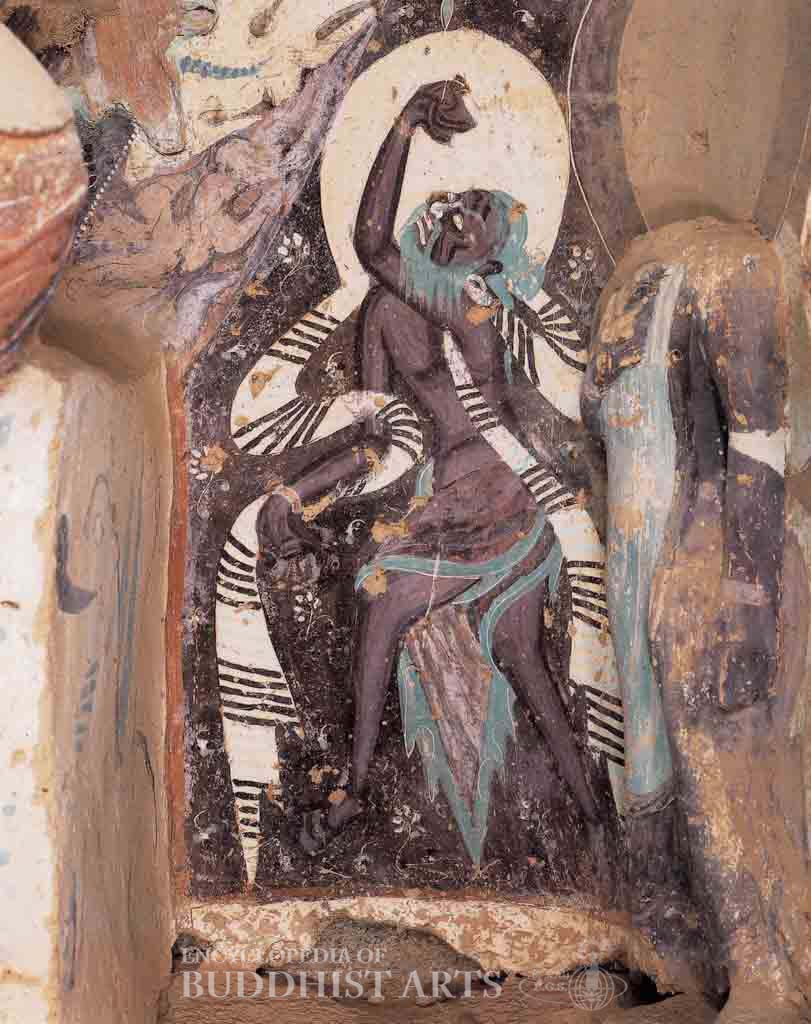
This image is located to the right of the Buddha within the niche on the east side of the central pillar. The story of Mrgasirsa, is narrated in the Ekottara Agama, within the “Chapter on Sravakas.” Mrgasirsa was an expert in healing and medicine. From the skull of a deceased person he could discern the gender, cause of death, and place of rebirth. One day, as he was wandering in a graveyard, he came upon Sakyamuni Buddha. On four occasions Sakyamuni took a skull of a deceased person to Mrgasirsa, and he was able to respond fluently to all the questions from the Buddha. Then the Buddha gave him the skull of a monk, and Mrgasirsa was unable to read it. The Buddha told him that the skull belonged to an Arhat. Mrgasirsa was deeply impressed and thereafter took refuge in the Buddha. He eventually attained Arhatship himself. In Buddhist murals, Mrgasirsa almost always appears together with an image of Vasu. When featured in the works of the Northern Wei dynasty (386–534), the two are most often positioned on either side of Sakyamuni Buddha.
In this image, Mrgasirsa has an oval nimbus, blue hair, a long beard, and dark skin. He glares upwards towards the Buddha. His left arm is raised, with a small sack clenched in the left hand. The face is contorted and the mouth is opened in a scowl. In the lowered right hand is a skull. Mrgasirsa wears a dhoti and a long stole wraps around the arms. He is barefoot and steps forward with one foot in the air.
For more details, go to the Encyclopedia of Buddhist Arts: Caves M-Mo, page 1069.
Cite this article:
author = Hsingyun and Youheng and Johnson, Peter and Mankuang and Huntington, Susan and Edson, Gary and Neather, Robert,
booktitle = {Encyclopedia of Buddhist Arts: Caves M-Mo},
pages = 1069,
title = {{Mogao Cave 254: Mrgasirsa}},
volume = 7,
year = {2016}}