
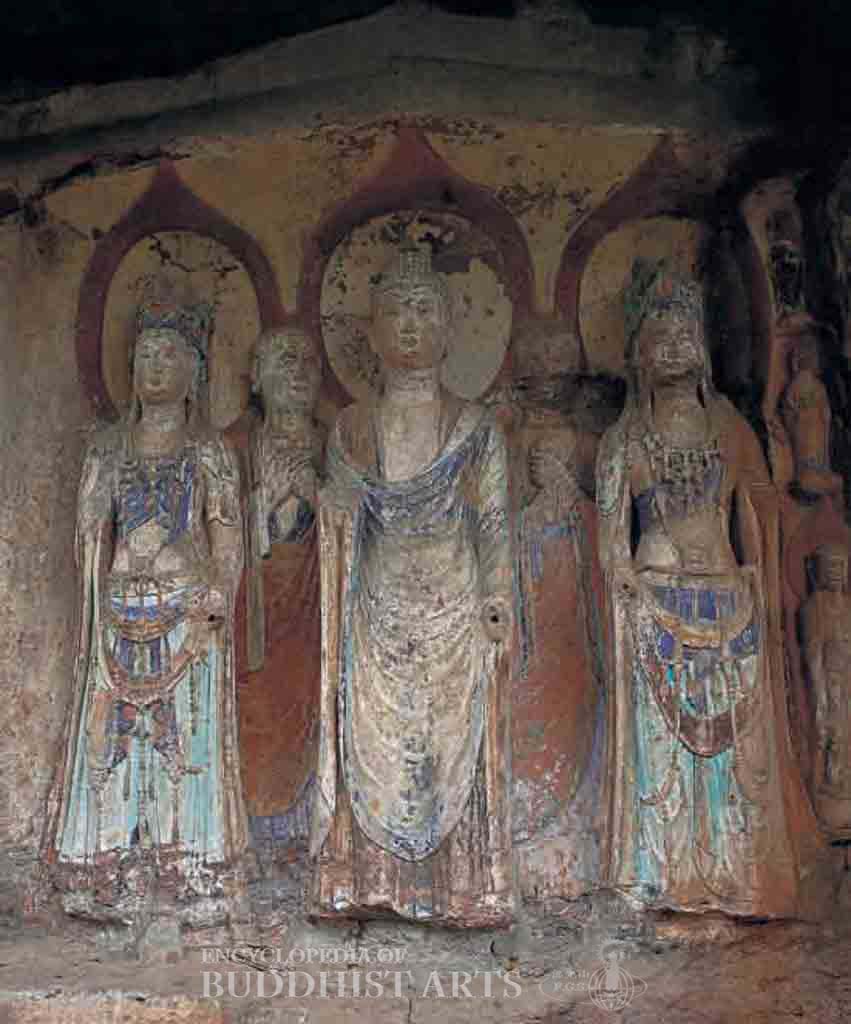
Pujiang Feixiange Rock Carvings: Niche 67 - Amitabha Buddha Pentad
Pujiang Feixiange Rock Carvings
CHINA, Sichuan, Chengdu
These rock carvings are located in Linyu village, 10 km southwest of Pujiang, Chengdu. Construction first started in the Early Tang period (618–712), and there are 92 extant niches containing 777 sculptures and 12 stele inscriptions. The rock carvings were listed as a National Cultural Heritage Site in 2006.
The site contains two types of niches: the rectangular niches and the double-layered niches with a circular inner layer and a rectangular outer layer. The statues are mainly Buddhist, although a few Daoist statues can also be found. Typical niche themes include Amitabha Buddha Triads, Buddhas attended by two Bodhisattvas and two disciples, images of Maitreya Buddha, illustrations of the Western Pure Land, Avalokitesvara Bodhisattvas, and the Bodhi Figures. Niche 9 contains statues of a Buddha presented as a Bodhi Figure, two disciples, two Bodhisattvas, and two Heavenly Kings. Reliefs of Heavenly Kings are depicted on the walls surrounding the statues, while the niche’s ceiling displays a relief of twin Bodhi trees. A number of figures within the niche are low reliefs or line engravings. Niche 60 has a similar subject matter. The Buddha is presented as a Bodhi Figure and is surrounded by two disciples and four Bodhisattvas. The two-layered Niche 55 contains carvings of Avalokitesvara flanking Ksitigarbha on the back wall. Niche 67 is an exposed rectangular niche with carvings of Amitabha Buddha, two disciples, and two Bodhisattvas.
For more details, go to the Encyclopedia of Buddhist Arts: Caves Mo-S, page 1317.
Cite this article:
author = Hsingyun and Youheng and Johnson, Peter and Mankuang and Huntington, Susan and Edson, Gary and Neather, Robert,
booktitle = {Encyclopedia of Buddhist Arts: Caves Mo-S},
pages = 1317,
title = {{Pujiang Feixiange Rock Carvings}},
volume = 8,
year = {2016}}