
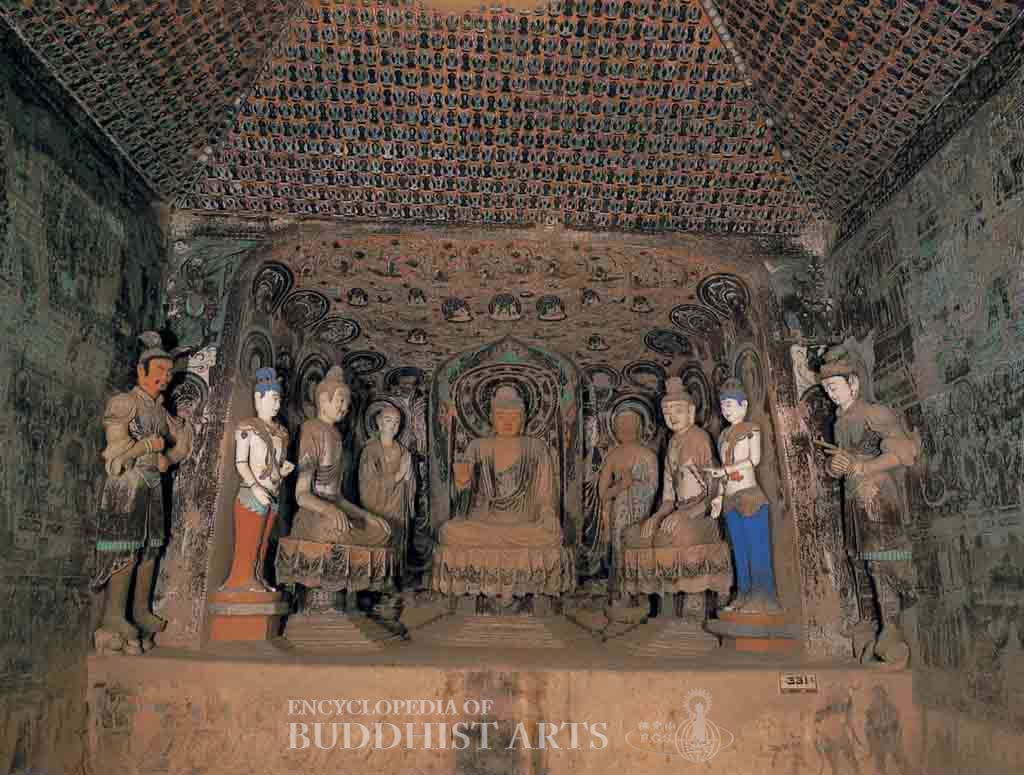
Mogao Cave 331: Niche Sculptures
Clay
Mogao Cave 331: Niche Sculptures
CHINA, Gansu, Dunhuang; Tang dynasty
These figures are enshrined in the niche on the back (west) wall of this cave. Five of them date to the Early Tang period (618–712) and include a Buddha, two disciples, and two attendant Bodhisattvas. Two more Bodhisattvas and two Heavenly Kings from the Qing dynasty (1644–1911) replace the four original sculptures.
The Buddha is seated in full lotus position on a Sumeru throne with nimbus and mandorla painted on the wall behind. The Buddha has a large usnisa, a round face, and wears inner and outer monastic robes. The raised right hand is held palm out in a mudra while the left hand rests on the knee. The disciples Mahakasyapa and Ananda have nimbuses and stand with palms joined. Mahakasyapa wears a monastic robe draped over the left shoulder and Ananda wears inner and outer robes which cover both shoulders. The two attendant Bodhisattvas are seated in full lotus position on Sumeru thrones. They wear high topknots, necklaces, stoles, and long lower garments. They have nimbuses and their hands rest on their knees.
For more details, go to the Encyclopedia of Buddhist Arts: Caves Mo-S, page 1163.
Cite this article:
author = Hsingyun and Youheng and Johnson, Peter and Mankuang and Huntington, Susan and Edson, Gary and Neather, Robert,
booktitle = {Encyclopedia of Buddhist Arts: Caves Mo-S},
pages = 1163,
title = {{Mogao Cave 331: Niche Sculptures}},
volume = 8,
year = {2016}}