
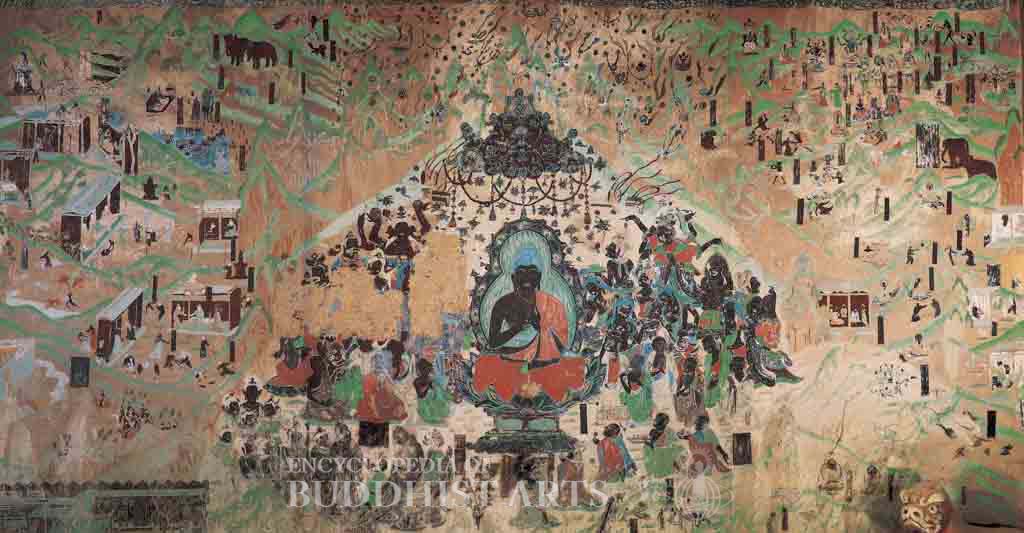
Mogao Cave 321: Illustration of the Ratnamegha Sutra
Mogao Cave 321: Illustration of the Ratnamegha Sutra
CHINA, Gansu, Dunhuang; Tang dynasty
Situated on the south wall of the main chamber, this is the only illustration of the Ratnamegha Sutra within the Mogao Caves. The sutra was first translated into Chinese during the Southern Dynasties (420–589) and was re-translated after Empress Wu Zetian (reigned 684–705) ascend the throne, with the addition of a description on the Moonlight Queen of the East. The mural is reflective of these later translations.
In the upper register is a layer of rolling clouds. Jeweled necklaces, flowers, pearls, and musical instruments fall from the sky upon Gayasirsa (Elephant Head Mountain). In the center is Sakyamuni Buddha seated in full lotus position on a lotus throne. A large canopy hangs above the Buddha, who has blue hair and wears a red robe that crosses the left shoulder. Gathered around are Bodhisattvas, disciples, heavenly beings, and the Eight Classes of Dharma Protectors. To the left of the Buddha is Mahesvara. The deity wears a crown over long hair and has six arms. Two hands are joined before the chest in anjali (reverence) mudra while the other four are raised and hold a lotus, bell, and ruyi (wish-fulfilling talisman). To the right of the Buddha is the asura king, who holds the sun and the moon in upraised palms. Monks seated around the Buddha look up with palms joined. On the lower right of the Buddha, the Moonlight Queen kneels with palms joined before the Buddha. She wears a crown, jewelry, and long, flowing garments, and is followed by court ladies and officials. The figure is likely symbolic of Empress Wu Zetian.
The Dharma teaching scene is surrounded on both sides by landscape style narrative illustrations and accompanied by descriptive cartouches. The images of green hills, houses, and scenes of people going about their daily affairs are based on the contents of the sutra. Among them are: farmers working in fields, people repairing a pagoda and temple, devotees making offerings to monastics, chanting sutras, and Bodhisattvas coming to the aid of sentient beings.
For more details, go to the Encyclopedia of Buddhist Arts: Caves Mo-S, page 1146.
Cite this article:
author = Hsingyun and Youheng and Johnson, Peter and Mankuang and Huntington, Susan and Edson, Gary and Neather, Robert,
booktitle = {Encyclopedia of Buddhist Arts: Caves Mo-S},
pages = 1146,
title = {{Mogao Cave 321: Illustration of the Ratnamegha Sutra}},
volume = 8,
year = {2016}}