
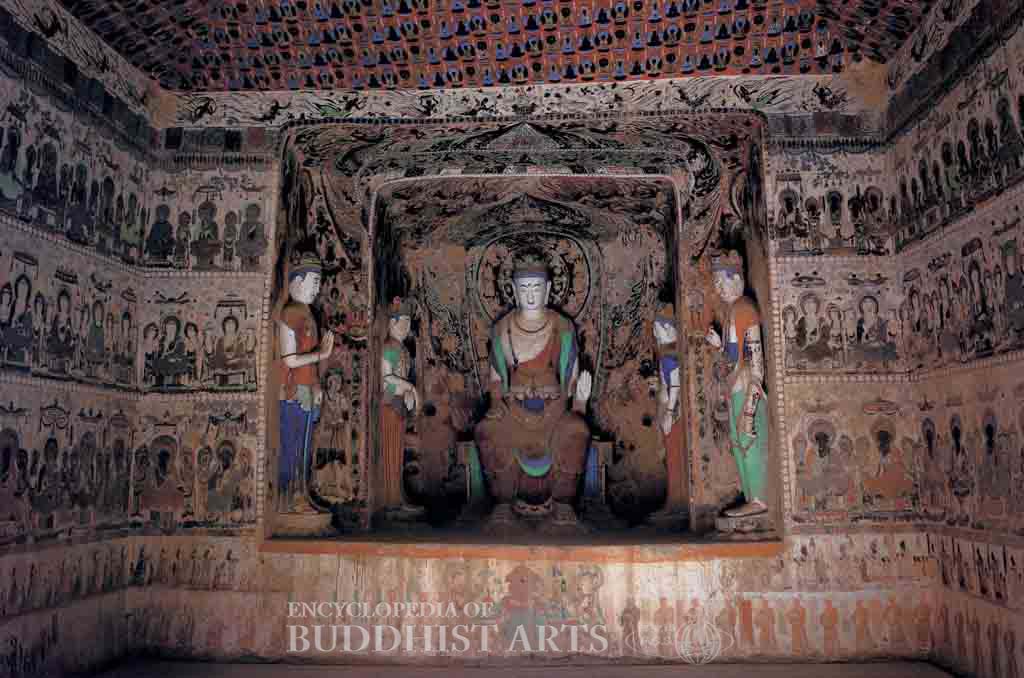
Mogao Cave 390: Main Chamber - Back Wall
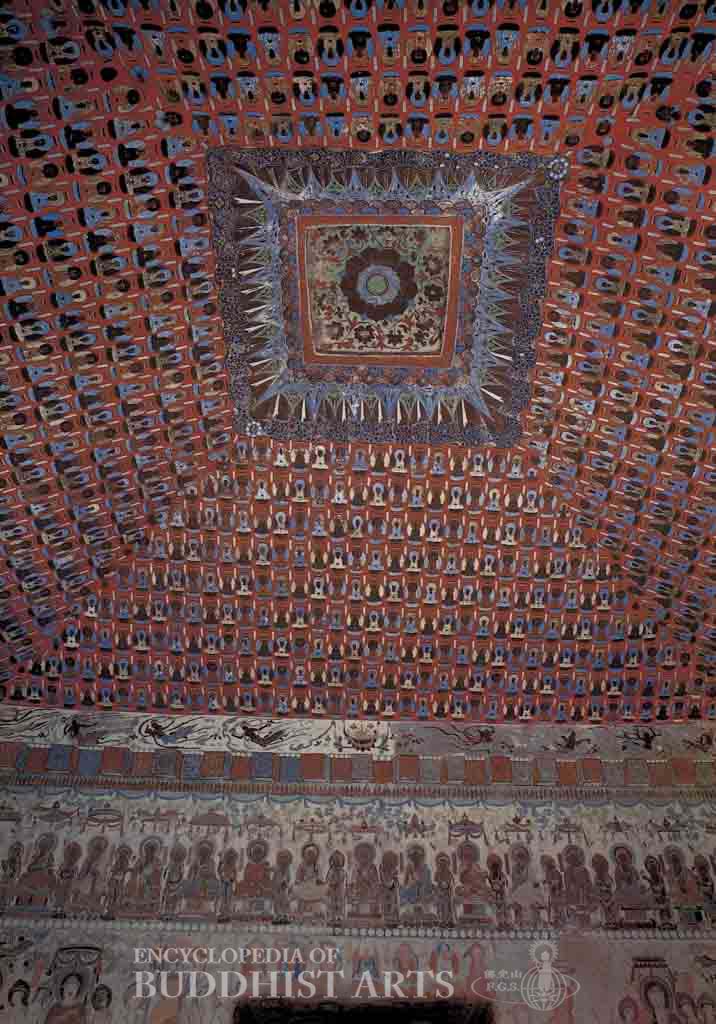
Mogao Cave 390: Main Chamber - Ceiling and Front Wall
Mogao Cave 390
CHINA, Gansu, Dunhuang
This shrine cave is situated on the third level in the northern section of the south area. It was constructed in the Sui dynasty (581–618) and was renovated in the Five Dynasties (907–960) and Qing dynasty (1644–1911). The center of the truncated pyramidal ceiling has a large lotus surrounded by foliage and small lotuses, and bordered by various patterns, including lotuses, beads, and pennants. The four slopes of the ceiling are covered with images of apsaras and flame patterns.
On the back (west) wall of the main chamber is a double-recessed niche, in the center of which is a Bodhisattva seated with legs pendent. On each side of the Bodhisattva are a disciple and two attendant Bodhisattvas, all repaired during the Qing dynasty. On the niche walls are a large mandorla around the Buddha and paintings of Bodhisattvas and apsaras. The murals on the four walls of the cave include rows of apsaras and heavenly palaces at the top, Buddhas teaching the Dharma in the middle, and donors from the Sui dynasty and the Five Dynasties at the bottom. The background color of the ceiling is red while the four walls are white.
For more details, go to the Encyclopedia of Buddhist Arts: Caves Mo-S, page 1183.
Cite this article:
author = Hsingyun and Youheng and Johnson, Peter and Mankuang and Huntington, Susan and Edson, Gary and Neather, Robert,
booktitle = {Encyclopedia of Buddhist Arts: Caves Mo-S},
pages = 1183,
title = {{Mogao Cave 390}},
volume = 8,
year = {2016}}