
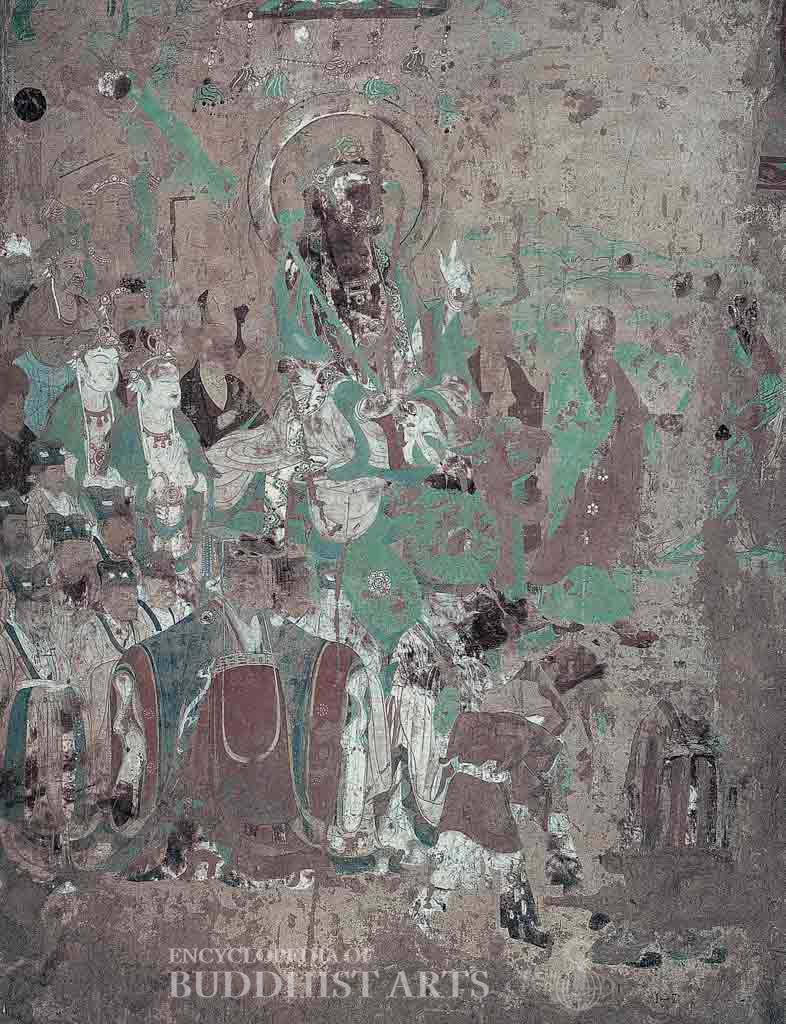
Mogao Cave 220: Illustration of the Vimalakirti Sutra - Chapter on Manjusri’s Visit
Mogao Cave 220: Illustration of the Vimalakirti Sutra - Chapter on Manjusri’s Visit
CHINA, Gansu, Dunhuang; Tang dynasty
Located on the left side of the front (east) wall, this image depicts the “Chapter on Manjusri’s Visit” from the Vimalakirti Sutra. Manjusri Bodhisattva is painted in front of a green landscape of hills and streams. Manjusri has a circular nimbus and hair coiled in a topknot beneath a headdress. The Bodhisattva wears celestial garments, necklaces, and other ornaments, and sits in full lotus position upon a square throne. The right hand forms a mudra while the left hand clasps a stole. A tasseled canopy hangs above the Bodhisattva.
Behind Manjusri is a group of figures including monks, Bodhisattvas, and officials of various kingdoms. Among them are Ganesa and Mahesvara, the latter with three heads and six arms that hold objects including sun and moon discs. Below Manjusri is an emperor clad in a red ceremonial robe who wears a tasseled crown and spreads his arms wide. An attendant stands before him, holding up a feathered parasol, and officials in uniform follow behind.
The mural contains numerous figures but is uncluttered and orderly. Each figure has distinctive features. The main colors are mineral green, red, and black. The emperor resembles the great Tang dynasty artist Yan Liben’s portraits of emperors in the Thirteen Emperors Scroll.
For more details, go to the Encyclopedia of Buddhist Arts: Caves M-Mo, page 1032.
Cite this article:
author = Hsingyun and Youheng and Johnson, Peter and Mankuang and Huntington, Susan and Edson, Gary and Neather, Robert,
booktitle = {Encyclopedia of Buddhist Arts: Caves M-Mo},
pages = 1032,
title = {{Mogao Cave 220: Illustration of the Vimalakirti Sutra - Chapter on Manjusri’s Visit}},
volume = 7,
year = {2016}}