

Mogao Cave 220: Niche with the Buddha Teaching the Dharma
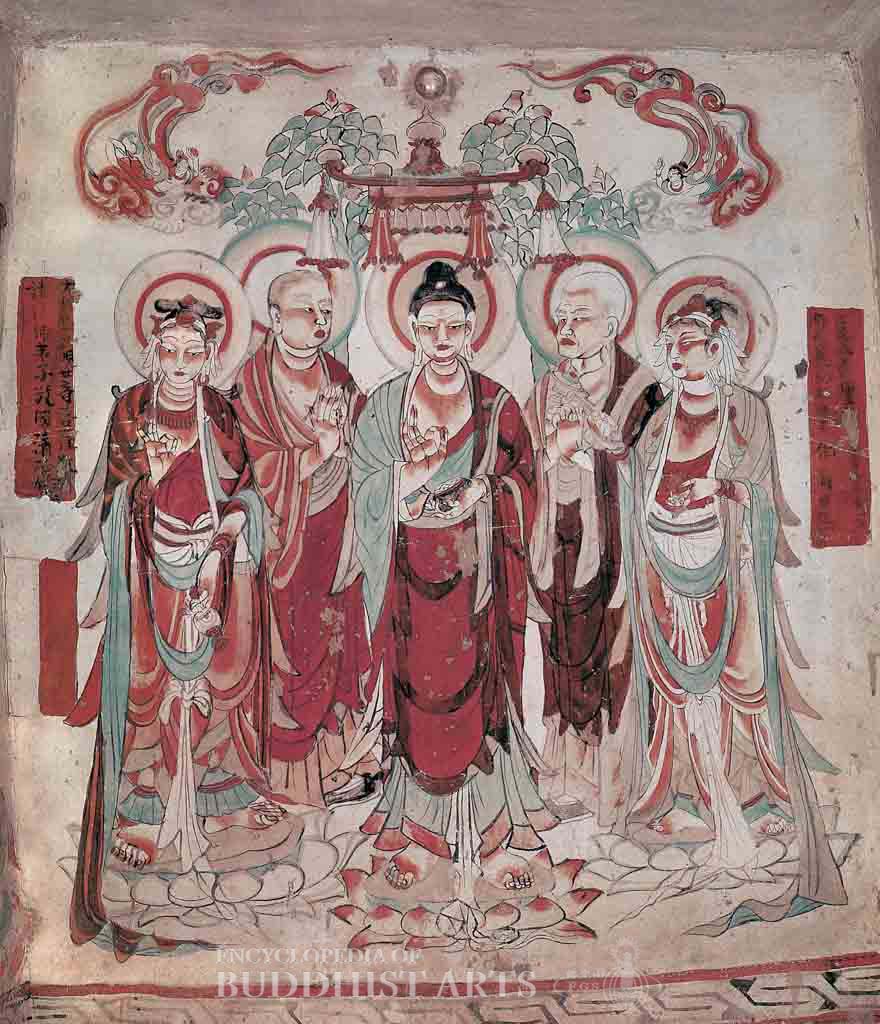
Mogao Cave 220: Buddha Teaching the Dharma
Mogao Cave 220: Buddha Teaching the Dharma
CHINA, Gansu, Dunhuang; Tang dynasty
Originally located in the niche on the south wall of the corridor, this mural was removed in 1975 when the corridor was rebuilt. It is thought to have been painted during the late 8th or early 9th century, during the Tibetan occupation of Dunhuang (781–847).
The mural consists of five standing figures: the Medicine Buddha, two disciples, and two Bodhisattvas. All the figures are light-skinned with round nimbuses. Medicine Buddha has a usnisa, elongated earlobes, plump cheeks, and three lines on the neck. He is clad in green and scarlet robes. The Buddha stands barefoot on a lotus pedestal, forming the vitarka (teaching) mudra with the right hand and holding a medicine bowl in the left hand. Above the Buddha is a canopy surrounded by pipal leaves and flanked by flying apsaras.
A young disciple stands to the right of the Buddha and an elder disciple stands to the left. Both face toward the Buddha and wear red and white robes. They have black shoes on their feet and their palms are joined. The Bodhisattvas wear celestial garments, white headdresses, and green stoles. The one on the left faces forward and wears a crimson outer robe. The hair is tied in a topknot, the face is delicate, and the figure is adorned with ornaments. The Bodhisattva forms the vitarka (teaching) mudra with the right hand and holds a vase in the left. The Bodhisattva on the right wears a white outer robe and faces slightly inward. A ruyi (wish-fulfilling talisman) is held in the right hand, and a wish-fulfilling jewel is in the left. Both Bodhisattvas stand barefoot upon lotus pedestals.
Offering inscriptions are written on both sides of the image. The mural is painted with smooth lines and elegant colors. The faces, hands, and chests of the figures, as well as the folds in their robes, are given a three-dimensional appearance with the wash technique.
For more details, go to the Encyclopedia of Buddhist Arts: Caves M-Mo, page 1027.
Cite this article:
author = Hsingyun and Youheng and Johnson, Peter and Mankuang and Huntington, Susan and Edson, Gary and Neather, Robert,
booktitle = {Encyclopedia of Buddhist Arts: Caves M-Mo},
pages = 1027,
title = {{Mogao Cave 220: Buddha Teaching the Dharma}},
volume = 7,
year = {2016}}