
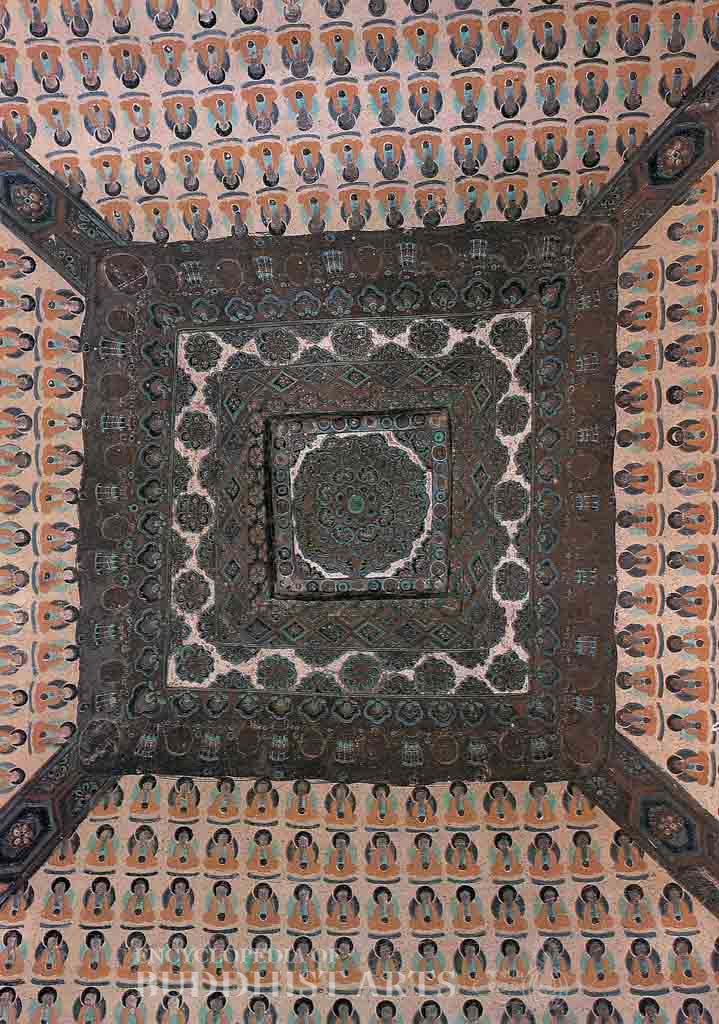
Mogao Cave 123: Ceiling
Mogao Cave 123: Ceiling
CHINA, Gansu, Dunhuang; Tang dynasty
Cave 123 dates to the High Tang period (712–756). In the caisson center of the ceiling is a lotus motif consisting of eight curled petals and eight leaves surrounded by auspicious clouds. Successive patterns surround the lotus, including bead strings, diamonds, circular floral patterns, trefoil, and valance patterns. The intricate designs vary in size and are arranged in an orderly fashion, with clear outlines and regular color variation. The dominant color is red ocher, with malachite, mineral blue, and white details. The Thousand Buddhas are painted on the four slopes of the ceiling.
For more details, go to the Encyclopedia of Buddhist Arts: Caves M-Mo, page 945.
Cite this article:
Hsingyun, et al. "Mogao Cave 123: Ceiling." Encyclopedia of Buddhist Arts: Caves M-Mo, vol. 7, 2016, pp. 945.
Hsingyun, Youheng, Peter Johnson, Mankuang, Susan Huntington, Gary Edson, and Robert Neather. 2016. "Mogao Cave 123: Ceiling" In Encyclopedia of Buddhist Arts: Caves M-Mo, 7:945.
Hsingyun, Youheng, Johnson, P., Mankuang, Huntington, S., Edson, G., & Neather, R.. (2016). Mogao Cave 123: Ceiling. In Encyclopedia of Buddhist Arts: Caves M-Mo (Vol. 7, pp. 945).
@misc{Hsingyun2016,
author = Hsingyun and Youheng and Johnson, Peter and Mankuang and Huntington, Susan and Edson, Gary and Neather, Robert,
booktitle = {Encyclopedia of Buddhist Arts: Caves M-Mo},
pages = 945,
title = {{Mogao Cave 123: Ceiling}},
volume = 7,
year = {2016}}
author = Hsingyun and Youheng and Johnson, Peter and Mankuang and Huntington, Susan and Edson, Gary and Neather, Robert,
booktitle = {Encyclopedia of Buddhist Arts: Caves M-Mo},
pages = 945,
title = {{Mogao Cave 123: Ceiling}},
volume = 7,
year = {2016}}