
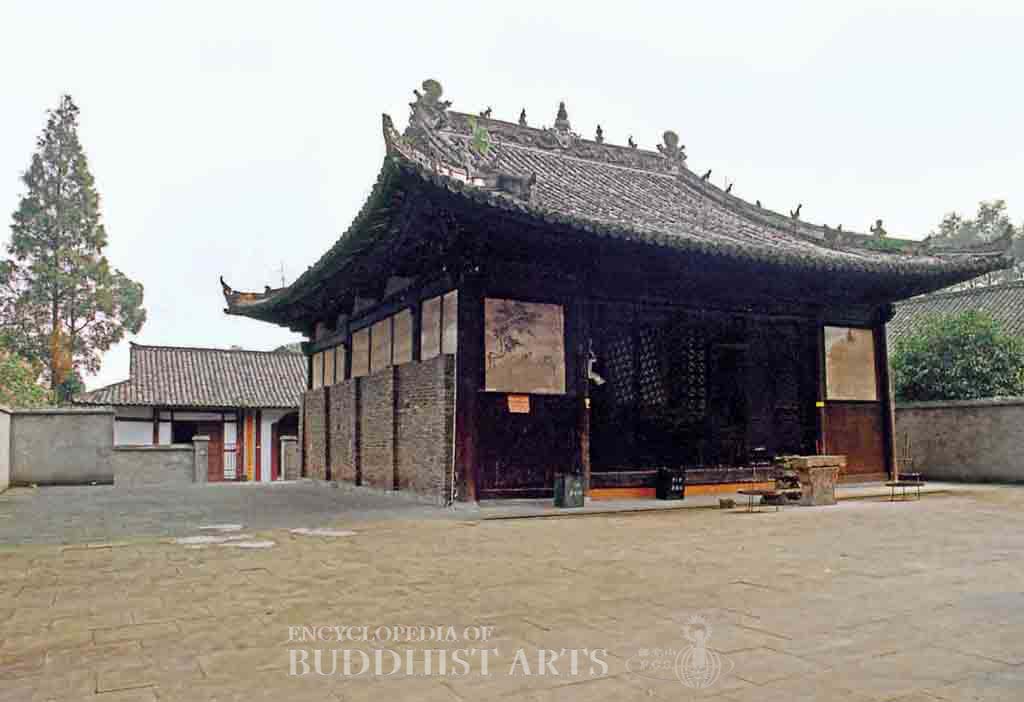
Guanyin Temple: Vairocana Hall
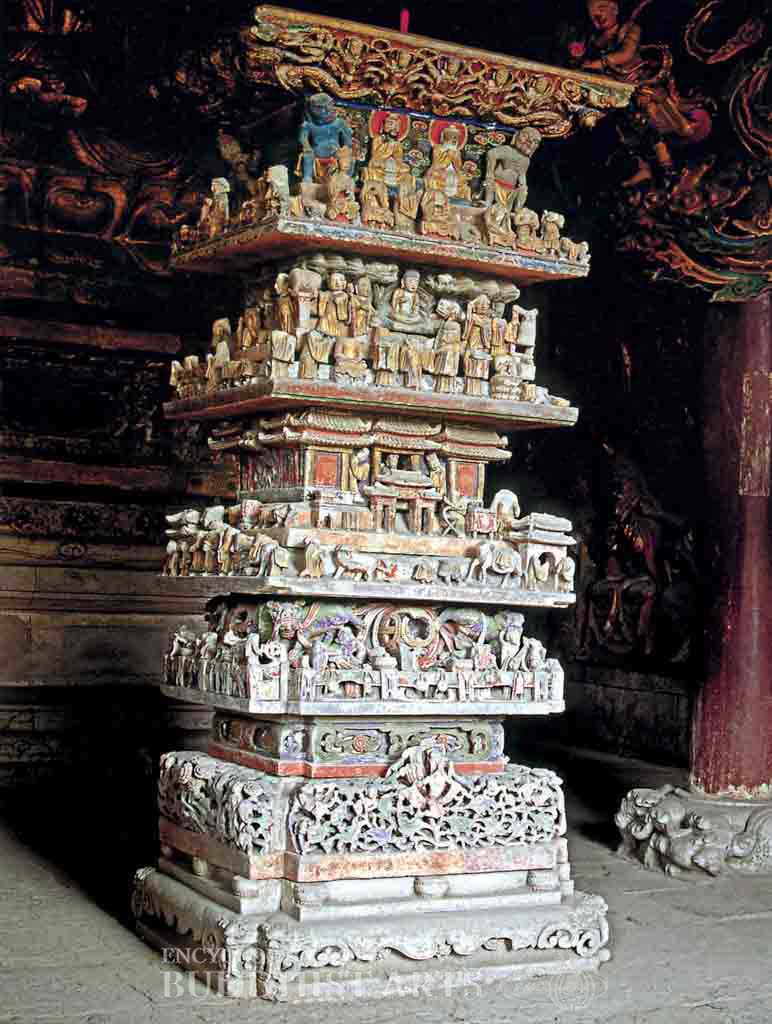
Guanyin Temple: Avalokitesvara Hall - Incense Burner
Guanyin Temple
CHINA, Sichuan, Chengdu
Guanyin stands for Avalokitesvara. The temple is dedicated to Avalokitesvara Bodhisattva and was built between 1174 and 1189 the Southern Song dynasty. It was destroyed at the end of the Yuan dynasty (1271–1368) and was rebuilt during the Ming dynasty (1368–1644). It was again destroyed at the beginning of the Qing dynasty (1644–1911). It has been renovated a number of times during its history. It was listed as a National Cultural Heritage Site in 2001.
The existing buildings include the Vairocana Hall and Avalokitesvara Hall, which were constructed during the Ming dynasty, together with the main temple gate, Maitreya Hall, and the Welcoming Hall, which were built during the Qing dynasty. The south-facing, three-bay wide Vairocana Hall was built in 1462 during the Ming dynasty. It has a single-eave hip-and-gable roof and the main ridge is highly decorated. The bracket sets are colorfully painted. The Trikaya Buddhas are enshrined inside the hall with Dharmakaya Buddha in the center, and Sambhogakaya Buddha and Nirmanakaya Buddha on either side. There are murals mainly on the side walls, as well as behind the Buddhas. The side walls feature Twelve Perfect Enlightenment Bodhisattvas, as well as Twenty-Four Heavenly Beings, and various figures making offerings. According to the inscription above the murals, they were completed in 1468 during the Ming dynasty.
The five-bay wide Avalokitesvara Hall was built in 1468 during the Ming dynasty. It has a single-eave hip-and-gable roof. Inside the hall there is a statue of Avalokitesvara Bodhisattva riding a unicorn. On either side there are Bodhisattvas Manjusri and Samantabhadra seated in the lotus position on a lotus throne. Behind them, on the other side, there is a large clay relief depicting these three Bodhisattvas, which is the most exquisite artwork within the temple. There are life-like statues of Five Hundred Arhats along the sides of the hall. The building also contains three incense burners from the Ming dynasty. These 3 m high incense burners are carved from stone, have five tiers, and are hollow.
For more details, go to the Encyclopedia of Buddhist Arts: Architecture G-L, page 405.
Cite this article:
author = Hsingyun and Youheng and Johnson, Peter and Mankuang and Lancaster, Lewis,
booktitle = {Encyclopedia of Buddhist Arts: Architecture G-L},
pages = 405,
title = {{Guanyin Temple}},
volume = 2,
year = {2016}}