
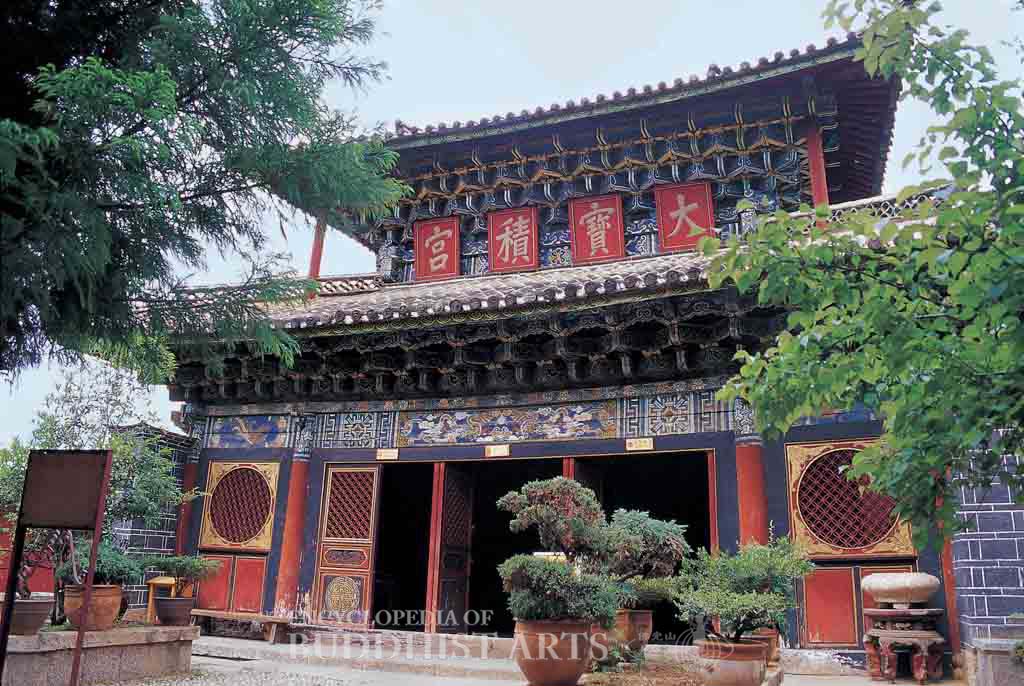
Dabaoji Palace
Dabaoji Palace and Liuli Hall
CHINA, Yunnan, Lijiang
The Liuli Hall was built in 1417 during the Ming dynasty by Chieftain Mu De, while the Dabaoji Palace was constructed in 1582 by Chieftain Mu Wang. The Dabaoji Palace stands in front of the Liuli Hall and the two are connected by a covered walkway. As the Mu clan chieftains were devout Buddhists during the Ming dynasty (1368–1644), the temple was expanded and decorated with large murals. The two buildings were listed as National Cultural Heritage Sites in 1996.
Both the Liuli Hall and the Dabaoji Palace face the east. The three-by-four bay Liuli Hall has a double-eave hip-and-gable roof with large, plain bracket sets. Most of the murals within the building were destroyed except for some small images on the beams, as well as eight sections that are currently kept in the Yunnan Museum.
The three-by-three bay Dabaoji Palace has a double-eave hip-and-gable roof. The bracket sets are so closely arranged that they link with each other and form an unusual web-like pattern. There are 12 murals covering a total of 61.5 sq m within the building. They are some of the best preserved and largest murals in the Lijiang region. The subject matter includes aspects of Chinese Buddhism, Tibetan Buddhism, and Daoism, a result of the Naxi people being influenced by different religious traditions during the rule of the Mu clan.
For more details, go to the Encyclopedia of Buddhist Arts: Architecture A-F, page 182.
Cite this article:
author = Hsingyun and Youheng and Johnson, Peter and Mankuang and Lancaster, Lewis,
booktitle = {Encyclopedia of Buddhist Arts: Architecture A-F},
pages = 182,
title = {{Dabaoji Palace and Liuli Hall}},
volume = 1,
year = {2016}}