
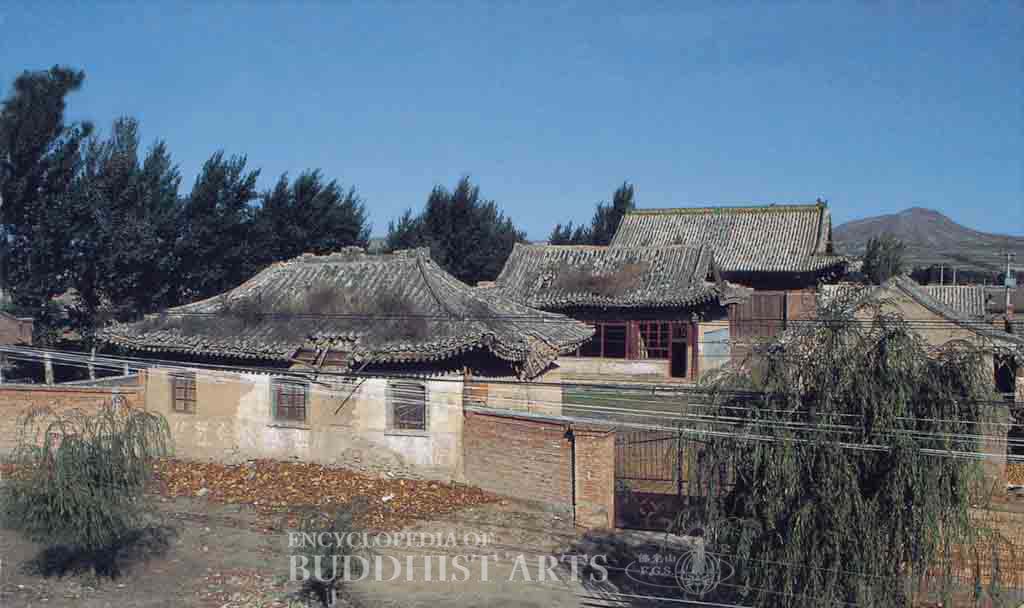
Zhaohua Temple
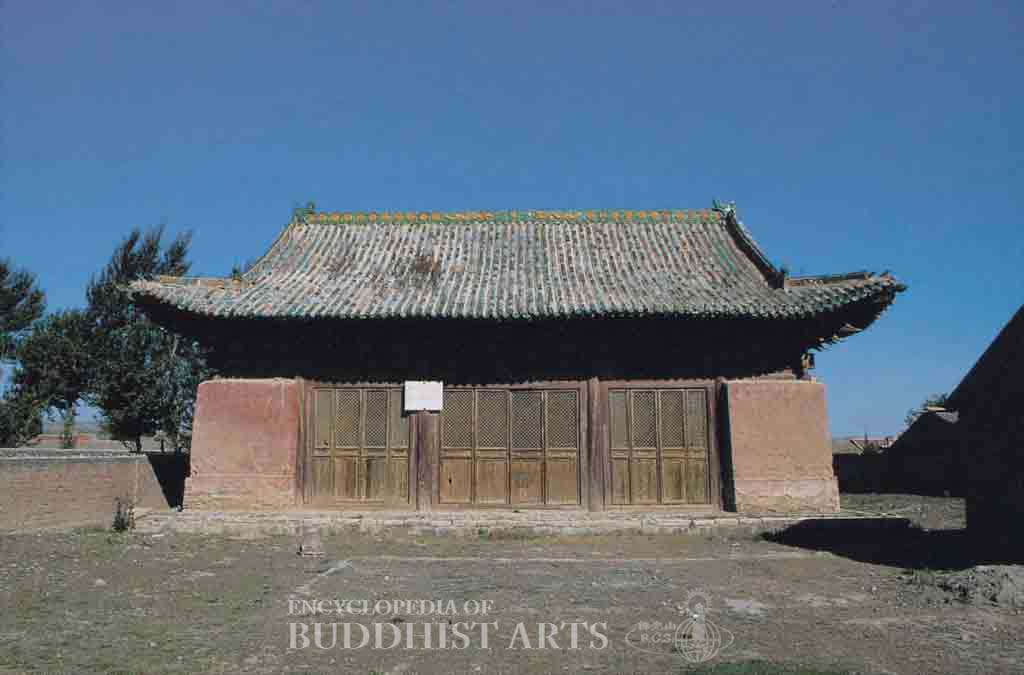
Zhaohua Temple: Great Hero Hall
Zhaohua Temple
CHINA, Hebei, Zhangjiakou
The temple was built in 1392 during the Ming dynasty, but was soon destroyed. It was rebuilt between 1436 and 1443 during the same dynasty, and has been repaired a number of times. It was listed as a National Cultural Heritage Site in 2001.
Facing south, the temple occupies more than 3,600 sq m. The existing buildings include the main temple gate, Heavenly King Hall, Great Hero Hall, Hall of the Three Great Bodhisattvas, and side halls. The three-bay wide main temple gate has a single-eave hip roof. The three-by-one bay Heavenly King Hall has a single-eave hip-and-gable roof.
The five-by-three bay Great Hero Hall is the main building and occupies 292 sq m. It has a single-eave hip-and-gable roof covered in glazed tiles. The hall walls are filled with murals of the Water and Land Dharma Service. They consist of 47 groups of paintings and occupy about 94 sq m. In the right corner of the south wall, there are inscriptions located above and to the side of the Vajrapanibalin statue. The inscriptions document the year 1562 and names of the artisans who painted the murals.
Apart from displaying features of early Ming dynasty architecture, the buildings show a combination of imperial and local architectural styles. The temple provides valuable information for the study of Chinese architecture.
For more details, go to the Encyclopedia of Buddhist Arts: Architecture T-Z, page 1392.
Cite this article:
author = Hsingyun and Youheng and Johnson, Peter and Mankuang and Lancaster, Lewis,
booktitle = {Encyclopedia of Buddhist Arts: Architecture T-Z},
pages = 1392,
title = {{Zhaohua Temple}},
volume = 4,
year = {2016}}