
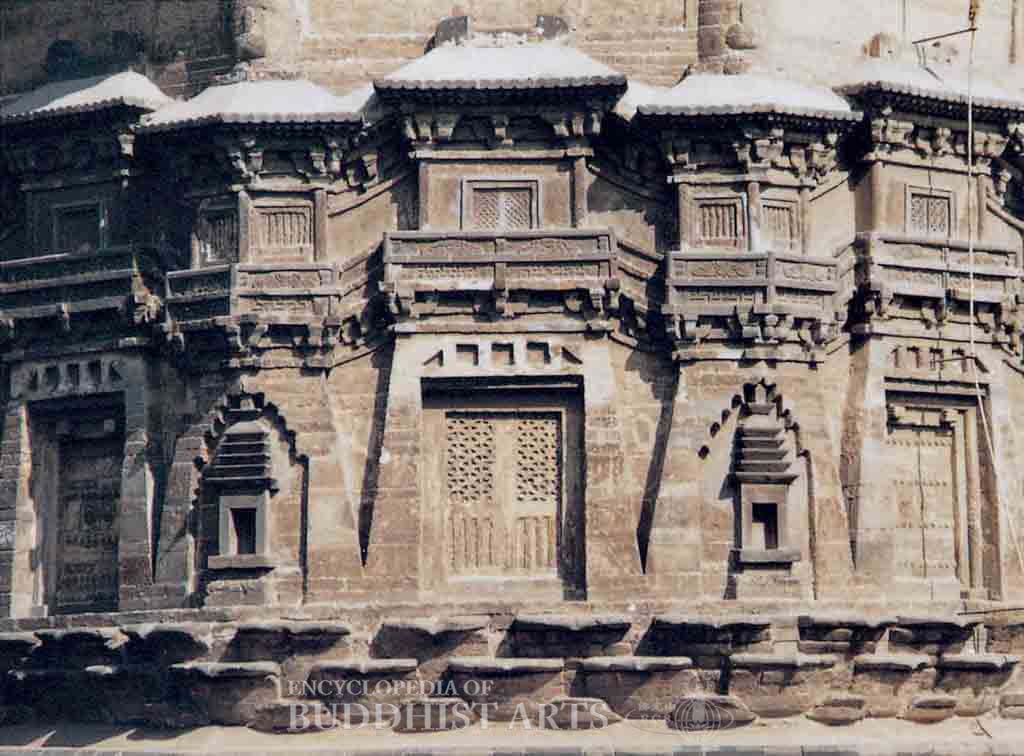
Yuanying Temple Pagoda (detail)
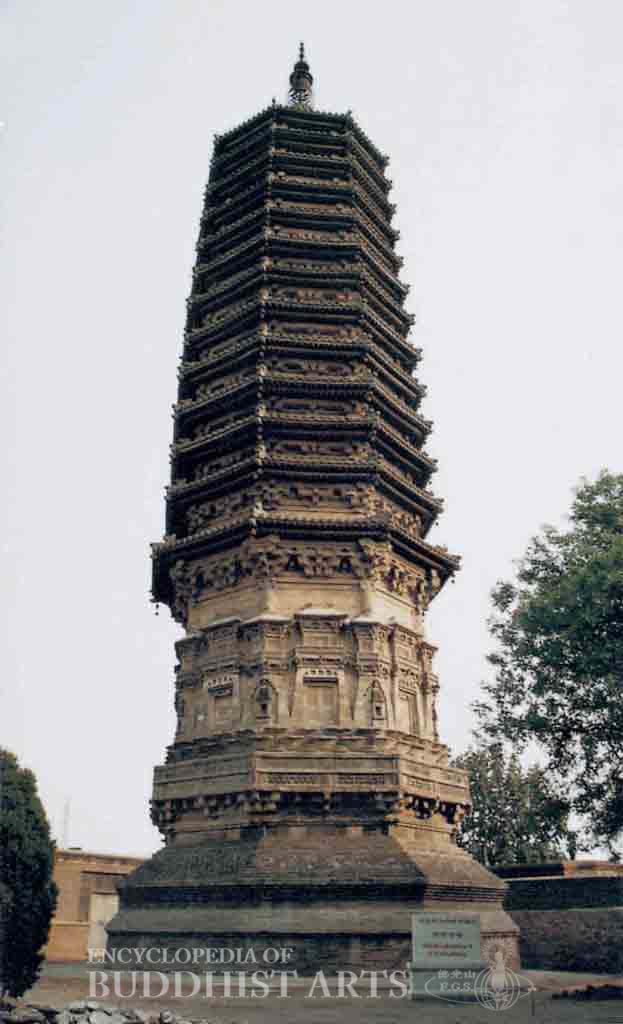
Yuanying Temple Pagoda
Yuanying Temple Pagoda
CHINA, Hebei, Qinhuangdao
The pagoda was built during the Jin dynasty (1115–1234) and repaired in 1541 during the Ming dynasty. It has been repaired a number of times since then. The Tangshan earthquake of 1976 caused extensive damage and large-scale repairs were undertaken between 1982 and 1985. It was listed as a National Cultural Heritage Site in 2001.
The 13-tier, octagonal, solid brick pagoda is 36 m high. At the top of the Sumeru base there are bracket sets supporting the base of the pagoda body, which is surrounded by balustrades decorated with carvings of geometric or floral patterns. There are then two tiers of lotus petals.
The lower section of the first tier is carved with heavenly palaces. On each side there is tower located at the center, as well as at the corners, while bridges link the buildings together. The upper section of the first tier has pilasters at the corners with architraves and bracket sets supporting the eaves.
The roofs of each tier are covered with clay tiles. Directly beneath the eaves of each tier, there are two rows of wooden rafters. The spire consists of upright lotuses, stacked rings, a flame, a horizontal crescent moon, and a jewel.
For more details, go to the Encyclopedia of Buddhist Arts: Architecture T-Z, page 1374.
Cite this article:
author = Hsingyun and Youheng and Johnson, Peter and Mankuang and Lancaster, Lewis,
booktitle = {Encyclopedia of Buddhist Arts: Architecture T-Z},
pages = 1374,
title = {{Yuanying Temple Pagoda}},
volume = 4,
year = {2016}}