
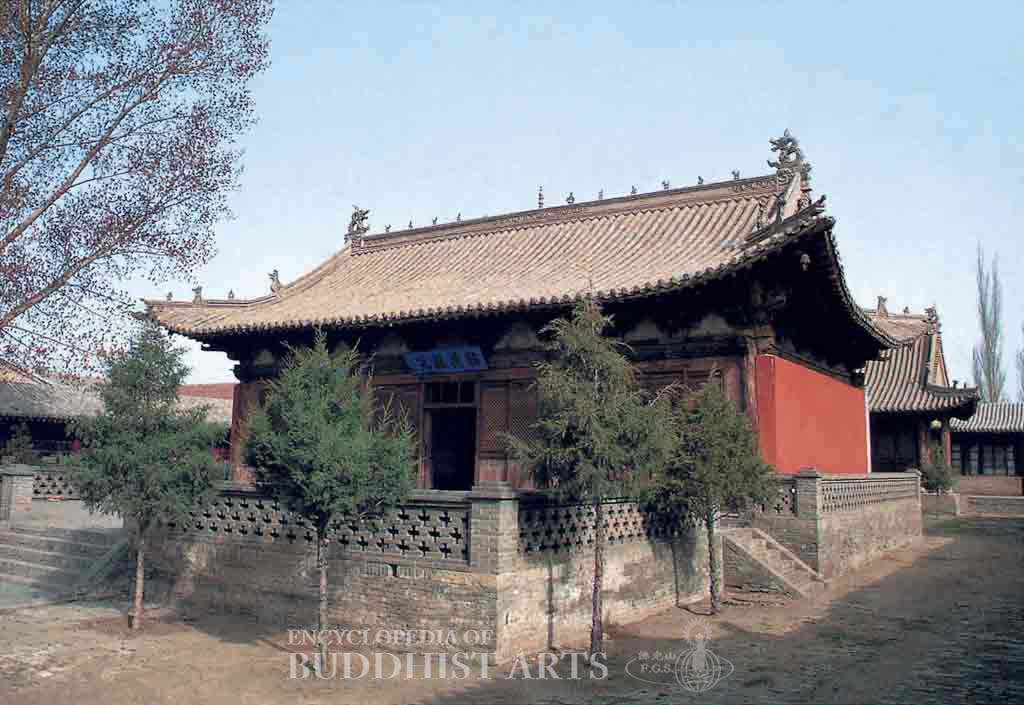
Shijia Temple: Heavenly King Hall
Shijia Temple
CHINA, Hebei, Zhangjiakou
Shijia refers to Sakyamuni Buddha. According to the local gazetteer, it was still a hut during the Yuan dynasty (1271–1368) but became a temple during the rule of Emperor Taizu (reigned 1368–1398) of the Ming dynasty. The temple gets its name from the Reclining Buddha statue that is located there. It was listed as a National Cultural Heritage Site in 2001.
The temple occupies an area of 4,950 sq m. The existing buildings include the Heavenly King Hall, Great Hero Hall, and the Reclining Buddha Hall. Both the Heavenly King Hall and the Reclining Buddha Hall have single-eave hip-and-gable roofs, and both have three-by-three bay structures. The three-by-two bay Great Hero Hall is the main hall of the temple and it has a single-eave hip-and-gable roof. The eaves are supported by single-tier bracket sets. Inside the hall, delicate ceilings are located in the center of each bay. The walls and ceilings are painted and gilded. They complement each other, even though they were not all painted at the same time.
For more details, go to the Encyclopedia of Buddhist Arts: Architecture M-S, page 993.
Cite this article:
author = Hsingyun and Youheng and Johnson, Peter and Mankuang and Lancaster, Lewis,
booktitle = {Encyclopedia of Buddhist Arts: Architecture M-S},
pages = 993,
title = {{Shijia Temple}},
volume = 3,
year = {2016}}