
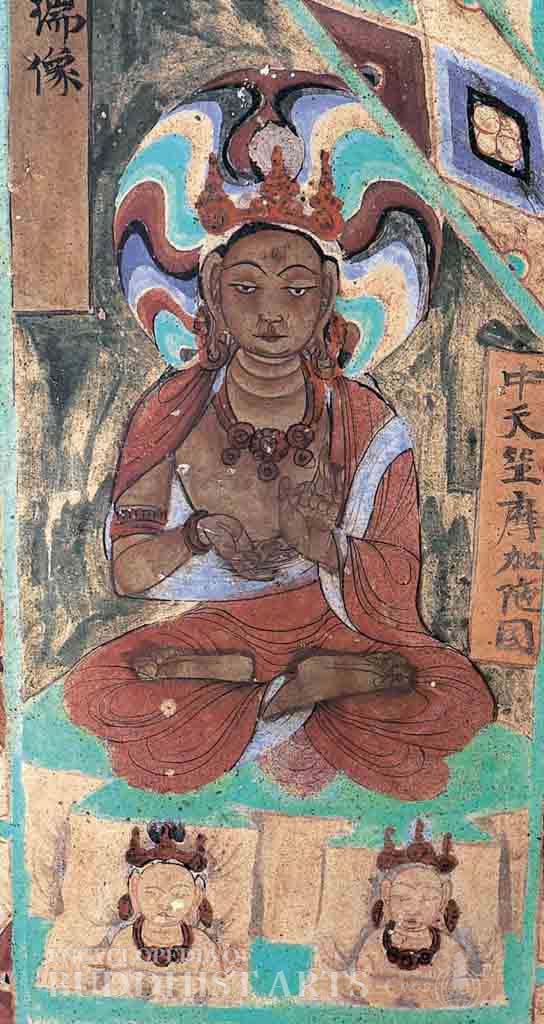
Mogao Cave 231: Auspicious Buddha in Magadha
Mogao Cave 231: Auspicious Buddha in Magadha
CHINA, Gansu, Dunhuang; Tang dynasty
This auspicious Buddha image is on the ceiling of the back (west) wall niche within the main chamber. The Buddha has features typically associated with Bodhisattvas, such as a three-pointed crown and jeweled adornments on the body. The face is round and there are three lines on the neck. The Buddha is clothed in a red monastic robe and sits in full lotus position on a green throne. On the front of the throne are the busts of two Bodhisattvas. The Buddha’s nimbus is composed of wave-like patterns of green, red, white, blue, and black. The inscription on the right reads, “Auspicious Illuminating Buddha in Magadha, Central India.”
The Magadha Kingdom was the center of Buddhism in ancient India. Monks from the Central Plains in China who journeyed to the kingdom brought back a considerable number of texts and sculptures. It is recorded in the Great Tang Records on the Western Regions that in the large monastery west of the Bodhi tree, there is a stone Buddha statue with a green limestone front that illuminates light. This stone Buddha dates back to when Sakyamuni Buddha attained enlightenment, Brahma constructed a hall of seven jewels, and Sakra built a throne of seven jewels for the Buddha to meditate. Eventually, the Buddha emitted light, which illuminated the Bodhi tree, and the jewels turned into a stone. This stone Buddha is likely what the Auspicious Buddha in Magadha refers to. The same statue is also mentioned in the Dunhuang manuscript Records of the Auspicious Signs of the Buddhas.
For more details, go to the Encyclopedia of Buddhist Arts: Caves M-Mo, page 1040.
Cite this article:
author = Hsingyun and Youheng and Johnson, Peter and Mankuang and Huntington, Susan and Edson, Gary and Neather, Robert,
booktitle = {Encyclopedia of Buddhist Arts: Caves M-Mo},
pages = 1040,
title = {{Mogao Cave 231: Auspicious Buddha in Magadha}},
volume = 7,
year = {2016}}