
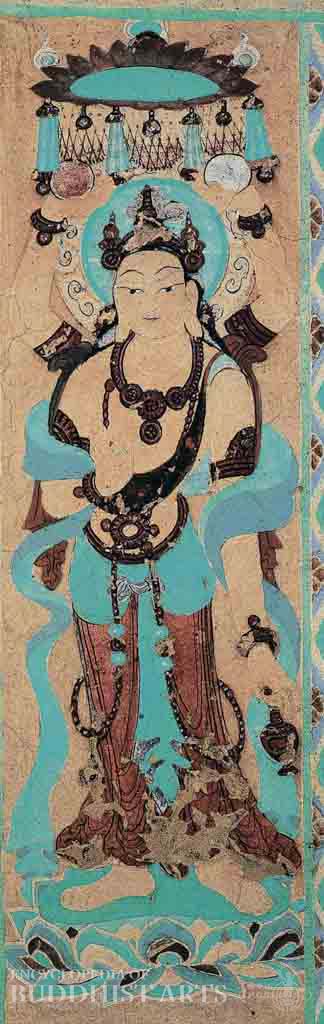
Mogao Cave 237: Avalokitesvara Bodhisattva in Potalaka
Mogao Cave 237: Avalokitesvara Bodhisattva in Potalaka
CHINA, Gansu, Dunhuang; Tang dynasty
This image is found on the west slope of the niche ceiling in the back (west) wall of the main chamber. It dates from the Mid-Tang period (756–846). Mount Potalaka is said to stand along the south coast of India, and is where Avalokitesvara resides.
Avalokitesvara stands in a graceful posture upon a lotus pedestal, wearing a three-pointed crown, a brown dhoti, a blue sash, and many ornaments. Two arms are raised above the head, holding a sun disc and a moon disc. A blue stole is wrapped around the two lowered arms; one of the lowered hands holds a vase and the other forms the vitarka (teaching) mudra. A mesh canopy hangs above the patterned nimbus that surrounds the Bodhisattva’s head. The inscription reads, “Avalokitesvara on Mount Potalaka during Enlightenment,” which matches a description in the Records of the Auspicious Signs of the Buddhas.
For more details, go to the Encyclopedia of Buddhist Arts: Caves M-Mo, page 1049.
Cite this article:
author = Hsingyun and Youheng and Johnson, Peter and Mankuang and Huntington, Susan and Edson, Gary and Neather, Robert,
booktitle = {Encyclopedia of Buddhist Arts: Caves M-Mo},
pages = 1049,
title = {{Mogao Cave 237: Avalokitesvara Bodhisattva in Potalaka}},
volume = 7,
year = {2016}}