
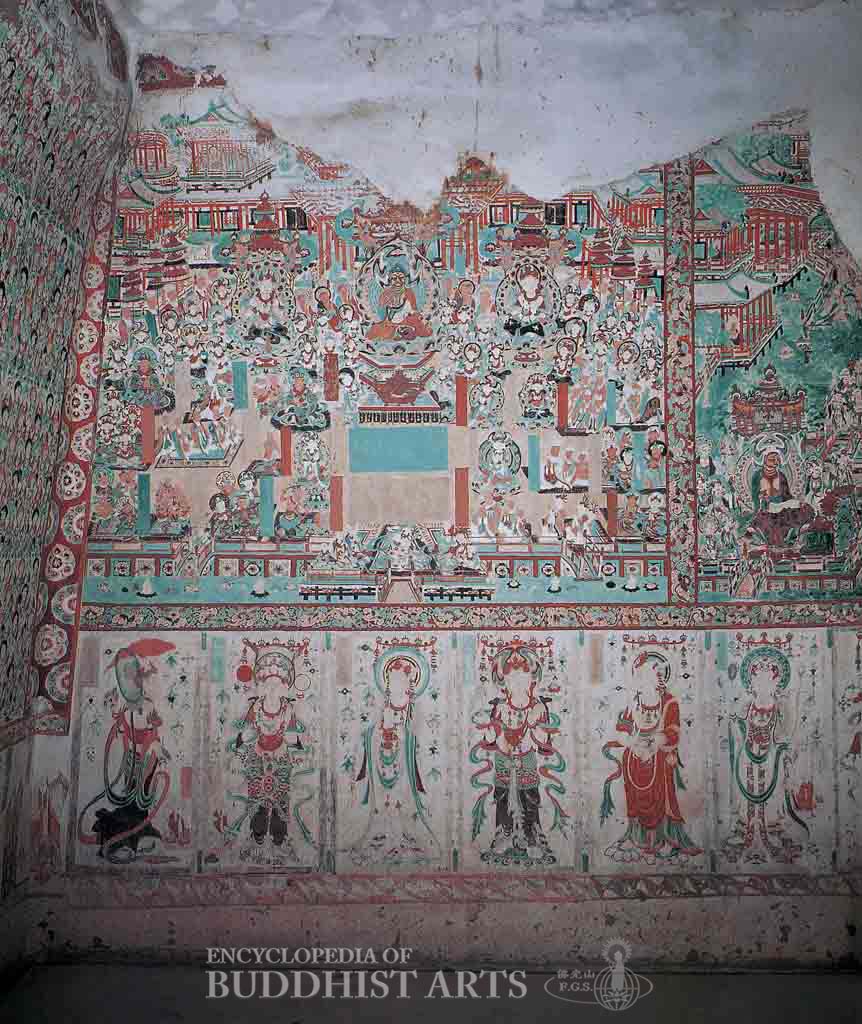
Mogao Cave 196: Sutra Illustration
Mogao Cave 196
CHINA, Gansu, Dunhuang
Also called the Cave of Monk He, this altar cave is located in the southern section of the south area. It was built in 892 of the Late Tang period, and consists of an antechamber and a main chamber connected by a corridor. Within the antechamber, part of a timber structure remains from the Late Tang period, the oldest such structure still preserved within the Mogao Caves. Above the entrance on the back (west) wall are depictions of the Seven Buddhas of the Past, with partially damaged images of Heavenly Kings and donors on either side. Portraits of Suo Xun, governor of the Guiyi Army, and his son are also painted on the north wall. The corridor ceiling features the Thousand Buddhas, while the north and south slopes of the ceiling display Dharma teaching scenes. Images of donors line the walls of the corridor.
The main chamber has a truncated pyramidal ceiling, the four slopes of which are painted with the Thousand Buddhas, Bodhisattvas, and apsaras. On the central altar, all but two statues remain of a group of seven, which are a seated Buddha, two disciples, two Bodhisattvas, and two Heavenly Kings. The Bodhisattva and Heavenly King that originally stood on the left are now missing. The disciple Ananda is to the left of the Buddha, and Mahakasyapa is on the right. All the figures wear ornate garments decorated with floral motifs. The back screen of the central altar extends up to the ceiling.
The mural on the back wall depicts the Battle Between Raudraksa and Sariputra. On the north wall are illustrations of the Avatamsaka Sutra, Medicine Buddha Sutra, and Maitreya Sutras, while on the south wall are illustrations of the Golden Light Sutra, Amitabha Sutra, and Lotus Sutra. On the lower register of both walls are 15 panels, each with a Bodhisattva in the center. Portraits of the Bodhisattvas Ksitigarbha, Avalokitesvara, and Vajrapani are painted above the entrance on the front (east) wall, and on the right and left sides of the entrance there are illustrations of Manjusri and Samantabhadra Bodhisattvas. Donors are depicted along the bottom of the front wall.
For more details, go to the Encyclopedia of Buddhist Arts: Caves M-Mo, page 1010.
Cite this article:
author = Hsingyun and Youheng and Johnson, Peter and Mankuang and Huntington, Susan and Edson, Gary and Neather, Robert,
booktitle = {Encyclopedia of Buddhist Arts: Caves M-Mo},
pages = 1010,
title = {{Mogao Cave 196}},
volume = 7,
year = {2016}}