
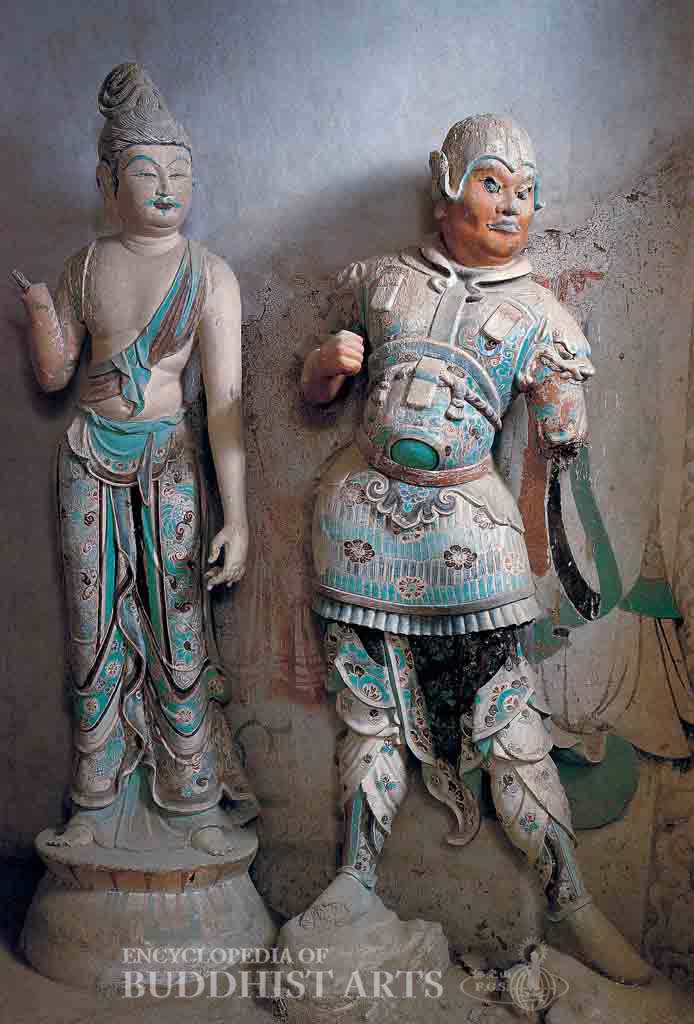
Mogao Cave 194: Bodhisattva and Heavenly King (back wall niche, right side)
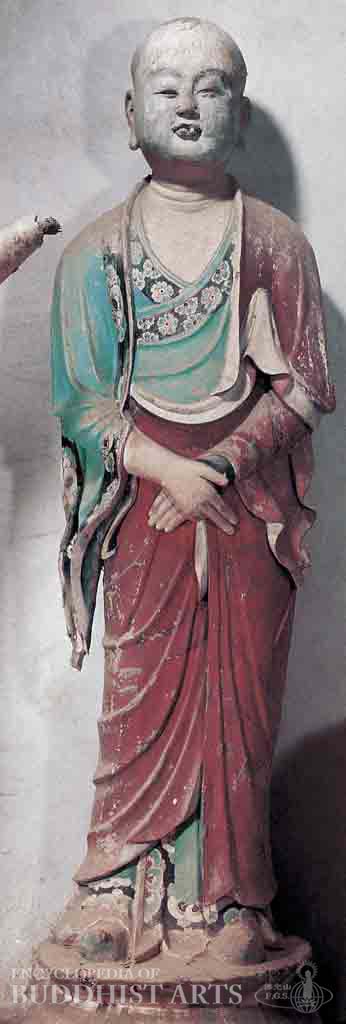
Mogao Cave 194: Disciple (back wall niche, left side)
Mogao Cave 194
CHINA, Gansu, Dunhuang
This shrine cave is located in the southern section of the south area. It was built during the High Tang (712–756) and Mid-Tang (756–846) periods and consists of an antechamber and a main chamber linked by a corridor. The antechamber underwent renovation during the Late Tang period (846–907). A Dharma teaching scene is above the entrance on the back (west) wall, with Heavenly Kings on both sides. Damaged paintings of donors are found near the bottom of the south wall, and on the north wall is a Heavenly King. A doorway leading to Cave 195 is on the front (east) wall. The ceiling of the corridor is painted with Dharma teaching scenes, while the north and south walls display images of Cintamanicakra Avalokitesvara and Amoghapasa Avalokitesvara, respectively.
The main chamber has a truncated pyramidal ceiling and a large niche in the back wall. Part of the cave has collapsed, leaving the north wall in ruins. Within the back wall niche is a seated Buddha flanked by two disciples, two Bodhisattvas, and two Heavenly Kings. Two warriors stand guard outside the niche. The murals on the walls of the niche have largely faded, with only traces of crimson whirling patterns remaining. Standing below the two warriors at each corner are remnants of donor portraits painted during the Western Xia period (1032–1227).
On the south wall are images from the Vimalakirti Sutra, and to the right is a damaged mural of a king’s procession. The north wall has an illustration of the Amitayurdhyana Sutra, with panels on the left and right illustrating the story of Ajatasatru and the Sixteen Contemplations. On the front wall, images of the Thousand Buddhas images cover the upper register, Ksitigarbha and Avalokitesvara Bodhisattvas are painted on the right of the entrance, and on the left is another image of Avalokitesvara Bodhisattva. Images from both the High Tang and Western Xia period line the lower portion of the walls, including portraits of donors and seated Buddhas.
For more details, go to the Encyclopedia of Buddhist Arts: Caves M-Mo, page 1006.
Cite this article:
author = Hsingyun and Youheng and Johnson, Peter and Mankuang and Huntington, Susan and Edson, Gary and Neather, Robert,
booktitle = {Encyclopedia of Buddhist Arts: Caves M-Mo},
pages = 1006,
title = {{Mogao Cave 194}},
volume = 7,
year = {2016}}