
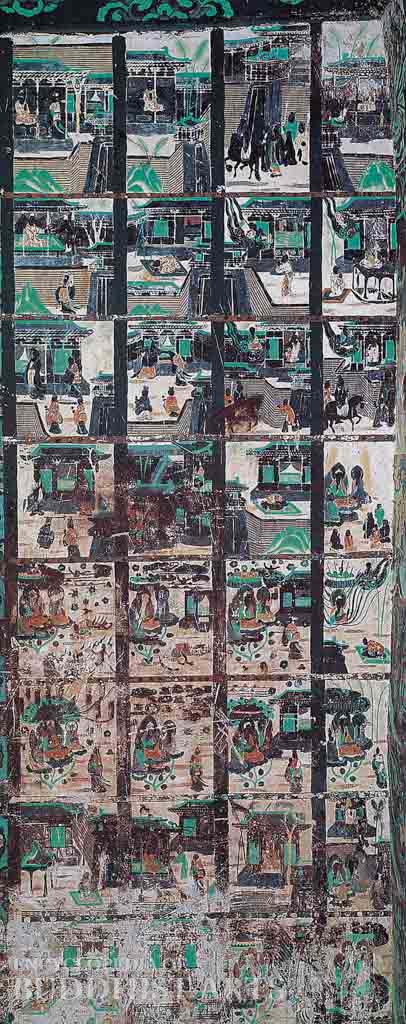
Mogao Cave 171: Illustration of the Amitayurdhyana Sutra - Ajatasatru
Mogao Cave 171: Illustration of the Amitayurdhyana Sutra - Ajatasatru
CHINA, Gansu, Dunhuang; Tang dynasty
The story of Ajatasatru is found on the right side of the illustration of the Amitayurdhyana Sutra located on the north wall within the main chamber of Cave 171. Dating from the High Tang period (712–756), the mural is similar in layout to the illustration of the Sixteen Contemplations on the left side of the wall. The sequential narrative style seen here was not often used in later portrayals of the same theme.
The framed scenes are comprised of four columns divided into eight rows. The story begins in the top right corner and proceeds in an “S” sequence, moving back and forth across the rows as follows: a villainous man convinces Prince Ajatasatru to plot against his father; the prince arrests and imprisons his father, King Bimbisara; Queen Vaidehi offers food to her imprisoned husband; the king asks for water to rinse his mouth; the king appeals to the Buddha in full prostration; Maudgalyayana appears before the king; Purna teaches the Dharma to the king; the prince questions the gatekeeper; the gatekeeper replies by holding up a baton; the prince threatens to kill his mother; the prince orders the imprisonment of his mother in an inner chamber; the queen is imprisoned; the queen prays to the Buddha to dispatch his disciples; the Buddha and many great sages gather at Vulture Peak; the Buddha and Ananda appear before the queen; the queen pays respect to the Buddha and his disciples; Queen Vaidehi takes off her ornaments and prostrates on the ground; the Buddha radiates light from the urna between his eyebrows; the Buddha illuminates the innumerable worlds in the ten directions; the queen asks the Buddha to teach her how to meditate and be reborn in Amitabha Buddha’s Western Pure Land; the queen joins her palms; the king looks at the Buddha from afar; and the queen practices the three acts of merit in the pavilion: filial piety, taking refuge, and reciting Mahayana sutras. The last few frames, wherein the Buddha bids farewell to Queen Vaidehi and leaves upon an auspicious cloud, are damaged.
For more details, go to the Encyclopedia of Buddhist Arts: Caves M-Mo, page 999.
Cite this article:
author = Hsingyun and Youheng and Johnson, Peter and Mankuang and Huntington, Susan and Edson, Gary and Neather, Robert,
booktitle = {Encyclopedia of Buddhist Arts: Caves M-Mo},
pages = 999,
title = {{Mogao Cave 171: Illustration of the Amitayurdhyana Sutra - Ajatasatru}},
volume = 7,
year = {2016}}