

Mogao Cave 159: Illustration of the Amitayurdhyana Sutra - Music and Dance (top platform)
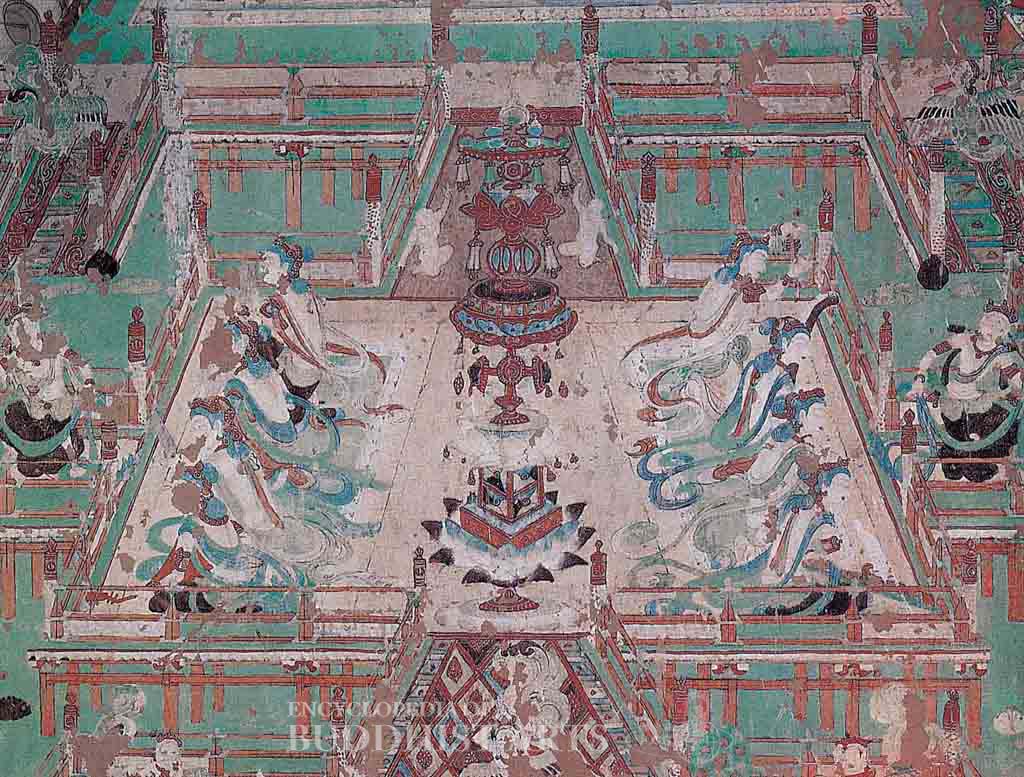
Mogao Cave 159: Illustration of the Amitayurdhyana Sutra - Music and Dance (bottom central platform)
Mogao Cave 159: Illustration of the Amitayurdhyana Sutra - Music and Dance
CHINA, Gansu, Dunhuang; Tang dynasty
Part of a Mid-Tang period (756–846) illustration of the Amitayurdhyana Sutra on the south wall of the main chamber, these dancers and musicians perform on a platform below the central Buddha figure. Two heavenly beings face each other and dance on a carpeted platform. The dancer on the left has upraised arms and holds a stole in both hands. The left leg is raised high and the figure arches to one side. The dancer on the right leans toward the other dancer; the right leg is raised high and the knee is bent. Their dynamic poses and long, fluttering stoles express rapid movement. On both sides of the dancers are three rows of musicians playing different kinds of musical instruments, and below are three platforms. A tower of canopies rests on a lotus throne in the middle of the central platform, with a row of musicians on either side. The musicians face outward, playing their instruments for the Buddhas and Bodhisattvas on the side platforms. The musicians on the left play a lute, reed instrument, panpipe, and clappers, while the musicians on the right play a zither, an end-blown flute, a harp, and cymbals. There is a dancer on each of the connecting bridges, and two more musicians on each of the auxiliary platforms.
For more details, go to the Encyclopedia of Buddhist Arts: Caves M-Mo, page 989.
Cite this article:
author = Hsingyun and Youheng and Johnson, Peter and Mankuang and Huntington, Susan and Edson, Gary and Neather, Robert,
booktitle = {Encyclopedia of Buddhist Arts: Caves M-Mo},
pages = 989,
title = {{Mogao Cave 159: Illustration of the Amitayurdhyana Sutra - Music and Dance}},
volume = 7,
year = {2016}}