
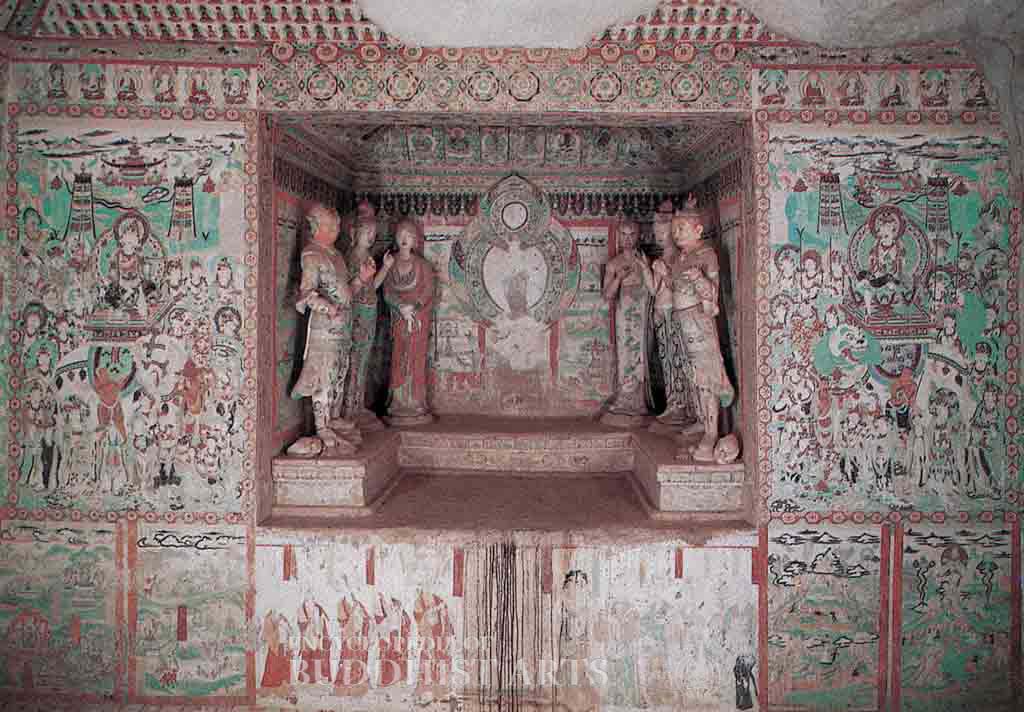
Mogao Cave 159: West Wall
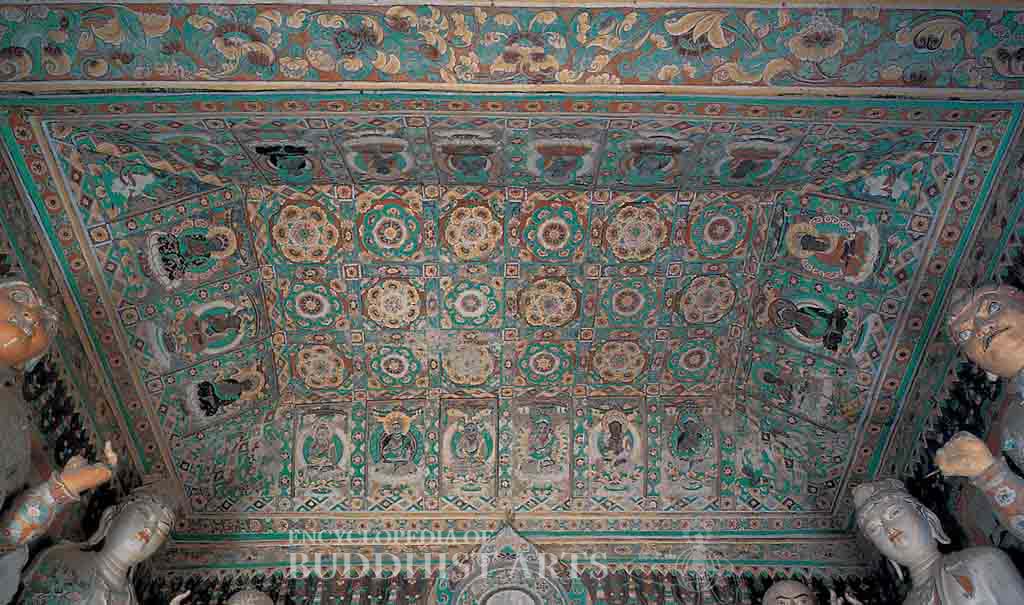
Mogao Cave 159: West Wall Niche - Ceiling
Mogao Cave 159
CHINA, Gansu, Dunhuang
Located in the south area, this shrine cave was constructed during the Mid-Tang period (756–846). It is composed of an antechamber and a main chamber connected by a corridor. The antechamber and corridor have both suffered extensive damage. On the west slope of the ceiling within the antechamber are the remnants of Thousand Buddha images. On the back (west) wall are a monk above the entrance and Heavenly Kings on both sides. Murals from the Western Xia period (1032–1227) were at one time painted over the Heavenly Kings. On the south wall is an illustration of the Amitabha Sutra, and on the north wall is an entrance leading to Cave 160. The ceiling of the corridor is decorated with floral patterns, and Western Xia murals are painted on the walls.
The main chamber has a truncated pyramidal ceiling and a niche in the back wall. The center of the ceiling is decorated with interlocking branches and camellias, and Thousand Buddha images are painted on the four slopes. The niche in the back wall originally housed statues of a Buddha, two disciples, two Bodhisattvas, and two Heavenly Kings. The Buddha is now missing, but the other sculptures are in remarkably good condition. The truncated pyramidal ceiling of the niche has floral patterns in the center, three seated Buddhas and one manifested Buddha painted on the north and south slopes, and six Buddhas and two Bodhisattvas on the east and west slopes. The walls of the niche are embellished with foliage and drapery above panels depicting the Twelve Great Vows of the Medicine Buddha and the nine kinds of untimely death. To the left of the niche is an illustration of Samantabhadra and Attendants, with two panels below that depict stories of the Bodhisattva. To the right of the niche is an illustration of Manjusri Bodhisattva and Attendants; below it, there are two panels with illustrations of Wutaishan (Five Plateau Mountain). Directly below the niche are portraits of donors, including nuns, laywomen, and servants.
The north and south walls of the main chamber display sutra illustrations. On the north wall are illustrations of the Devata Sutra, the Medicine Buddha Sutra, and the Avatamsaka Sutra, and on the south wall are illustrations of the Maitreya Sutras, the Amitayurdhyana Sutra, and the Lotus Sutra. On both sides of the cave entrance on the front (east) wall are illustrations of the Vimalakirti Sutra, with Vimalakirti depicted on the right of the entrance and Manjusri painted on the left. To the lower right of Vimalakirti is an image of a Tibetan king with princes from other regions of Central Asia. This scene is a significant marker of the Tibetan occupation of Dunhuang (781–847).
For more details, go to the Encyclopedia of Buddhist Arts: Caves M-Mo, page 986.
Cite this article:
author = Hsingyun and Youheng and Johnson, Peter and Mankuang and Huntington, Susan and Edson, Gary and Neather, Robert,
booktitle = {Encyclopedia of Buddhist Arts: Caves M-Mo},
pages = 986,
title = {{Mogao Cave 159}},
volume = 7,
year = {2016}}