
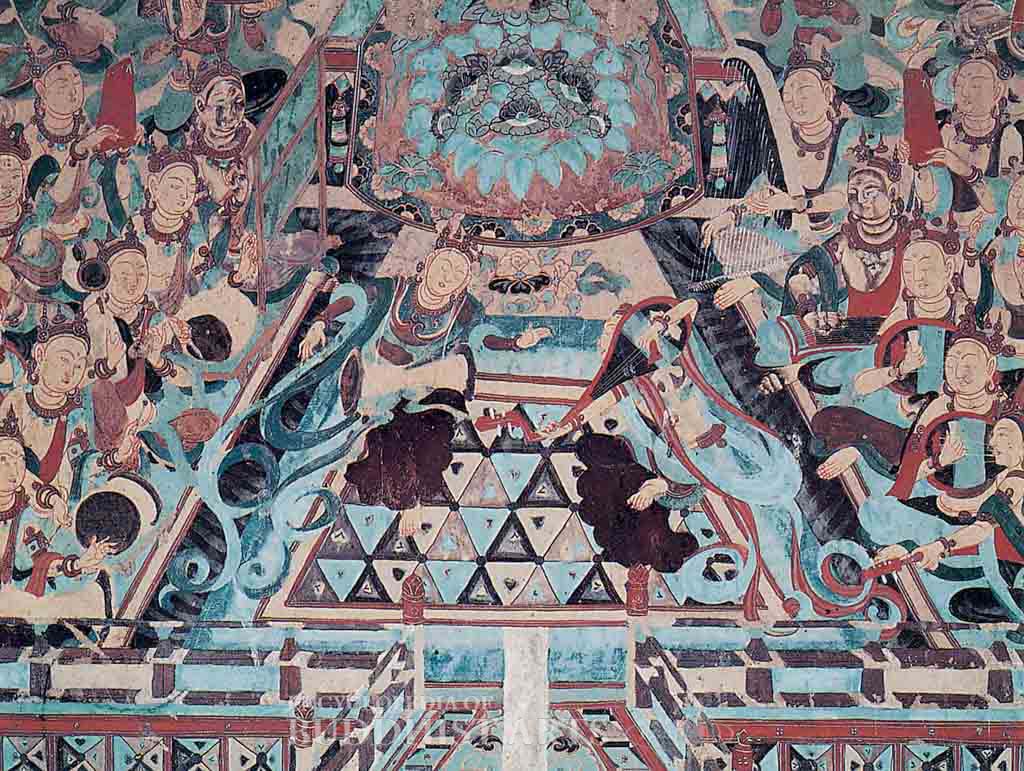
Mogao Cave 156: Illustration of the Sutra on the Questions of Visesa Cinti Brahma - Music and Dance
Mogao Cave 156: Illustration of the Sutra on the Questions of Visesa Cinti Brahma - Music and Dance
CHINA, Gansu, Dunhuang; Tang dynasty
This scene is found just below the image of Sakyamuni Buddha in the center of the sutra illustration on the right side of the south wall within the main chamber, and dates to the Late Tang period (846–907). Two heavenly beings dance upon a square carpet with a colorful triangular pattern. The figure on the left wears a headdress, a necklace, long celestial garments, and a fluttering stole. Playing a drum that hangs from the shoulders at waist level, the heavenly being closes both eyes and raises one leg. The other figure faces back towards the drummer and is dressed in similar clothing. Raising a pear-shaped lute behind the head, this dancer strums the instrument with rapture, one foot raised high and long stole swirling. The face, in profile, is only partially visible behind the lute. Both appear to dance at a quick cadence, with strong movements and exuberant playing suggested by the twirling stoles and the positioning of their arms and legs. The complimentary arrangement of the two figures conveys a sense of harmony and balance.
For more details, go to the Encyclopedia of Buddhist Arts: Caves M-Mo, page 973.
Cite this article:
author = Hsingyun and Youheng and Johnson, Peter and Mankuang and Huntington, Susan and Edson, Gary and Neather, Robert,
booktitle = {Encyclopedia of Buddhist Arts: Caves M-Mo},
pages = 973,
title = {{Mogao Cave 156: Illustration of the Sutra on the Questions of Visesa Cinti Brahma - Music and Dance}},
volume = 7,
year = {2016}}