
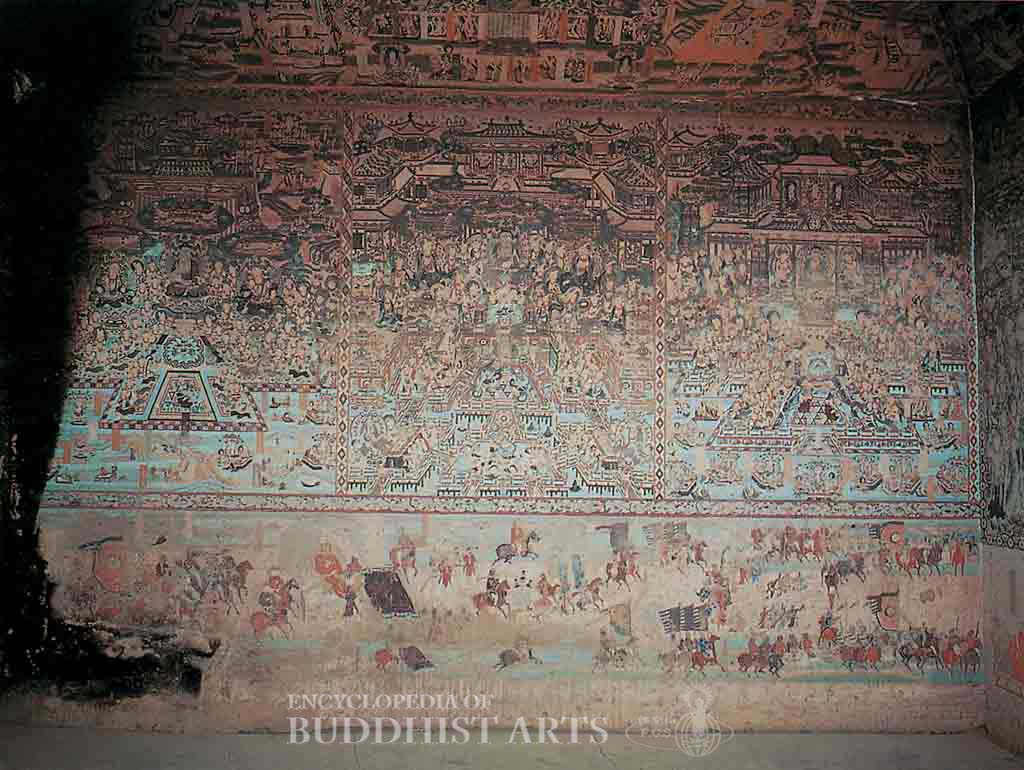
Mogao Cave 156: South Wall
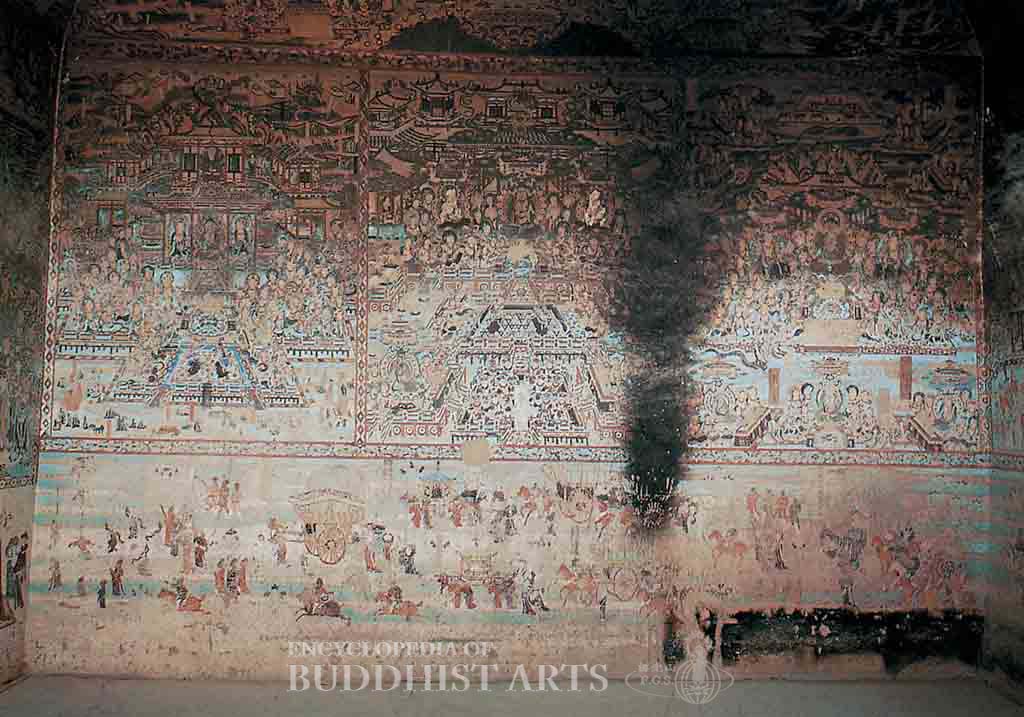
Mogao Cave 156: North Wall
Mogao Cave 156
CHINA, Gansu, Dunhuang
This shrine cave is located in the southern section of the south area of the site. It was constructed between 865 and 867 during the Tang dynasty by Zhang Huaishen, then governor of Shazhou. He dedicated it to his uncle, Zhang Yichao, hence it is also known as the Zhang Yichao Cave. The murals in the cave were partially damaged in 1921 by smoke from the fires of Russian White Army soldiers.
The cave consists of an antechamber and a main chamber linked by a corridor. In the antechamber, there is an illustration of the Defeat of Mara and Enlightenment in the center of the ceiling, and the south and north sides of the ceiling have illustrations of the Lotus Sutra and the Sutra on the Profound Kindness of Parents, respectively. An illustration of the Seven Buddhas of the Past is painted above the back (west) wall entrance, and images of the Four Heavenly Kings are painted on the south and north walls, as well as on either side of the back wall entrance. In the upper left corner of the north wall is an ink inscription of the Records of the Mogao Caves, an account of the history of the site written during the Tang dynasty (618–907).
The main chamber has a truncated pyramidal ceiling and a niche on the back wall. At the center of the ceiling within the main chamber is a lotus with curled petals surrounded by various border motifs, including key floral, scrolling, geometric, and bell-shaped patterns. On the four slopes of the ceiling are illustrations of the Lankavatara Sutra, Lotus Sutra, Maitreya Sutras, and Avatamsaka Sutra. On the south wall are illustrations of the Sutra on the Questions of Visesa Cinti Brahma, Amitabha Sutra, and Diamond Sutra, and on the north wall are illustrations of the Returning Favors Sutra, Medicine Buddha Sutra, and Devata Sutra. On the lower portion of the south wall and extending onto the front (east) wall is a mural which depicts the Journey of Zhang Yichao. A corresponding image on the lower north wall and extending onto the front wall depicts the Journey of Zhang Yichao’s Wife. The Journey of Zhang Yichao is a restrained and orderly composition, while the Journey of Zhang Yichao’s Wife is comparatively lively. Both illustrations reflect the historical context of the time and served as blueprints for similar murals within other caves at the Mogao site. Above the entrance on the front wall are illustrations of male and female devotees making offerings, and to the upper left and right of the entrance are illustrations of the Vimalakirti Sutra and the Golden Light Sutra, respectively.
A statue of the Buddha seated in full lotus position is installed in the niche on the back wall. The Buddha is clad in a robe with wide sleeves and sparse, heavy folds. The head of the Buddha is missing. At the center of the ceiling within the niche is an illustration of a Thousand-Armed, Thousand-Eyed Avalokitesvara Bodhisattva, seated in full lotus position upon a lotus throne. The Bodhisattva wears a crown that contains a small Buddha image and appears solemn. A Dharma instrument is held in each of the 40 prominent hands, with smaller hands forming a mandorla around the figure. Avalokitesvara is surrounded by a multitude of other Bodhisattvas, including Suryaprabha, Candraprabha, Vajragiti, and Vajranrti, as well as the Heavenly Kings. On the west slope of the niche ceiling are portraits of Eight-Armed Ratnadhvaja Bodhisattva and an unknown Bodhisattva with three heads and four arms. On the east slope are images of Vajrasamadhi Bodhisattva and Vajracinta Bodhisattva. The south and north slopes feature images of Amoghapasa Avalokitesvara and Cintamanicakra Avalokitesvara respectively, both surrounded by other beings. There are four vertical panels on the three walls of the niche. The panels on the back and south walls are illustrated with the Twelve Great Vows of the Medicine Buddha, while the panels on the north wall have illustrations of the nine kinds of untimely death, as well as images of figures erecting banners, lighting lamps, and performing meal offerings to the sangha. At the bottom of the niche, 14 heavenly musicians are depicted within an ogival shape carved into the Buddha’s throne. Outside the niche, illustrations of Manjusri and Samantabhadra Bodhisattvas are painted on the right and left, and above the niche is a floral pattern surrounding an image of a mythical creature. Finally, figures making offerings are painted on the lower part of the wall.
For more details, go to the Encyclopedia of Buddhist Arts: Caves M-Mo, page 970.
Cite this article:
author = Hsingyun and Youheng and Johnson, Peter and Mankuang and Huntington, Susan and Edson, Gary and Neather, Robert,
booktitle = {Encyclopedia of Buddhist Arts: Caves M-Mo},
pages = 970,
title = {{Mogao Cave 156}},
volume = 7,
year = {2016}}