
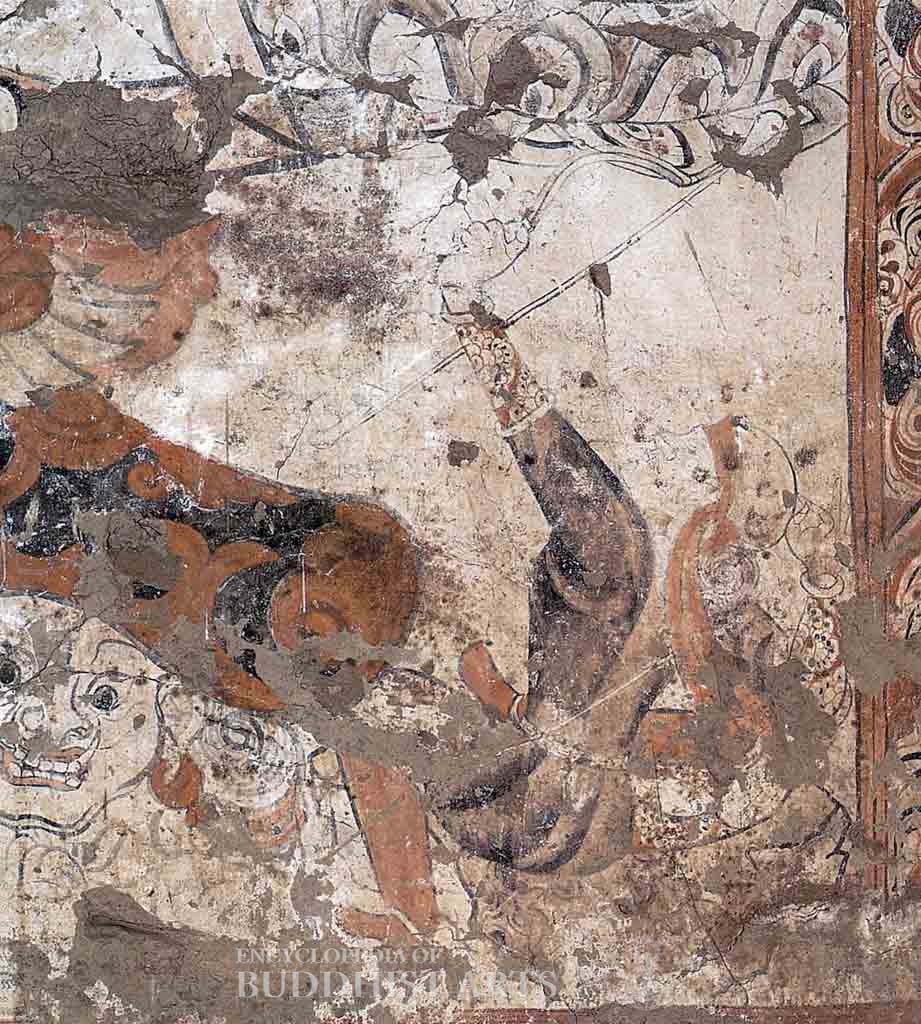
Mogao Cave 53: Antechamber - Archer (south wall)
Mogao Cave 53
CHINA, Gansu, Dunhuang
Located in the south area, this shrine cave was constructed in the Tang dynasty (618–907) and expanded during the Five Dynasties (907–960). It consists of an antechamber and a main chamber connected by a corridor. The heavily damaged paintings within the antechamber mostly date from the Mid-Tang period (756–846). They include a Bodhisattva on either side of the doorway in the back (west) wall, and Heavenly Kings on the north and south walls.
The truncated pyramidal ceiling in the main chamber has a coiled dragon and lotus motif in the center, and on the slopes are illustrations of the Maitreya Sutras, Avatamsaka Sutra, and Devata Sutra, together with decorative draperies and floral motifs. The niche on the back wall has a truncated pyramidal ceiling and contains a Buddha statue. The niche ceiling is painted with persimmon flowers, and its four slopes contain Bodhi figures. There are traces of paintings on the side walls of the niche. The north wall of the main chamber has an illustration of Vimalakirti, and the south wall is painted with Battle Between Sariputra and Raudraksa.
A Mid-Tang niche on the north wall was discovered in 1952. That niche is now known as Cave 469. Inside the niche are paintings of a Buddha and Bodhisattvas on the side walls.
For more details, go to the Encyclopedia of Buddhist Arts: Caves M-Mo, page 872.
Cite this article:
author = Hsingyun and Youheng and Johnson, Peter and Mankuang and Huntington, Susan and Edson, Gary and Neather, Robert,
booktitle = {Encyclopedia of Buddhist Arts: Caves M-Mo},
pages = 872,
title = {{Mogao Cave 53}},
volume = 7,
year = {2016}}