
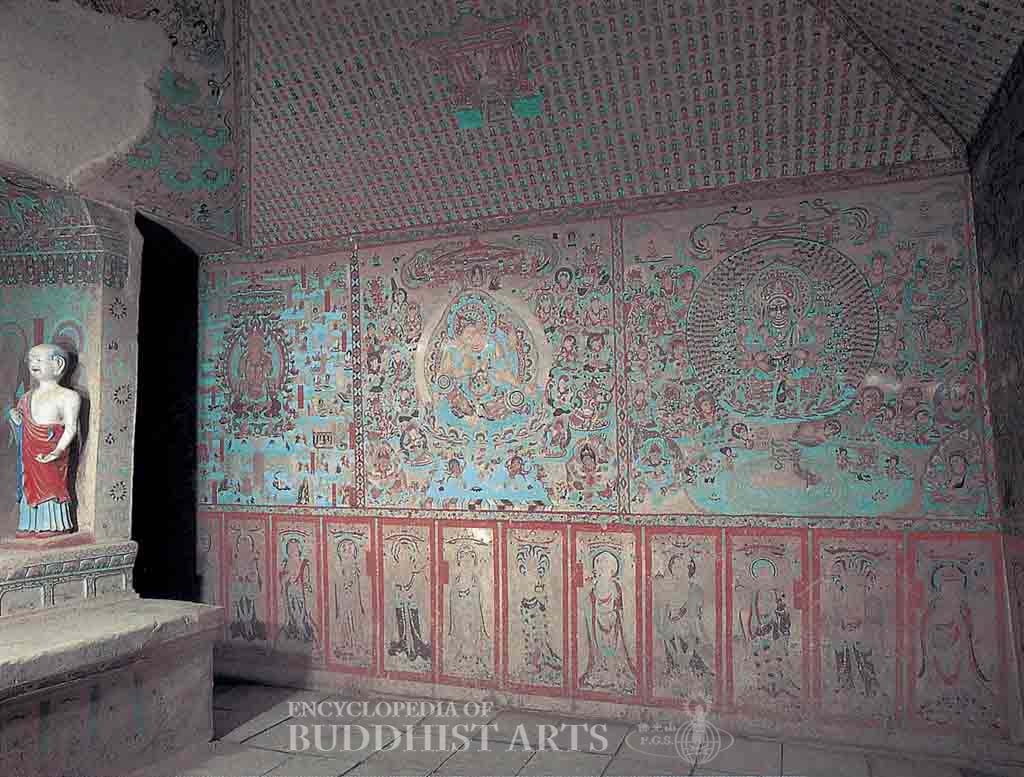
Mogao Cave 14: Main Chamber - North Wall
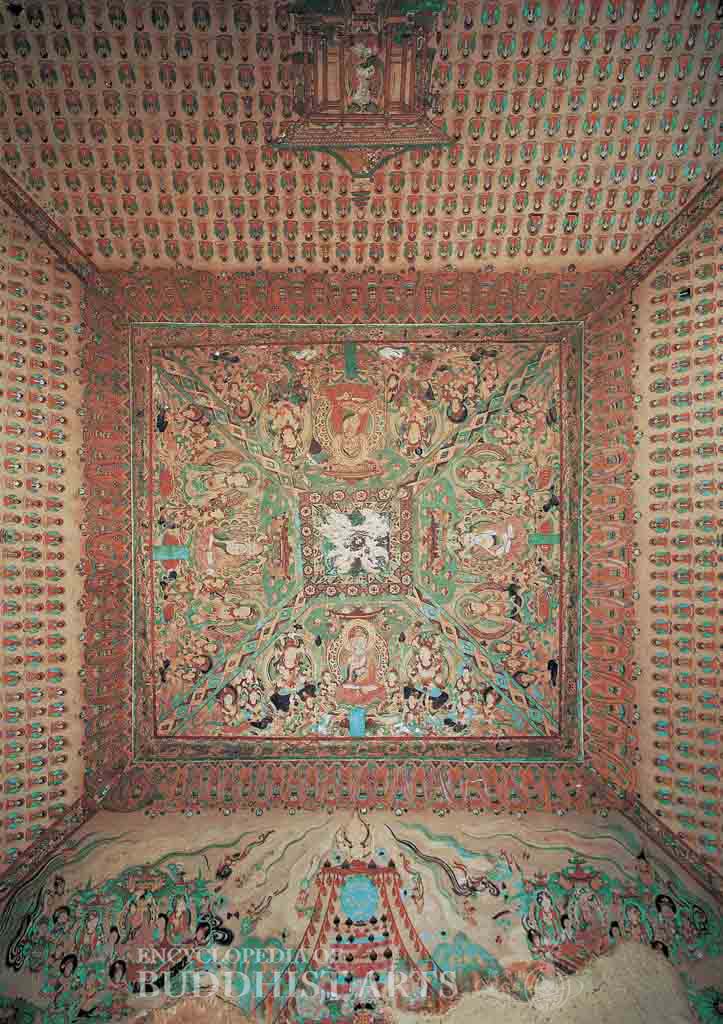
Mogao Cave 14: Main Chamber - Front Ceiling
Mogao Cave 14
CHINA, Gansu, Dunhuang
Located in the south area, this central pillar cave was built during the Late Tang period (846–907) and consists of an antechamber and a main chamber connected by a corridor.
In the antechamber, the remnants of a Heavenly King image can be seen on the back (west) wall, and there is a Song dynasty (960–1279) illustration of the Pure Land on the south wall. Lotus flowers are painted on the ceiling of the corridor, and the side walls feature images of Bodhisattvas.
The main chamber has a central pillar, a truncated pyramidal ceiling at the front, and a flat ceiling at the rear. The center of the truncated pyramidal ceiling features a double vajra surrounded by the Buddhas of the Four Directions. On the west slope is a light pagoda surrounded by trees, with a Buddha Teaching the Dharma on each side. The other three slopes of the ceiling have Thousand Buddha motifs.
In the east side of the central pillar is a niche housing seven statues from the Qing dynasty (1644–1911). On the lintel is an interlocking floral pattern and images of seated Buddhas and lotus-born children. Inside the niche are paintings of six disciples on the back wall, and two more disciples on each of the side walls. The north and south sides of the central pillar feature illustrations of Maitreya Sutras and the Medicine Buddha Sutra respectively, beneath which are images of monks making offerings that date from the Song dynasty (960–1279).
The doorway on the front (east) wall of the main chamber is flanked by illustrations of Manjusri, Samantabhadra, and Attendants. Above the doorway, Sakyamuni and Prabhutaratna Buddhas are pictured.
The south wall displays illustrations of the Vajravarahi Mandala, Eleven-Headed Avalokitesvara, Amoghapasa Avalokitesvara, and Thousand-Armed, Thousand-Eyed Avalokitesvara. The Eleven-Headed Avalokitesvara is painted in accordance with the passages of “gaining ten benefits in this life and four additional merits” as described in the Eleven-Headed Dharani Heart Sutra. It is the only mural of its type found in the Dunhuang caves.
On the north wall are illustrations of the Vajrasattva Mandala, Avalokitesvara, the Cintamanicakra Avalokitesvara Sutra, and Manjusri with Thousand Arms and Thousand Bowls. This last illustration features a tree-shaped lotus throne growing from a sea in the lower part of the painting. On either side of the lotus throne, snakes with human faces curl around the branches. Flanking the snakes are a golden bird in the sun and a toad in the moon. These figures represent the celestial deities Fuxi and Nuwa, an important part of pre-Buddhist folk religion from as early as the Han (206 BCE–220) and Jin (265–420) dynasties.
For more details, go to the Encyclopedia of Buddhist Arts: Caves M-Mo, page 842.
Cite this article:
author = Hsingyun and Youheng and Johnson, Peter and Mankuang and Huntington, Susan and Edson, Gary and Neather, Robert,
booktitle = {Encyclopedia of Buddhist Arts: Caves M-Mo},
pages = 842,
title = {{Mogao Cave 14}},
volume = 7,
year = {2016}}