
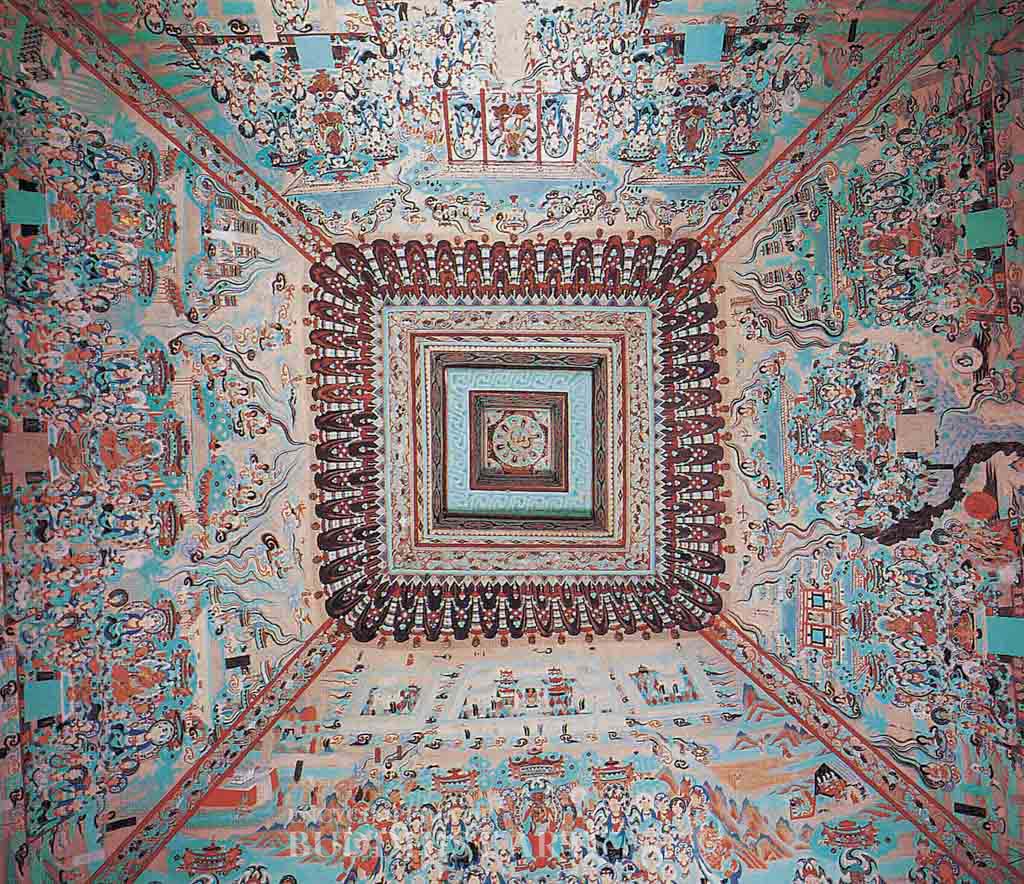
Mogao Cave 9: Main Chamber - Front Ceiling
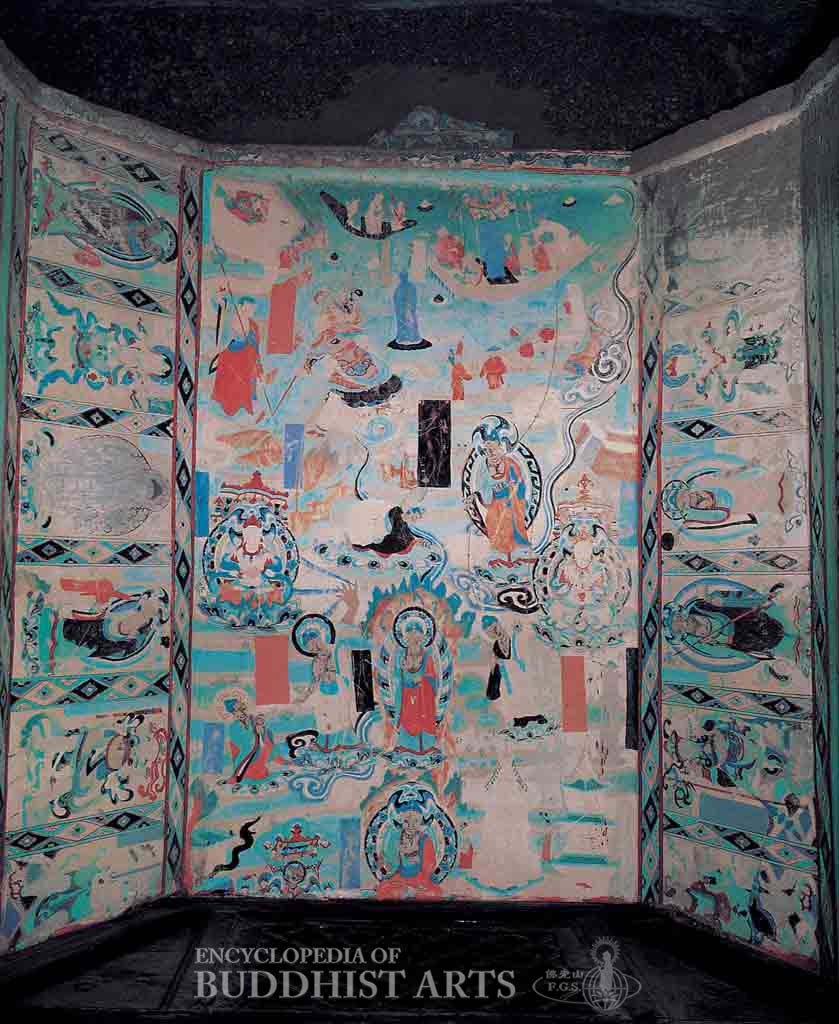
Mogao Cave 9: Corridor - Ceiling
Mogao Cave 9
CHINA, Gansu, Dunhuang
This central pillar cave is located in the northern section of the south area. According to an inscription, it is believed that the cave was built in the year 892 during the Tang dynasty (618–907). It has an antechamber and a main chamber connected by a corridor. The antechamber has a gabled ceiling with three severely damaged murals of Avalokitesvara on the west slope. Remanants of Vaisravana images are found above and to the right side of the doorway on the back (west) wall. Doorways in the north and south walls lead to Caves 8 and 10. The ceiling in the corridor displays a mural of the Spread of Buddhism, with Buddhist legends surrounding an image of Gosrnga (Ox Head Mountain). On the walls of the corridor are four figures making offerings. Based on an inscription, these are representations of Suo Xun, the governor of Guiyi Army, and three officials named Zhang Fengcheng, Li Hongyuan and Li Hongjian.
The main chamber has a truncated pyramidal ceiling at the front and a flat ceiling at the rear. The center of the front ceiling is decorated with an image of a kalavinka bird and a lotus surrounded by a variety of geometric and floral patterns. On the east slope of the ceiling is an illustration of the Maitreya Sutra, while the other three slopes display the nine assemblies described in the Avatamsaka Sutra. The flat ceiling at the rear of the cave is supported by the central pillar and has images of Thousand Buddhas and the Four Heavenly Kings.
On the east side of the central pillar is a niche which houses nine statues from the Qing dynasty (1644–1911). The center of the niche ceiling features a floral medallion, with seated Medicine Buddhas and Bodhisattvas on its four slopes. Four vertical panels form the back wall of the niche. Scenes from the Jataka of Sacrifice for a Gatha by Jumping off a Cliff are painted on two of them, while the other two portray the Prince Mahasattva Jataka. On each side wall of the niche are three vertical panels, one painted with a map of Wutaishan (Five Plateau Mountain), and the other with the Prince Sudana Jataka. Below the niche is a small altar for offerings, on each side of which are a Bodhisattva and three figures making offerings. To the upper right and left of the niche are Surya and Candra respectively, and below these are warriors and lions. On the west side of the pillar is an ink brush painting of a pavilion and human figures, and on the north and south sides are figures making offerings to seated Buddhas. All of these murals date from the Song dynasty (960–1279).
On the back and side walls are illustrations of the Lankavatara Sutra, the Vimalakirti Sutra, and the Battle Between Sariputra and Raudraksa, respectively. To the left of the doorway on the front (east) wall is an illustration of Manjusri and Attendants, while on the right is a depiction of Samantabhadra and Attendants. Devotees are shown making offerings below the Bodhisattvas and above the doorway.
For more details, go to the Encyclopedia of Buddhist Arts: Caves M-Mo, page 834.
Cite this article:
author = Hsingyun and Youheng and Johnson, Peter and Mankuang and Huntington, Susan and Edson, Gary and Neather, Robert,
booktitle = {Encyclopedia of Buddhist Arts: Caves M-Mo},
pages = 834,
title = {{Mogao Cave 9}},
volume = 7,
year = {2016}}