
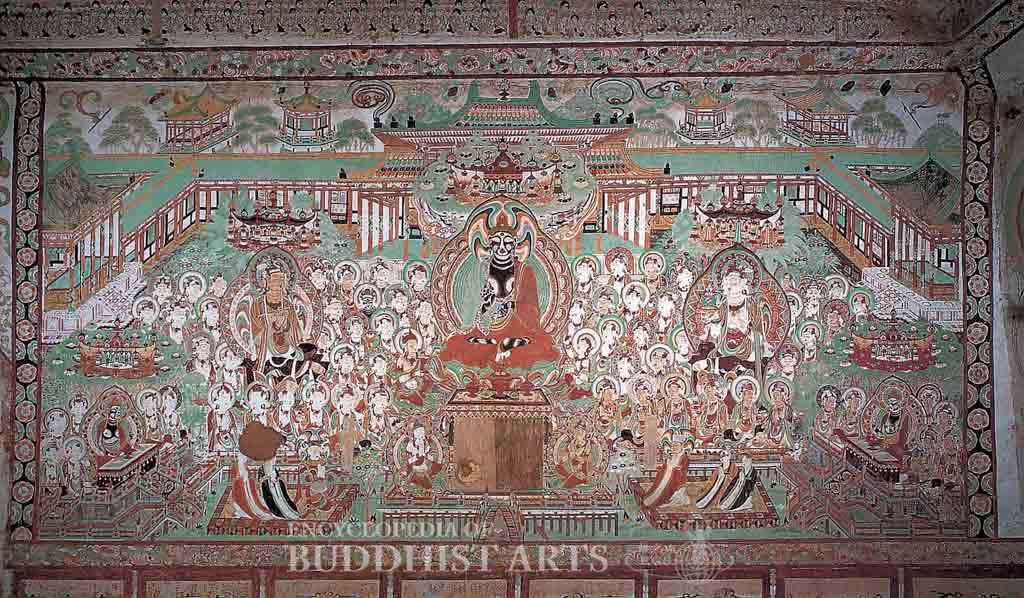
Mogao Cave 158: Illustration of the Devata Sutra
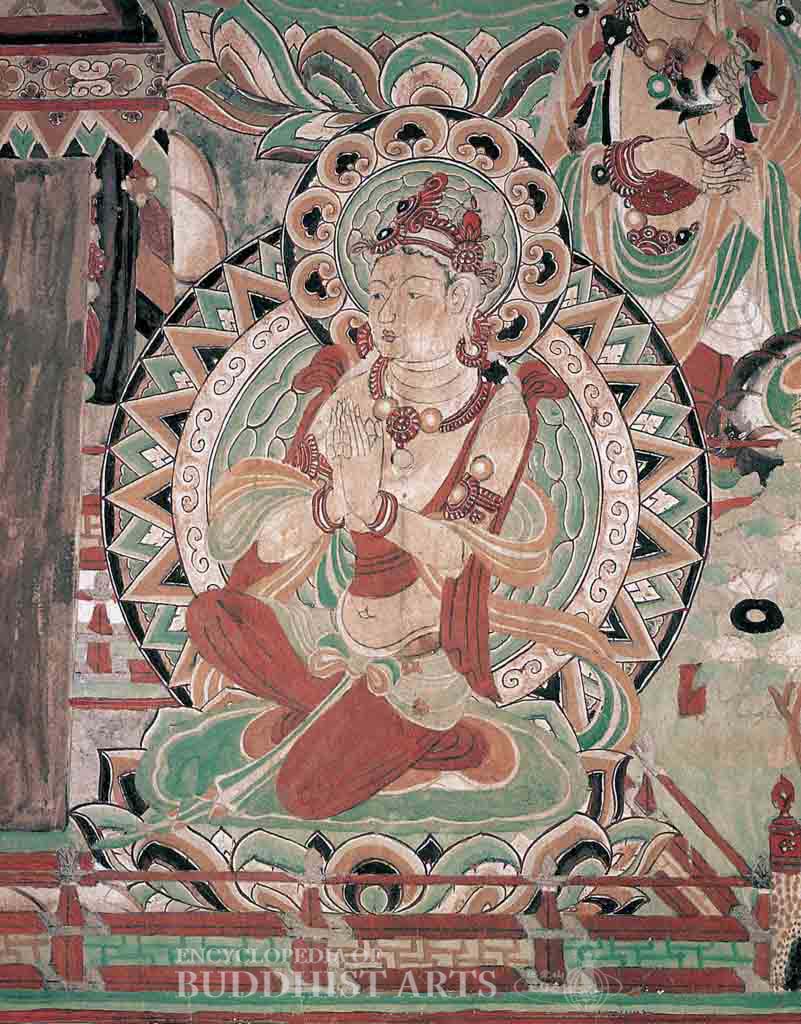
Mogao Cave 158: Illustration of the Devata Sutra - Bodhisattva
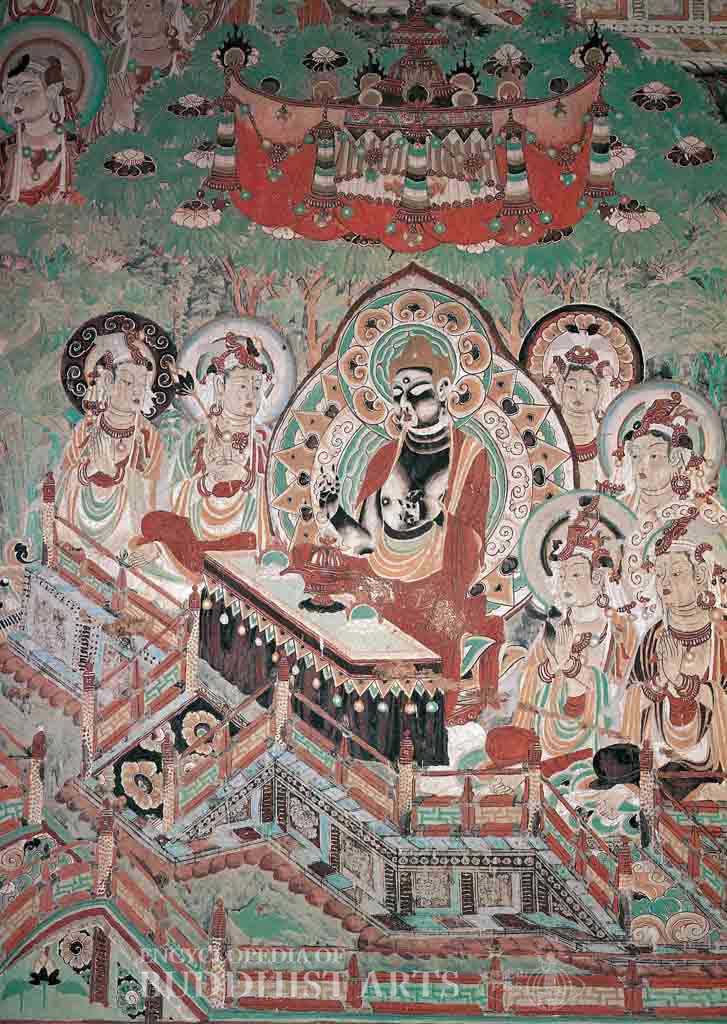
Mogao Cave 158: Illustration of the Devata Sutra (detail)
Mogao Cave 158: Illustration of the Devata Sutra
CHINA, Gansu, Dunhuang; Tang dynasty
Located on the right side of the front (east) wall within the main chamber, this mural has a similar layout to the illustration of the Golden Light Sutra found on the left side of the front wall. The Devata Sutra principally records the dialogue between the Buddha and a heavenly being at Jetavana Monastery in Sravasti. The nine questions and nine answers are arranged in stanzas. Illustrations of the Devata Sutra first appeared during the High Tang period (712–756). While only one work from that period, in Cave 148, has been found at the Mogao Caves, there are at least ten illustrations of the sutra from the Mid-Tang (756–846) at the site, including this one.
In the center of the mural is Sakyamuni Buddha seated cross-legged upon a lotus throne. The Buddha has a usnisa, soft features, and long, arched eyebrows. The hands form the Dharmacakra (Dharma wheel) mudra. An offering altar stands below the Buddha, and a decorative canopy hangs above. On each side of the Buddha is an attendant Bodhisattva, also with a canopy overhead. They have rounded features and wear headdresses. The figure on the left holds a ruyi (wish-fulfilling talisman) and the one on the right holds a lotus. Surrounding the Buddha and two Bodhisattvas are disciples, heavenly beings, and other Bodhisattvas who kneel and listen to the Dharma. The Buddha and assembly are situated within a grand courtyard, and in the upper register are palatial buildings and walled enclosures. A Bodhisattva and a figure in royal attire stand on separate platforms in the lower register. Each is accompanied by a pair of lay attendants. The two figures are possibly Sakya and Brahma. A lotus pond is depicted below the platforms, and below the main image are panels with scenes of the dialogue between the heavenly being and the Buddha.
For more details, go to the Encyclopedia of Buddhist Arts: Caves M-Mo, page 978.
Cite this article:
author = Hsingyun and Youheng and Johnson, Peter and Mankuang and Huntington, Susan and Edson, Gary and Neather, Robert,
booktitle = {Encyclopedia of Buddhist Arts: Caves M-Mo},
pages = 978,
title = {{Mogao Cave 158: Illustration of the Devata Sutra}},
volume = 7,
year = {2016}}