
Mogao Cave 158: Illustration of the Mahaparinirvana Sutra - Apsara Offering Jewels
Mogao Cave 158: Illustration of the Mahaparinirvana Sutra - Apsara Offering Jewels
CHINA, Gansu, Dunhuang; Tang dynasty
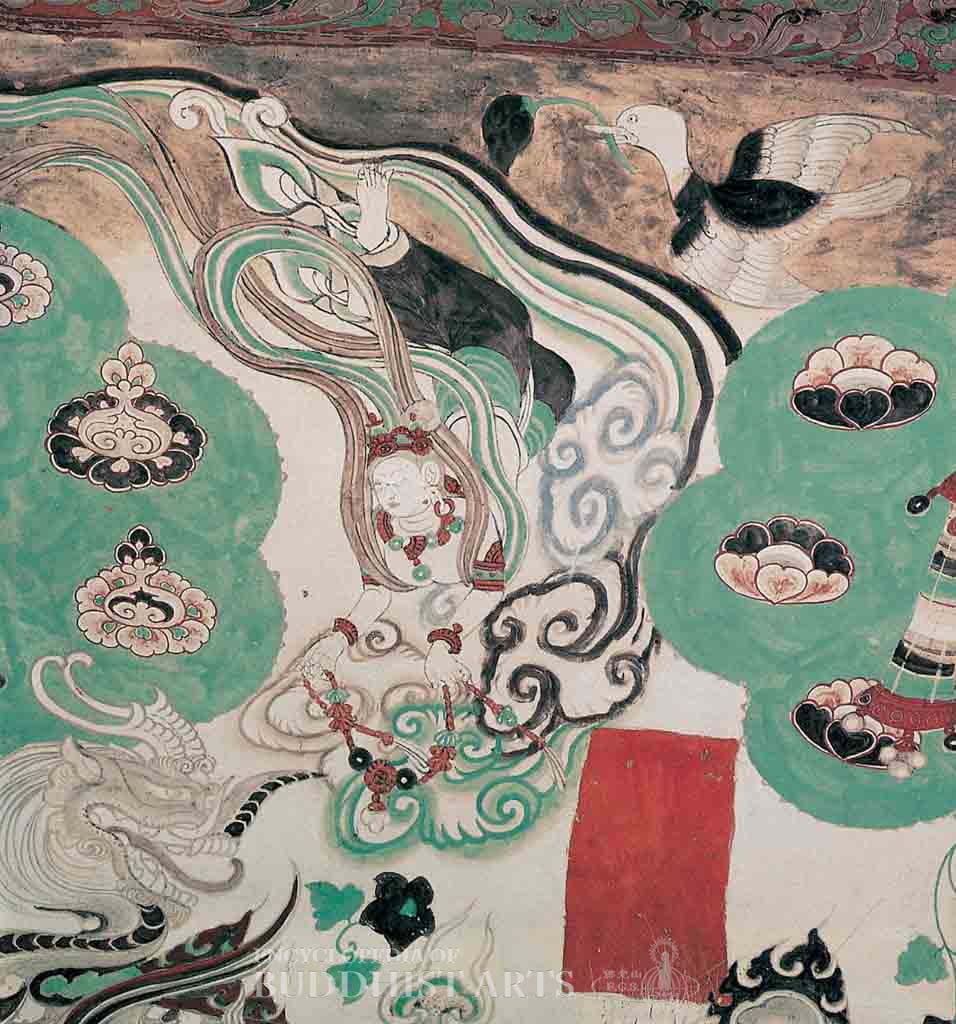
This image from the illustration of the Mahaparinirvana Sutra is found on the upper right corner of the back (west) wall within the main chamber, and dates to the Mid-Tang period (756–846). At the time of Sakyamuni Buddha’s parinirvana, the sky was said to rain innumerable pennants, banners, garlands, parasols, and gems. Fragrant flowers, heavenly music, and a miraculous display of colors were offered out of empty space. These offerings were the work of apsaras.
The apsara wears a crown, necklace, stole, armlets, and long lower garment. The figure presents a jeweled garland in both hands and appears to move weightlessly through the air. The long stole flows gracefully around the apsara and trails behind, emphasizing a sense of movement. The face is round with curved eyebrows, and the figure is painted in green, black, and gray.
For more details, go to the Encyclopedia of Buddhist Arts: Caves M-Mo, page 981.
Cite this article:
author = Hsingyun and Youheng and Johnson, Peter and Mankuang and Huntington, Susan and Edson, Gary and Neather, Robert,
booktitle = {Encyclopedia of Buddhist Arts: Caves M-Mo},
pages = 981,
title = {{Mogao Cave 158: Illustration of the Mahaparinirvana Sutra - Apsara Offering Jewels}},
volume = 7,
year = {2016}}