
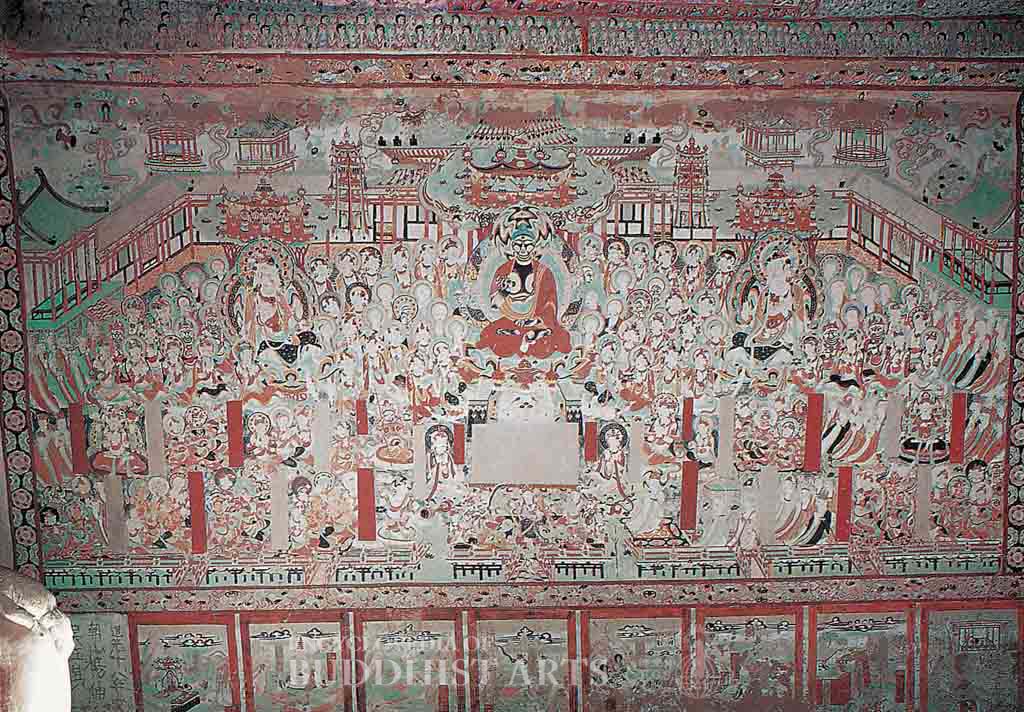
Mogao Cave 158: Illustration of the Golden Light Sutra

Mogao Cave 158: Illustration of the Golden Light Sutra (detail)
Mogao Cave 158: Illustration of the Golden Light Sutra
CHINA, Gansu, Dunhuang; Tang dynasty
This mural is on the left side of the front (east) wall in the main chamber. Dating from the Mid-Tang period (756–846), it is among the first illustrations of the Golden Light Sutra painted in the Dunhuang caves. The mural is relatively large in scale, and the scenes are portrayed in careful detail.
In the center, the Buddha is shown at Vulture Peak, surrounded by disciples, laypeople, Bodhisattvas, heavenly beings, and the Eight Classes of Dharma Protectors. The Buddha sits in full lotus position on a lotus throne and is flanked by two attendant Bodhisattvas. Canopies hang above the three central figures. The assembly gathers in a courtyard surrounded by buildings and garden pavilions. Below the courtyard and situated on platforms over a lotus pond are figures representing various chapters of the sutra, including the “Introductory Chapter,” the “Chapter on Repentance in a Dream,” the “Chapter on the Commitments of the Four Heavenly Kings,” and the “Chapter on Sravasti.” Each is accompanied by a description within a cartouche.
Below the main figures are a series of eight panels containing scenes from the chapters. The third and fourth panels from the left are illustrations of the “Chapter on Prince Mahasattva Offering his Body to the Tigress,” a Jataka tale that was a popular theme for murals since the Northern Dynasties (386–581). This illustration shows a variant of the story in which the prince sacrifices his life by jumping from a cliff to feed the starving tigress and her five cubs. The last panel on the right is an illustration of the “Chapter on Jalavahana.” In this tale, upon seeing a school of fish trapped within a drying pond, the compassionate Elder Jalavahana collected water to add to the pond and procured food for the fish. When the fish he saved later died and were reborn in heaven, they offered pearls to the elder, who had fallen on hard times and taken to drinking. Jalavahana is depicted intoxicated in a building as lotuses shower down upon the surrounding countryside. The image can be compared to an illustration of the story found in Cave 417, painted during the Sui dynasty (581–618).
For more details, go to the Encyclopedia of Buddhist Arts: Caves M-Mo, page 979.
Cite this article:
author = Hsingyun and Youheng and Johnson, Peter and Mankuang and Huntington, Susan and Edson, Gary and Neather, Robert,
booktitle = {Encyclopedia of Buddhist Arts: Caves M-Mo},
pages = 979,
title = {{Mogao Cave 158: Illustration of the Golden Light Sutra}},
volume = 7,
year = {2016}}