
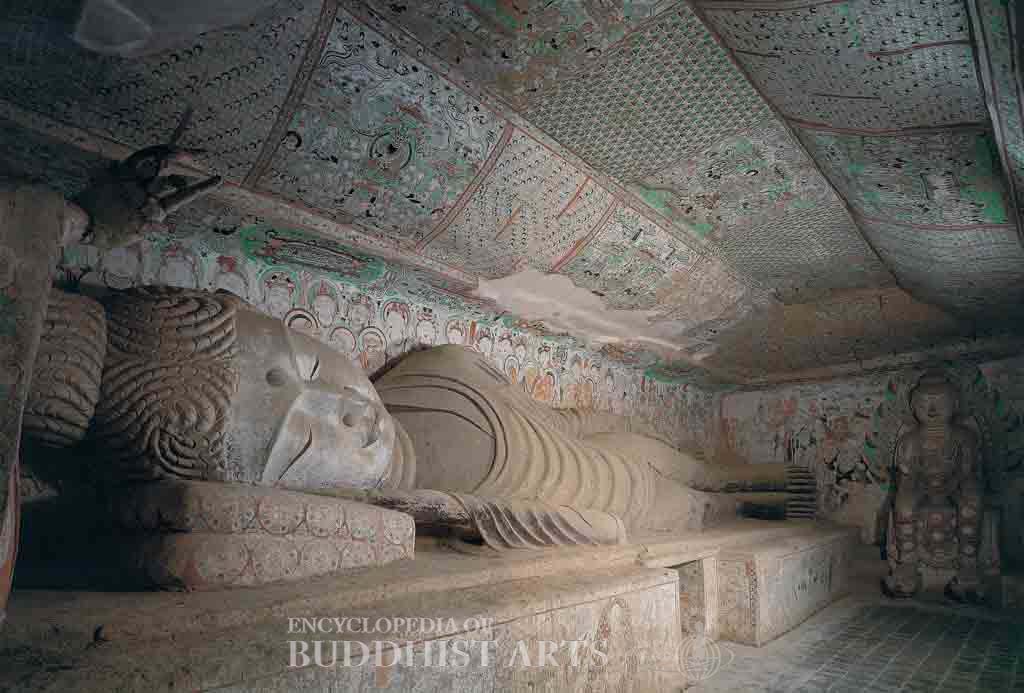
Mogao Cave 158
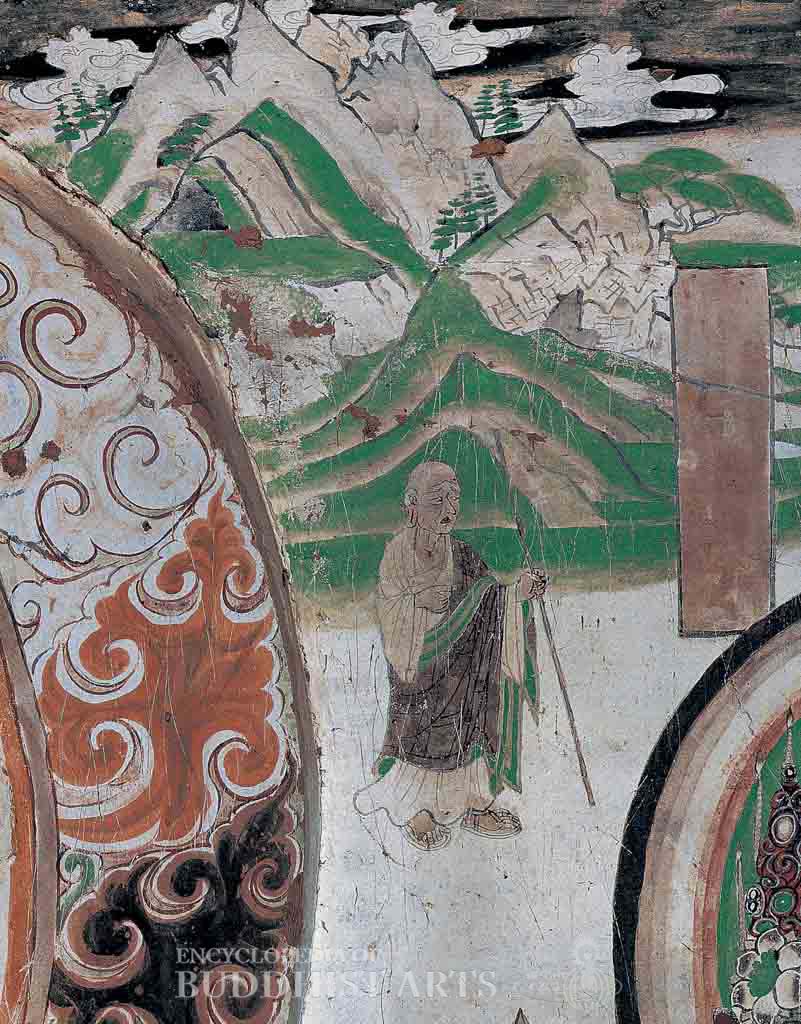
Mogao Cave 158: Illustration of the Mahaparinirvana Sutra - Mahakasyapa (south wall, upper right corner)
Mogao Cave 158
CHINA, Gansu, Dunhuang
Located in the south area, this Tang dynasty (618–907) cave is also known as the Parinirvana Cave or Sleeping Cave. The main chamber is rectangular with a gabled ceiling, and is roughly 17.1 m wide, 9.5 m high, and 7.4 m deep. The entire cave is an illustration of the Mahaparinirvana Sutra. A reclining Sakyamuni Buddha statue lies on a rectangular platform against the back (west) wall. The Buddha rests on his right side and has a tranquil expression. A standing statue of Kasyapa, the Buddha of the past, is on the south wall, and a seated statue of Maitreya, the Buddha of the future, is on the north wall. On the ceiling are images of nine of the ten Pure Lands of the Ten Directions, alternating with blocks of the Thousand Buddhas. The Pure Lands of the Ten Directions include those of each cardinal and intermediate direction, as well as the Pure Lands of above and below. The Pure Land of Below is depicted within a niche below the reclining Buddha statue on the back wall.
On the back wall and the edges of the north and south walls are paintings of mourning disciples, Bodhisattvas, the Four Heavenly Kings, the Eight Classes of Dharma Protectors, emperors, officials, and others. The arrival of Mahakasyapa and Queen Maya at the site of the Buddha’s parinirvana are depicted on the upper right corner of the south wall and the upper left corner of the north wall, respectively. To the left of the niche below the reclining Buddha statue are paintings of Heavenly Kings in mourning, Subhadra becoming a disciple just prior to the Buddha’s parinirvana, and Cunda’s last offering. To the right of the niche are paintings of a heavenly being in mourning, an offering from a lion and a deer, as well as the celebration of the six non-Buddhist teachers.
There are statues of Avalokitesvara and Mahasthamaprapta Bodhisattvas on the sides of the front (east) wall. Avalokitesvara wears a crown and holds a willow branch in the right hand. Mahasthamaprapta wears a lotus crown and holds a vase in the left hand at shoulder height and a lotus in the lowered right hand. Cintamanicakra Avalokitesvara is painted on the upper part of the front wall above the entrance, and a Bodhisattva making an offering is depicted on each side of the doorway. Eight panels of narrative illustrations of the Devata Sutra are painted on the right side of the entrance. The Golden Light Sutra is illustrated on the left side of the entrance, with eight panels portraying the “Chapter on Prince Mahasattva Offering His Body to the Tigress” and the “Chapter on Jalavahaha.” Illustrations of these sutras first appeared during the High Tang (715–756) and the Mid-Tang (756–846) periods, adopting a layout similar to that seen in illustrations of Amitayurdhyana Sutra, Maitreya Sutras, and Lotus Sutra. In both murals, a Buddha and two Bodhisattvas are seated in the center, surrounded by an assembly who listen to the Dharma. In the upper register of the murals are shrines and pavilions, in the lower register are lotus ponds, and on both sides and below the central images are scenes from the sutras.
In the corridor, clusters of flowers are painted in the center of the ceiling, and on either side are several Buddhas seated in full lotus position. The walls of the corridor were painted over during the Western Xia period (1032–1227). On the south wall are portraits of four monks, and on the north wall are two monks and two Tibetan benefactors. An inscription next to the second donor reads, “Mendicant Yi, Tibetan Master of Thisika,” indicating that the cave was completed during the Tibetan occupation of Dunhuang (781–847).
For more details, go to the Encyclopedia of Buddhist Arts: Caves M-Mo, page 976.
Cite this article:
author = Hsingyun and Youheng and Johnson, Peter and Mankuang and Huntington, Susan and Edson, Gary and Neather, Robert,
booktitle = {Encyclopedia of Buddhist Arts: Caves M-Mo},
pages = 976,
title = {{Mogao Cave 158}},
volume = 7,
year = {2016}}