
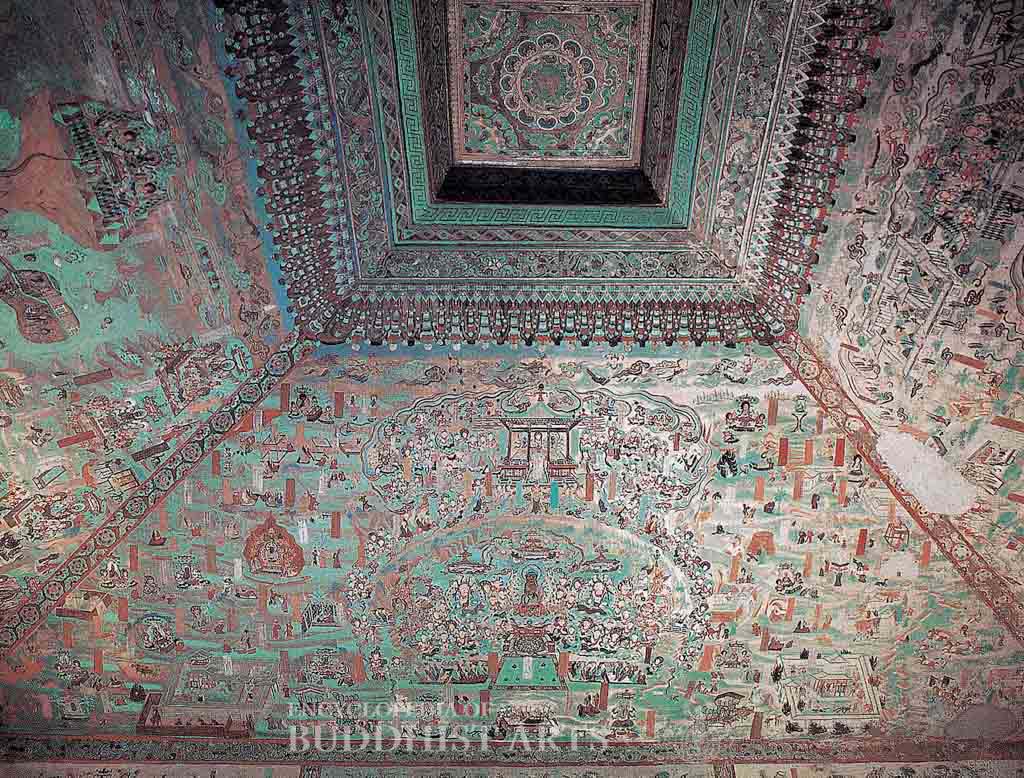
Mogao Cave 85: Ceiling and Ceiling Slopes
Mogao Cave 85
CHINA, Gansu, Dunhuang
This altar cave is also known as the cave of Superintendent Monk Zhai, the Zhai Family Cave, and is located in the central section of the south area. It consists of an antechamber and a main chamber connected by a corridor. According to an inscription in the corridor, the cave was built between 862 and 867 of the Tang dynasty.
Most of the extant paintings in the antechamber and corridor are from later periods. Fragments of paintings of Manjusri and Samantabhadra Bodhisattvas from the Yuan dynasty (1271–1368) can be found on either side of the entrance on the back (west) wall of the antechamber. The ceiling of the corridor has the Thousand Buddhas and lotuses in the center. Both walls of the corridor feature paintings of donors and their attendants from the Late Tang period (864–907) and the Five Dynasties (907–960), including the Superintendent Monk Zhai on the north wall.
The main chamber has a truncated pyramidal ceiling. In the center of the ceiling is a lion surrounded by lotuses and other decorative motifs, and on the four sloping walls are illustrations of the Lankavatara Sutra, Lotus Sutra, Maitreya Sutras, and Avatamsaka Sutra. A Buddha statue from the Late Tang period (846–907) is located on the altar in the center of the chamber. It is flanked by statues of Mahakasyapa and Ananda from the Qing dynasty (1644–1911). On the back wall is an illustration of the Battle Between Sariputra and Raudraksa. On the north wall are illustrations of the Ghanavyuha Sutra, the Medicine Buddha Sutra, and the Sutra on the Questions of Visesa Cinti Brahma. On the south wall are illustrations of the Diamond Sutra, Amitabha Sutra, and Returning Favors Sutra. In the lower registers of the back and side walls are 14 panels of illustrations of the Sutra of the Wise and the Foolish, the earliest and most complete depiction of this sutra in the Mogao Caves. Above the entrance on the front (east) wall are illustrations of the “Chapter on Prince Mahasattva Offering His Body to the Tigers” from the Golden Light Sutra. Other illustrations from this sutra, along with scenes from the Vimalakirti Sutra, continue down either side of the entrance. There are paintings of donors in the lower register of the front wall.
For more details, go to the Encyclopedia of Buddhist Arts: Caves M-Mo, page 906.
Cite this article:
author = Hsingyun and Youheng and Johnson, Peter and Mankuang and Huntington, Susan and Edson, Gary and Neather, Robert,
booktitle = {Encyclopedia of Buddhist Arts: Caves M-Mo},
pages = 906,
title = {{Mogao Cave 85}},
volume = 7,
year = {2016}}