
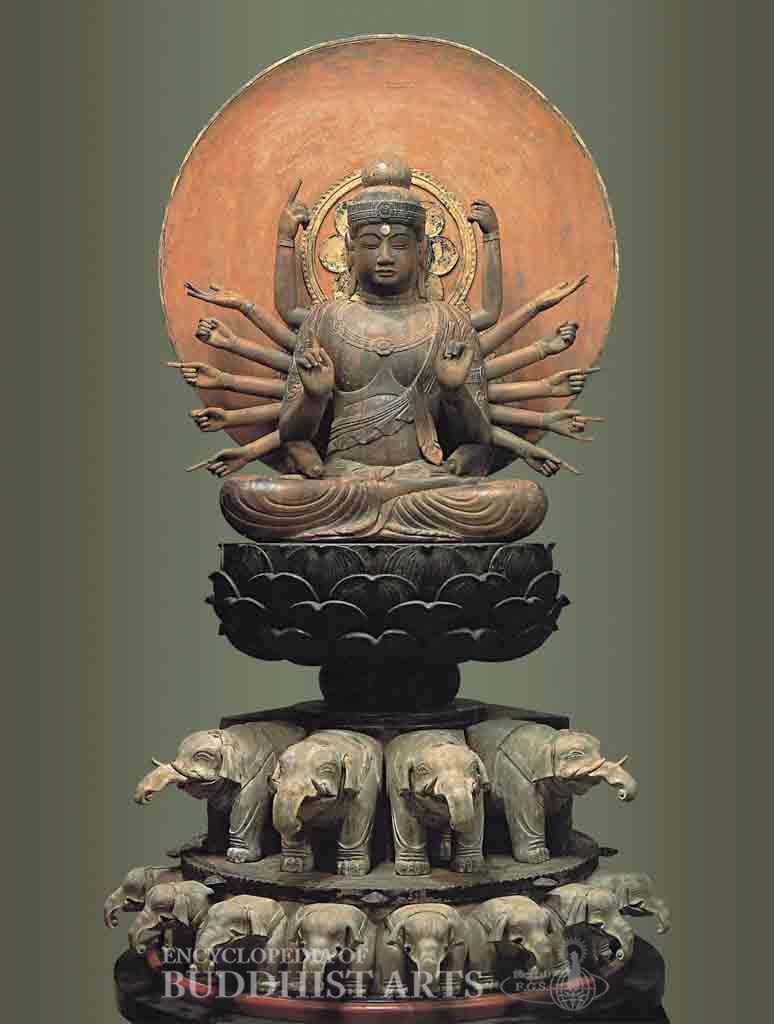
Taisanji Temple: Samantabhadra Bodhisattva
Nutmeg wood
Taisanji Temple: Samantabhadra Bodhisattva
JAPAN, Oita; Heian period
This Vajrayana sculpture of Samantabhadra dates from the latter half of the 10th century, at a time when the Bodhisattva was thought to bestow the blessing of longevity. It was listed as an Important Cultural Property in 1975.
The main figure was carved from a single piece of Japanese nutmeg yew, and mounted on a lotus throne supported by two rings of elephant figures mounted on top of each other. Samantabhadra is framed by a vermilion mandorla that encloses a golden nimbus patterned with lotus petals. Only 16 of his original 20 arms have survived and they are spread out in an arc, with two arms flexed in the center and two resting in the lap. The hands are empty, but each displays a mudra that is mirrored on the opposite side. The Bodhisattva wears a crown over his topknot and ornaments on his arms. A stole falls across the body to the skirt as he sits in half lotus position.
For more details, go to the Encyclopedia of Buddhist Arts: Sculpture St-Z, page 1190.
Cite this article:
author = Hsingyun and Youheng and Lovelock, Yann and Chou, Yuan and Huntington, Susan and Edson, Gary and Neather, Robert,
booktitle = {Encyclopedia of Buddhist Arts: Sculpture St-Z},
pages = 1190,
title = {{Taisanji Temple: Samantabhadra Bodhisattva}},
volume = 13,
year = {2016}}