
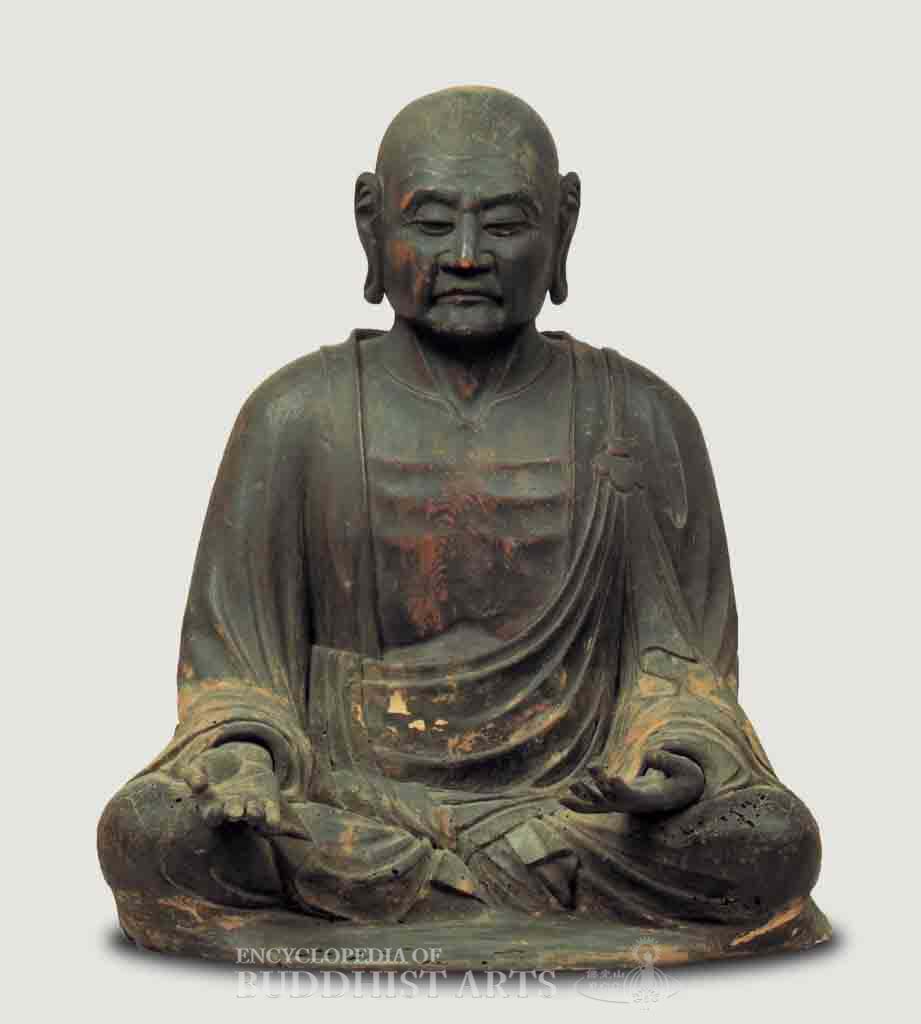
Toji Temple: Manjusri as a Monk
Cypress wood
Toji Temple: Manjusri as a Monk
JAPAN, Kyoto; Heian period
The figure was created during the early Heian period (794–1185) and is one of the earliest Japanese representations of Manjusri as a monk. Although the Bodhisattva is commonly portrayed as a non-ordained person, this form is found enshrined in Zen monasteries and dining halls. This custom was recorded in the Song Biographies of Eminent Monks, which states that the custom of enshrining Manjusri Bodhisattva in the dining halls was proposed by Amoghavajra to the emperor in 769. The statue was listed as an Important Cultural Property in 1901.
The wrinkled, bony figure is carved from two joined pieces of cypress wood. The figure is dressed in monastic robes and sits cross-legged with hands resting palm upward on his knees. The face, with contemplative eyes cast down, broad nose wings, and inset mouth, is individualized.
For more details, go to the Encyclopedia of Buddhist Arts: Sculpture St-Z, page 1233.
Cite this article:
author = Hsingyun and Youheng and Lovelock, Yann and Chou, Yuan and Huntington, Susan and Edson, Gary and Neather, Robert,
booktitle = {Encyclopedia of Buddhist Arts: Sculpture St-Z},
pages = 1233,
title = {{Toji Temple: Manjusri as a Monk}},
volume = 13,
year = {2016}}