
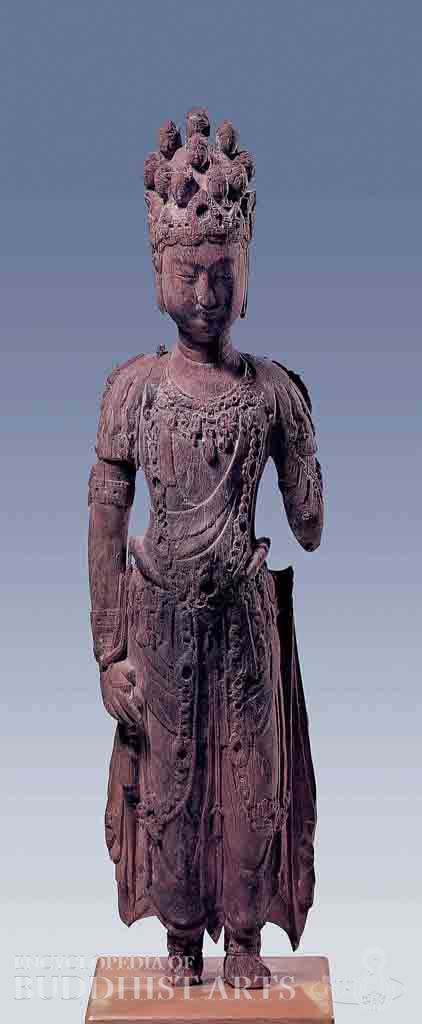
Tuyoq: Eleven-Headed Avalokitesvara
Wood
Tuyoq: Eleven-Headed Avalokitesvara
CHINA, Xinjiang, Turpan
This statue discovered in Tuyoq is the earliest example of Eleven-Headed Avalokitesvara in Central Asia. The style was made popular during the Tang dynasty (618–907) and reached its peak during the Wu Zhou period (684–705). The gems inlaid into the ornaments are now missing. The ten extra heads are dispersed around the three-leaf crown and all face the front. The Bodhisattva’s main head turns slightly to one side and the neck has the three lines that signify a great person. The left arm is damaged and the right arm hangs down to steady the fall of the numerous chains and ornaments over the skirt from a belt at the waist. These ornaments help define the shape of the legs.
For more details, go to the Encyclopedia of Buddhist Arts: Sculpture St-Z, page 1268.
Cite this article:
author = Hsingyun and Youheng and Lovelock, Yann and Chou, Yuan and Huntington, Susan and Edson, Gary and Neather, Robert,
booktitle = {Encyclopedia of Buddhist Arts: Sculpture St-Z},
pages = 1268,
title = {{Tuyoq: Eleven-Headed Avalokitesvara}},
volume = 13,
year = {2016}}