
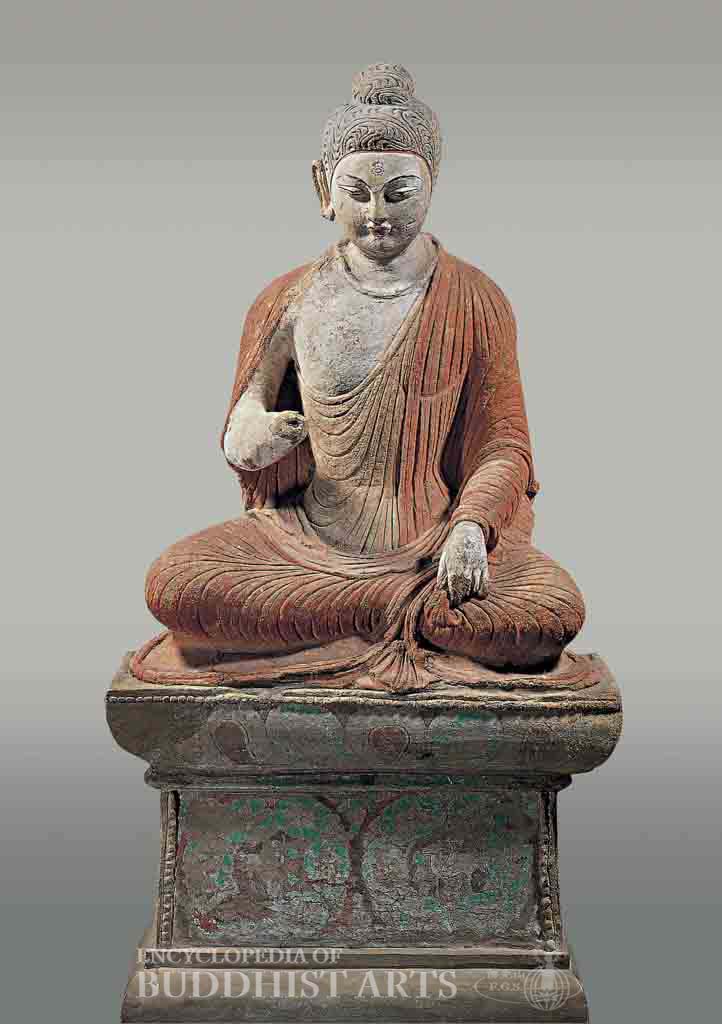
Qigxin: Seated Buddha
Clay
Qigxin: Seated Buddha
CHINA, Xinjiang, Bayingolin
It is not surprising to find sculptures with Indian-influence since the Qigxin site was located along the northern route of the Silk Road. The Buddha wears realistically rendered monastic robes that are reminiscent of the Gandharan style, as is the inner robe that leaves the right shoulder bare. The outer robe slightly covers the bare shoulder with one end looped across the lap and left forearm. The hair and round usnisa are incised with a decorative curving pattern to suggest wavy hair found often on Gandharan statues. The platform throne on which the figure sits cross-legged is decorated with paintings of lotus petals and winged deer, apparently in reference to the Buddha’s first teaching in Deer Park at Sarnath. It is therefore conjectured that the missing right hand was probably in the vitarka (teaching) mudra.
For more details, go to the Encyclopedia of Buddhist Arts: Sculpture N-Sr, page 856.
Cite this article:
author = Hsingyun and Youheng and Lovelock, Yann and Chou, Yuan and Huntington, Susan and Edson, Gary and Neather, Robert,
booktitle = {Encyclopedia of Buddhist Arts: Sculpture N-Sr},
pages = 856,
title = {{Qigxin: Seated Buddha}},
volume = 12,
year = {2016}}