
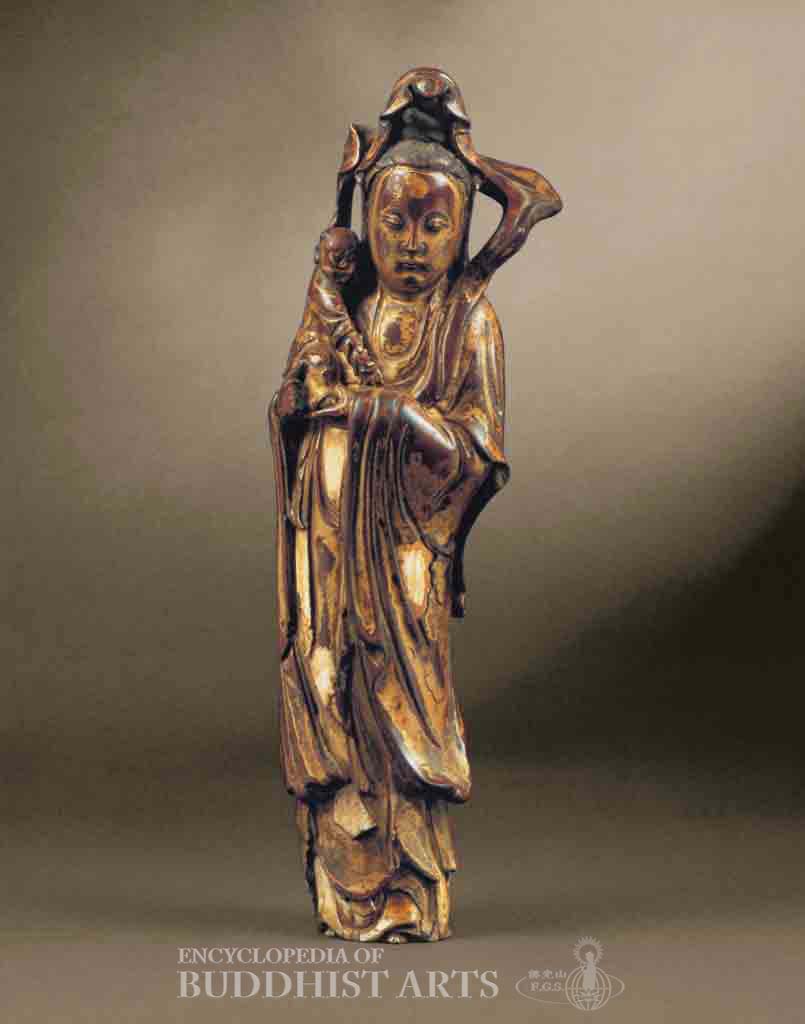
Child-Granting Avalokitesvara
Ivory with lacquer and gilding
Child-Granting Avalokitesvara
CHINA; Ming dynasty
The image of Avalokitesvara granting a child originated from the “Universal Gateway Chapter” in the Lotus Sutra, in which Avalokitesvara is said to fulfill the wishes of one who prays for a son or daughter. This image became increasingly popular in Chinese Buddhism with the growing faith in Avalokitesvara during the Ming dynasty (1368–1644).
This lacquered and gilded ivory image has a round face and a high topknot covered with a silk stole. The body is covered in a multi-layer robe with long sleeves. Avalokitesvara holds a boy against the right shoulder in a gracious and contemplative pose, symbolizing the gentleness and compassion of the Bodhisattva.
For more details, go to the Encyclopedia of Buddhist Arts: Sculpture A-F, page 251.
Cite this article:
author = Hsingyun and Youheng and Lovelock, Yann and Chou, Yuan and Huntington, Susan and Edson, Gary and Neather, Robert,
booktitle = {Encyclopedia of Buddhist Arts: Sculpture A-F},
pages = 251,
title = {{Child-Granting Avalokitesvara}},
volume = 10,
year = {2016}}