
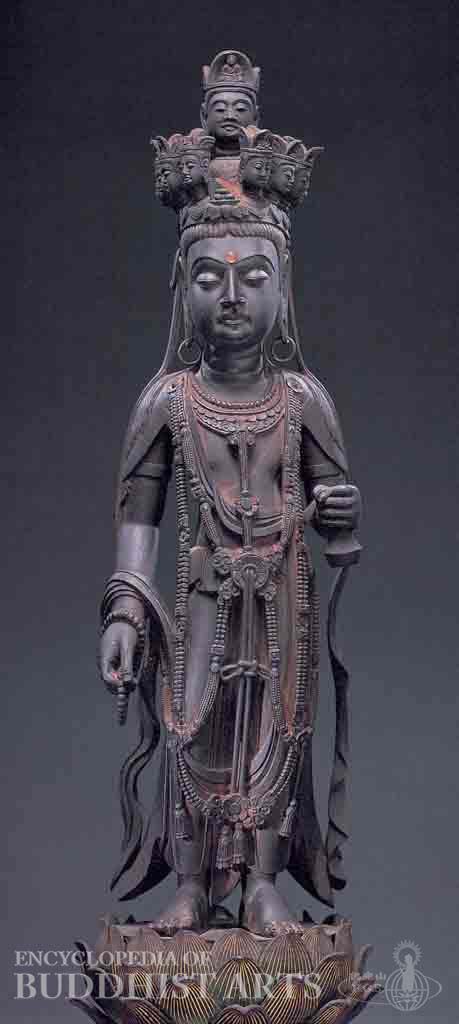
Eleven-Headed Avalokitesvara
Sandalwood
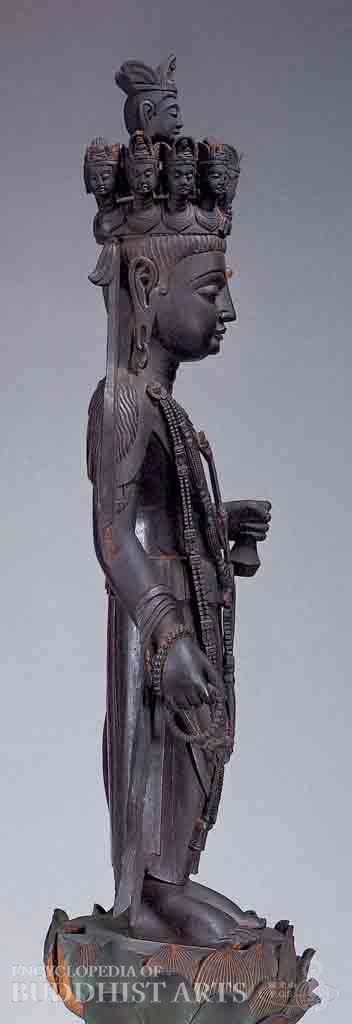
Eleven-Headed Avalokitesvara (side)
Eleven-Headed Avalokitesvara
JAPAN; Heian period
The style of the Eleven-Headed Avalokitesvara statue is similar to those described in the Eleven-Headed Dharani Heart Sutra. The text states, “use a piece of white sandalwood to carve out the likeness of Avalokitesvara Bodhisattva. The height of the statue is one and a half times the length between the extended middle finger and thumb. The Bodhisattva holds a red lotus and a vase in the left hand, while prayer beads hang from the right hand, forming the abhaya (fearlessness) mudra. The Bodhisattva has eleven heads; the three facing the front are benign, the three on the left are angry, the three on the right have fangs, the face on the back is mirthful, while the face on the top is of Amitabha Buddha. The faces wear headdresses with a seated Buddha. The figure is also decorated with jewelry.” It is listed as an Important Cultural Property of Japan.
Some details of this sculpture differs from those described in the Eleven-Headed Dharani Heart Sutra. The lotus is missing from the left hand, the right hand is not held in a mudra, and the laughing head at the back is missing. The main head is out of proportion to the body, due to having to bear the weight of the bulky crown and the heads arranged around it. The crown is fronted by a seated Buddha but the Amitabha head at the top is a later addition. The Bodhisattva has a pearl for the urna and the three lines signifying a great person on the neck. The figure stands on a lotus pedestal with the right leg slightly bent. The displacement of the waist to the right imparts a slight contour to the body. A monastic inner garment over the chest leaves the right shoulder bare, while a stole hangs over both shoulders before winding down the length of the body. A complicated bead ornament with floral decorations loops down over the folded skirt.
Some scholars suggest that this statue may be the Avalokitesvara statue brought back by a Japanese monk returning from China in 665. Therefore, it may be a Chinese artwork dating to the Early Tang period (618–712).
For more details, go to the Encyclopedia of Buddhist Arts: Sculpture A-F, page 313.
Cite this article:
author = Hsingyun and Youheng and Lovelock, Yann and Chou, Yuan and Huntington, Susan and Edson, Gary and Neather, Robert,
booktitle = {Encyclopedia of Buddhist Arts: Sculpture A-F},
pages = 313,
title = {{Eleven-Headed Avalokitesvara}},
volume = 10,
year = {2016}}