
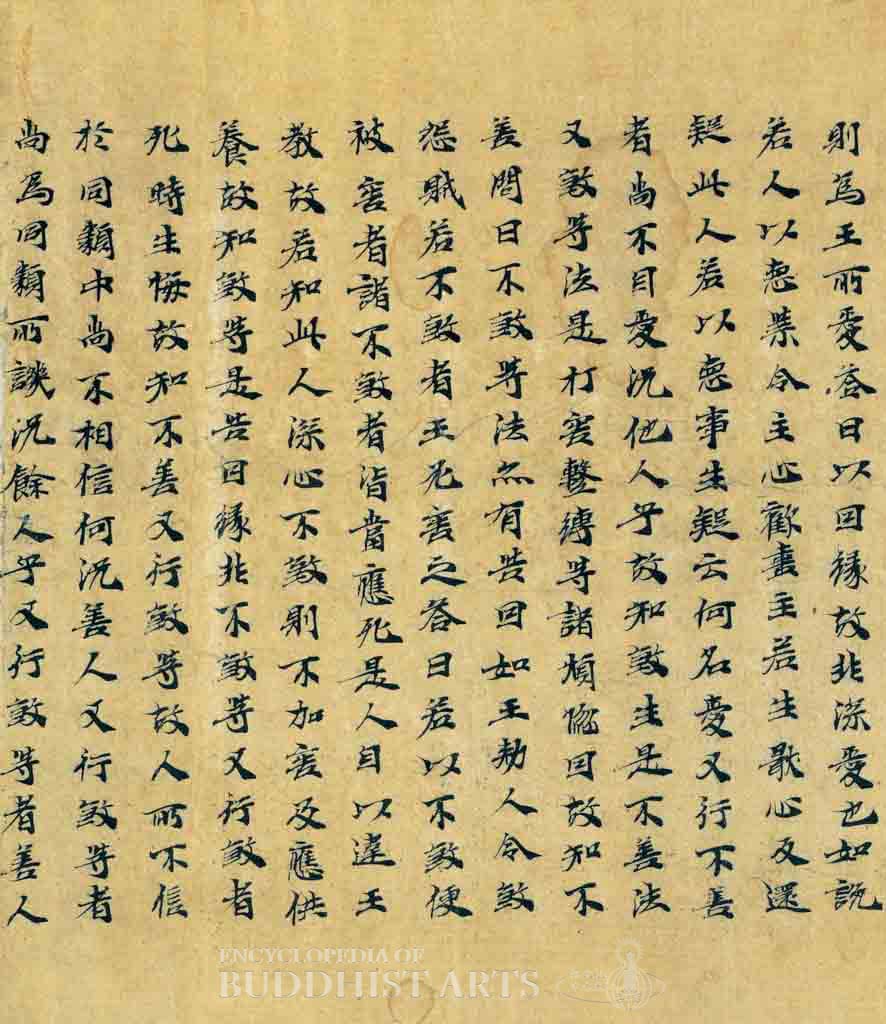
Satyasiddhi Sastra - Fascicle 8 (detail)
Ink on paper
Satyasiddhi Sastra
CHINA; Northern Wei dynasty
This piece was written in 514 of the Northern Wei dynasty by Linghu Chongzhe, a sutra copyist from Dunhuang, according to inscriptions at the end of the scroll. The Satyasiddhi Sastra is a classic text that forms the foundation of the Satyasiddhi school of Buddhism. Satyasiddhi means “Contemplation of the Four Noble Truths,” and encourages one to realize that nothing has an independent nature of its own. Therefore, comprehending this concept is thought to free oneself from the fetters of ignorance and move forward on the path to nirvana.
A colophon at the end of the scroll includes the name of the proofreaders. The manuscript is comprised of 26 sheets of paper and consists of lines of 17 characters each. The writing style is unadorned, and the characters are wider than they are tall. Although the calligraphy is scripted in regular style, it has a mild semblance to clerical script, with the brushwork especially broad at the tail ends of the “pie” (left-falling) and “na” (right-falling) diagonal strokes. Uniformity across the work implies that it was produced with utmost caution and reverence.
For more details, go to the Encyclopedia of Buddhist Arts: Calligraphy, page 214.
Cite this article:
author = Hsingyun and Youheng and Youlu and Pokorski, Stefanie and Mankuang and Edson, Gary,
booktitle = {Encyclopedia of Buddhist Arts: Calligraphy },
pages = 214,
title = {{Satyasiddhi Sastra}},
volume = 17,
year = {2016}}